





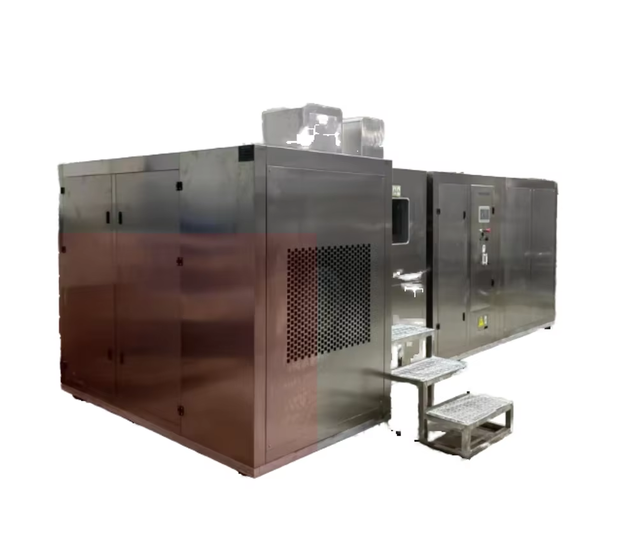
Photovoltaic Module Dust and Sand Blowing Test Chamber,IEC 61300-2-27
2026/02/03
Share:

Environmental Challenges for Photovoltaic Modules
In natural environments, PV modules are exposed to wind-blown sand, dust, and fine particulate matter. These particles can adhere to the module surface, penetrate edge seals, or compromise the junction box sealing, ultimately affecting module efficiency and lifespan. Dust deposition and sand particle impacts under strong winds can damage the glass surface, accelerate encapsulant aging, reduce light transmittance, and, over time, lead to power degradation or premature failure. Therefore, during development and production, modules must undergo simulated environmental testing to verify their real-world performance.
Purpose and Applications of the Test
The Photovoltaic Module Dust and Sand Blowing Test Chamber is specifically designed to simulate the effects of dust and sand particles on PV modules under controlled airflow conditions. Its primary purposes include:
Simulating natural wind-blown sand environments, allowing dust and sand particles to be blown across module surfaces under controlled conditions;
Evaluating the resistance of module components—including surface glass, encapsulant, edge seals, and junction boxes—against sand and dust;
Assessing key performance indicators such as power output and electrical insulation after exposure to simulated extreme environments;
Providing data for product design, material selection, and long-term reliability assessment.
This test is essential for environmental reliability verification of PV modules, particularly for products intended for deployment in desert and high-dust regions.
Basic Working Principle of the Dust and Sand Blowing Test Chamber
The core principle of the test chamber is to generate a controlled airflow that carries dry powder or sand particles onto the surface of the test module, simulating natural sand erosion. The basic steps include:
Sample installation: Secure the PV module sample inside the test chamber;
Loading dust and sand: Add dry dust or sand to the designated position according to testing standards;
Generating airflow: Activate the fan to produce airflow at specified wind speeds, directing particles toward the sample;
Cyclic blowing: Maintain airflow and particle circulation throughout the test cycle, creating dynamic conditions representative of real wind-blown sand environments;
Evaluation: After testing, assess module performance, including power output, electrical insulation, and surface wear.
This simulation reproduces the long-term effects of wind-blown dust and sand, providing critical validation from design and material perspectives.
Relevant International Standards
To ensure global comparability and consistency, international standards define the testing methods, equipment requirements, and evaluation criteria for dust and sand tests.
IEC 60068‑2‑68 – Environmental Testing: Dust and Sand Tests
IEC 60068‑2‑68 specifies procedures to evaluate equipment resistance to dust and sand environments. It defines test conditions such as particle size, wind speed, and test duration. Samples are exposed to vertical airflow containing a specified quantity of dust or sand, and performance is evaluated after testing based on power output, electrical insulation, and other key parameters.
IEC 60529 – IP Protection Levels (IP5X/IP6X)
IEC 60529 defines ingress protection (IP) ratings. IP5X and IP6X levels relate to dust testing:
IP5X: Dust may enter the enclosure, but not in quantities that impair normal operation;
IP6X: No dust ingress is allowed.
These ratings provide a basis for evaluating enclosure design and dust resistance in PV modules.
Other Relevant Standards
While IEC 60068‑2‑68 specifically addresses dust and sand testing, PV modules are also subject to other standards such as IEC 61730 and IEC 61215 for comprehensive environmental testing. Dust testing primarily relies on IEC 60068‑2‑68 and relevant IP protection standards.
Specific Testing Methods
Selection of Test Materials
Test materials typically include dry dust or standardized fine particles. Particle sizes are controlled via sieves to simulate natural conditions without clogging the equipment. Particle size can be adjusted to represent different environmental scenarios.
Wind Speed, Dust Concentration, and Test Duration
Standards define airflow speed, particle concentration, and test duration. IEC 60068‑2‑68 specifies multi-directional sand-blowing tests at defined wind speeds for set periods. Variations exist between standards, but all aim to replicate real-world erosion effects.
Evaluation of Results
Post-test assessment typically includes:
Functional evaluation: Measuring changes in power output before and after testing;
Electrical safety evaluation: Checking insulation resistance and leakage currents;
Surface and sealing evaluation: Visual inspection of glass wear and integrity of module sealing.
Comparison of pre- and post-test performance provides an overall assessment of dust and sand resistance.
Industry Significance
Enhancing Reliability and Stability
Dust and sand tests help identify design and material weaknesses, enabling improvements during R&D and production. This ensures modules maintain stable performance in adverse environments.
Global Applicability
As PV installations expand globally, dust testing verifies module suitability for high-dust regions, supporting international market deployment.
Risk Prevention and Lifetime Prediction
Simulating long-term dust exposure allows estimation of module lifespan and development of maintenance strategies, reducing field failure risks.
The Photovoltaic Module Dust and Sand Blowing Test Chamber is a standardized tool for simulating real-world dust and sand erosion. It evaluates the performance stability and sealing integrity of PV modules under high-dust airflow, following standards such as IEC 60068‑2‑68 and IP protection ratings. For PV systems deployed in dusty or high-wind areas, such testing ensures product quality and significantly enhances the reliability of long-term system operation.
Previous: What is a High-Temperature Aging Chamber?
N e x t : Ultraviolet Aging Test Chamber,IEC 61646
