





What is a fabric cooling sensation tester?
2026/02/28
Share:

This tester is suitable for various textiles such as fibers, yarns, fabrics, non-woven fabrics, and finished products, used to assess the cooling performance of samples. Additionally, it can serve as a reference tool for testing the cooling sensations of other materials.
In practical operation, the tester accurately controls parameters such as temperature and humidity in the testing environment to simulate various usage scenarios, thereby more precisely reflecting the cooling effect of fabrics under different conditions. Its working principle is based on the theory of heat transfer: when the fabric contacts the simulated skin, the device can continuously monitor the rate and magnitude of temperature changes, converting these data into quantifiable metrics. This helps researchers objectively assess the fabric's cooling performance and provides scientific evidence for the design, improvement, and quality control of textiles. At the same time, the device is easy to operate, and the testing process is efficient, meeting the needs of various scenarios, such as laboratories and production lines. It promotes technological advancement in the textile industry, particularly in the development of cooling functions.
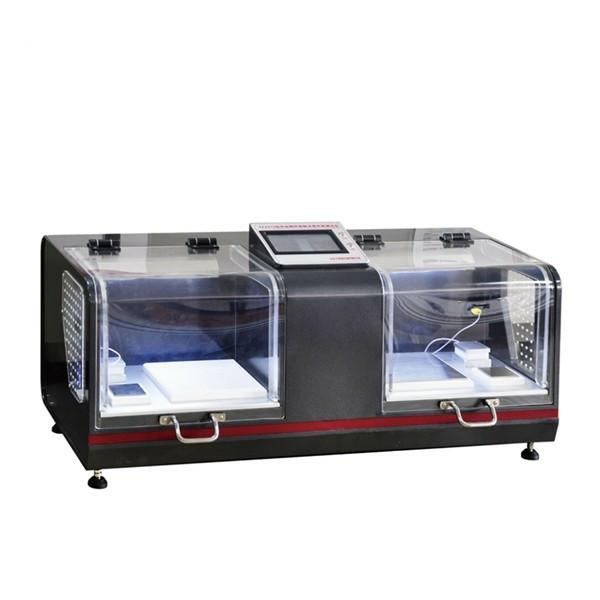
Principle of Operation
By testing the conductive heat flow and moisture permeability of fabrics under different temperature and humidity conditions, the cooling performance of the fabric is evaluated. The tester is characterized by high precision, stability, and sensitivity, providing accurate test results, thus offering scientific cooling options for fabric manufacturers and consumers.
The cooling performance tester is divided into two parts: thermal conductivity testing and moisture exclusion capacity testing. During the thermal conductivity test, the tester will contact the fabric with a heat source and then measure the fabric's ability to conduct heat. By measuring the fabric's thermal conductivity, we can understand its cooling effect at different temperatures, thus evaluating its cooling performance. In the moisture exclusion test, the tester contacts the fabric with a moisture source and then measures the speed at which moisture passes through the fabric. By measuring the fabric’s moisture permeability, we can assess its moisture-wicking performance, which in turn evaluates its cooling sensation.
The cooling performance of fabrics is closely related to their material, structure, and processing technology. Generally speaking, fabrics with higher thermal conductivity and better moisture permeability tend to have better cooling performance. For example, polyester fiber is a common fabric material with low thermal conductivity and good moisture permeability, making it effective in providing a cooling sensation. Furthermore, the fabric’s structure also impacts its cooling performance. The void structure within the fabric influences both thermal and moisture conduction abilities, thereby affecting the cooling effect.
Features of the Fabric Cooling Sensation Tester
High-precision temperature sensors to ensure accurate temperature measurements.
Automatic heating plate preheating function when powered on, saving testing time.
Data is automatically saved after the test, with options to view reports, calculations, and analysis results, as well as print test reports.
Touchscreen control panel with a clear graphical interface for easier and faster operation.
All data and statistical results are readily accessible within the main unit.
Uses a 32-bit ARM processor with high sampling frequency for high testing precision.
Infrared detection, offering both manual and automatic testing options, with automatic testing eliminating human errors.
Equipped with multiple test modes, the device allows flexible parameter switching based on fabric type and testing standards, meeting diverse experimental requirements.
Built-in intelligent fault diagnosis system that can monitor the instrument's operational status in real-time. In case of anomalies, it automatically triggers an alarm and provides information about the cause of the fault, ensuring the stability and safety of the testing process.
The body is made of corrosion-resistant, high-temperature-resistant materials, extending the instrument's service life and adapting to the complex environment of laboratories.
Equipped with a large-capacity data storage module, it can store historical test data for long periods and supports exporting data to a computer for in-depth analysis and archival management.
The testing chamber is designed with special thermal insulation to effectively reduce interference from external environmental temperatures on test results, further improving measurement accuracy.
Applications of the Fabric Cooling Sensation Tester
Evaluating Fabric Comfort: By testing the fabric’s temperature and humidity, it helps comprehensively assess its comfort level in summer, providing scientific data for brands and manufacturers.
Research and Development of New Fabrics: The tester can evaluate the cooling performance of new fabrics, helping better meet consumer needs.
Quality Control: By testing the cooling performance of fabrics from different batches, it assists in quality control during the manufacturing process.
Trend Analysis: By testing the cooling performance of different fabrics on the market, it helps identify current trends and market directions.
Main Testing Methods for Fabric Cooling Sensation
Human body try-on method: Wear the test sample on the human body and evaluate the cooling effect through human body feelings. The advantage of this method is that the test results are closer to actual usage, but the disadvantage is that the test process is greatly affected by human factors and the test results are not objective enough.
Instrumental testing method: Use special testing instruments to measure the temperature change of textiles after contact with human skin to evaluate the cooling effect. The advantage of this method is that the test results are objective and reliable, but the disadvantage is that there may be differences between the testing process and actual usage.
Artificial simulation method: Use artificial simulated skin to simulate human skin, and evaluate the cooling effect by measuring the temperature change after the simulated skin comes into contact with the test sample. The advantage of this method is that the test results are objective and reliable, while avoiding the shortcomings of the human try-on method.
Precautions for Fabric Cooling Sensation Testing
Test samples should meet relevant textile standards, such as fiber composition, fabric structure, and dyeing.
Testing conditions should simulate real-life usage, including temperature, humidity, and wind speed.
Safety and hygiene must be maintained throughout the testing process to avoid harm to the human body.
Before testing, samples should be pretreated to ensure they are in a stable state. For example, the samples can be placed under standard atmospheric conditions for a sufficient amount of time to eliminate the impact of environmental factors on the sample's initial state.
The testing instrument should be calibrated regularly to ensure the accuracy and consistency of measurement data, reducing the interference of instrument errors on the test results.
Test operators must undergo professional training to familiarize themselves with the operating procedures and precautions, preventing deviations in test results caused by improper handling.
When recording test data, detailed documentation of the test environment parameters, sample information, and instrument status should be made to enable traceability and analysis of the test results.
Conclusion
The widespread use and promotion of the Fabric Cooling Sensation Tester are of great significance for improving the comfort of clothing. Through the application of this tester, brands and manufacturers can more accurately evaluate the cooling performance of fabrics, offering consumers higher-quality products and services. Moreover, as the market expands and technology advances, the application prospects of the fabric cooling sensation tester will continue to broaden and deepen in the future.
Previous: What is the standard for control valve testing?
N e x t : What is the IEC standard for damp heat test?
