





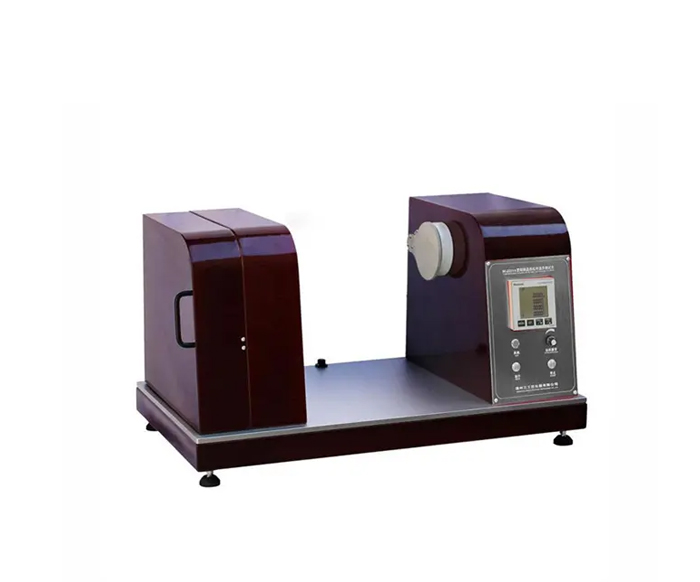
What is a textile far-infrared radiation temperature rise tester?
2026/03/02
Share:

Working Principle
The tester primarily simulates human or environmental thermal radiation conditions to measure the far-infrared radiation performance and temperature rise of textiles under controlled conditions. Its core components include a radiation source, temperature sensors, data acquisition system, and analysis software.
During testing, the instrument emits infrared radiation of a specific wavelength onto the textile sample. High-precision sensors monitor the surface temperature changes of the textile in real time, allowing calculation of its far-infrared emissivity and temperature rise effect.
Main Functions and Performance Indicators
Far-Infrared Emissivity Measurement:
The tester can accurately measure the far-infrared emissivity of textiles within a specified wavelength range (usually expressed as a percentage).
Higher emissivity indicates superior far-infrared radiation performance.
Temperature Rise Measurement:
By simulating body or environmental temperature, the tester measures the temperature increase of textiles under radiation.
Temperature rise is a key indicator for evaluating the thermal performance of far-infrared textiles.
Stability and Repeatability:
A high-quality tester ensures consistent results across multiple tests, providing a reliable basis for quality control.
Data Acquisition and Analysis:
Modern testers are equipped with professional software for real-time curve display, report generation, data export, and comparative analysis.
Testing Methods and Procedures
Far-Infrared Emissivity Measurement
Equipment: Fourier Transform Infrared Spectrometer (FTIR) or specialized emissivity tester (e.g., IREM-1).
Steps:
Sample Preconditioning: Place samples in a constant temperature and humidity chamber (20±2°C, 65%RH±5%) for 24 hours.
Blackbody Calibration: Place a standard blackbody plate (emissivity ≥0.95) on a heating plate, set temperature to 34±0.1°C, and measure its radiation intensity as a reference.
Sample Testing: Place the sample on the same heating plate under identical conditions and measure its radiation intensity.
Emissivity Calculation: Determine far-infrared emissivity (ε) by calculating the ratio of sample radiation intensity to blackbody intensity.
Result Evaluation: Classify according to GB/T 30127 (Grade A ≥0.88. Grade B ≥0.83).
Far-Infrared Radiation Temperature Rise Test
Equipment: Far-infrared radiation source (e.g., carbon fiber heating plate), high-precision temperature sensors (thermocouples or infrared thermal camera), constant temperature and humidity chamber, data acquisition system.
Steps:
Sample Preconditioning: Same as emissivity test (24 hours in controlled chamber).
Environmental Setup: Secure the sample on the holder, ensure it is flat without wrinkles; use a far-infrared radiation source (wavelength 4–14 μm, adjustable power density 500–1000 W/m²) to simulate a heat source.
Temperature Monitoring: Place thermocouples at the sample’s center and four corners (total 5 points), or use an infrared thermal camera to monitor surface temperature in real time.
Radiation Exposure Test: Turn on the infrared source, adjust to standard power density (e.g., 500 W/m²), irradiate for 30 minutes while recording temperature data.
Temperature Rise Calculation: Record initial temperature (T₀) and final temperature (T_final), then calculate ΔT = T_final - T₀.
Result Evaluation: According to GB/T 30127. samples with ΔT ≥1.4°C are considered qualified; for loose materials (e.g., nonwoven or flake types), ΔT ≥1.7°C is qualified.
Precautions
Equipment Calibration: Infrared source should be calibrated annually using a radiometer; thermocouples should be verified monthly with a standard temperature source (e.g., constant temperature water bath).
Sample Representativeness: Avoid edge areas prone to structural damage; for patterned or printed textiles, test different colored regions as pigments can affect infrared absorption.
Safety Protection: Wear heat-resistant gloves during testing; install an emergency power-off switch to prevent overheating accidents.
Daily Maintenance
Environmental Control: Place the tester in a controlled environment (20±2°C, 65±5% RH), away from strong electromagnetic fields, vibration sources, and direct sunlight. Cover with a dust-proof cover containing desiccant when idle.
Cleaning: Wipe the outer casing with a dry or slightly damp cloth; avoid organic solvents. Clean sample holders, radiation source windows, temperature sensor probes, and interfaces with a lint-free cloth. Inspect connection wires for wear.
Core Component Maintenance: Avoid touching sensor probes; calibrate monthly with standard temperature sources. Keep radiation source surfaces clean and monitor power output. Check integrity and positioning of insulation panels.
Startup and Usage: If idle long-term, power on 1–2 times per week for 30 minutes each. Operate strictly according to the manual. Replace samples only after radiation source has cooled. Ensure samples are clean and flat.
Periodic Calibration: Have a professional agency perform full calibration at least once a year; immediately stop testing and contact professionals in case of abnormalities. Never disassemble the device yourself.
Common Issues and Solutions
Temperature rise below standard (ΔT < 1.5°C):
Cause: Low emissivity, thin fabrics, rapid heat loss.
Solution: Add high-emissivity materials (e.g., silicon carbide microparticle coating); use a double-layer structure with reflective inner layer (e.g., aluminum foil) to reduce heat loss.
Large temperature fluctuations:
Cause: Poor sensor contact, air flow disturbances, unstable radiation power.
Solution: Fix thermocouples with thermal paste, ensure tight contact; add wind shield; calibrate infrared source power regularly.
Decreased temperature rise after washing:
Cause: Loss of functional materials (e.g., ceramic powders) or coating wear.
Solution: Use microencapsulation technology to improve wash durability; embed functional particles in fibers during melt-spinning.
The far-infrared radiation temperature rise tester is a critical tool for the research, development, and quality control of functional textiles. Through scientific testing and data analysis, manufacturers can optimize product design, improve market competitiveness, and provide consumers with genuinely effective functional textiles. With technological advances and increasing market demand, far-infrared textiles and their testing methods are expected to see broader application and development in the future.
Previous: Hydraulic Pump Contamination Resistance Tester,JB/T 7043-2006
N e x t : Thermal Protective Performance Tester (TPP), ISO 11612
