





Which kind of suit is required for protection against acid and alkali?
2026/03/09
Share:

Working Principle
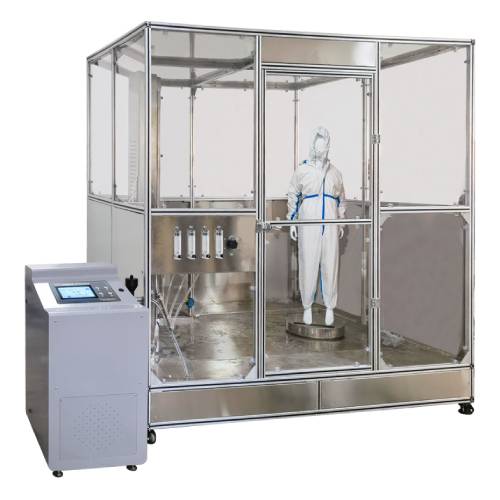
The working principle of the Acid and Alkali Protective Clothing Splash and Spray Liquid Tightness Tester is to simulate real-world scenarios of acid and alkali splashes or sprays and evaluate the protective clothing’s barrier performance against liquid penetration. The core mechanism is based on standard-specified liquid splash parameters and visual penetration determination methods.
Simulating realistic splash environments: A high-pressure nozzle system sprays a test liquid (usually water or simulated acid/alkali solution) onto a mannequin wearing the protective clothing, at a specified pressure, flow rate, angle, and distance.
Indicator garment visual assessment: An absorbent indicator garment is worn under the protective clothing. Any liquid that penetrates the outer layer creates visible stains on the indicator garment.
Quantitative evaluation of liquid tightness: By comparing the stained area with standard reference charts, it is determined whether the protective clothing meets the liquid penetration requirements.
Operating Procedure
The tester is primarily used for assessing splash and spray liquid tightness of protective clothing.
1. Preparation
Add indicator liquid: Pour standard test indicator liquid into the indicator tank, ensuring the liquid level is between 25–35 cm.
Connect waste container: Place a container to collect liquid discharged from the test chamber.
Check pipelines and pump: Ensure all connections are intact. Prime the water pump with a syringe as per the pump manual to avoid dry running.
Calibrate pressure and flow (if needed):
Splash pressure: 300 kPa (0.3 MPa)
Spray pressure: 150 kPa (0.15 MPa)
Splash flow rate: (1.14 ± 0.1) L/min
Adjust gauges or flow knobs with a hex wrench to standard values.
Wear test clothing: Put the indicator garment on the mannequin first, then wear the test protective clothing. Fix the mannequin on the rotating platform.
2. Splash Test
Power on the device.
Start the water pump to draw indicator liquid.
Press the “Splash” button on the control panel; the turntable rotates at 1 rad/min (~9.55 rpm), while the spray arm distributes the liquid.
After the preset time (default 60 s), the splash stops automatically.
Activate the drying timer (default 2 min); a warning light and sound indicate the end of timing.
Remove the protective clothing and record the stained area on the indicator garment.
Turn off the pump, timer, and main power.
3. Spray Test
Randomly select 5 test points on the protective clothing.
Power on and start the water pump, same as splash test.
Position the nozzle 1 m from the test point and aim directly.
Press the “Spray” button on the handle; spray for 5 seconds (default) and stop automatically.
Repeat for all 5 test points.
Activate the drying timer; at the end, a light and sound indicate completion.
Remove the protective clothing and record stains on the indicator garment.
Turn off all related switches and power.
Precautions
Operation precautions:
Test run: Perform a trial run before first use or when changing the indicator liquid to remove air from the pipelines.
Environmental requirements: Laboratory temperature should not be below 4°C; otherwise, the pump and pressure gauges may malfunction.
Electrical safety: Use grounded three-prong sockets with a leakage protection device.
Maintenance:
If unused for a long time, flush pipelines with pure water.
Check for clogged filters if flow or pressure drops.
Do not completely shut off water valves before spraying to prevent pipe rupture.
Avoid spraying solution on the pump, solenoid valves, or electrical circuits.
Core Advantages
The core advantages of the Acid and Alkali Protective Clothing Splash and Spray Liquid Tightness Tester lie in its automation, structural design, and application value.
1. Automation and precise control
Computer-controlled systems automate testing and data processing.
Automatic operations: splash, turntable rotation (typically 1 rpm or 1 rad/s), and timing are fully automated.
High-precision parameter control: Time range 0–99.99 s, resolution 0.01 s; flow and pressure are precisely adjustable.
Automated data processing reduces human error and ensures repeatability.
2. Stable structure and safety design
Solid aluminum alloy frame and enclosed test chamber provide stability and environmental isolation.
Reliable spray system with self-priming pump, pressure gauge, and flow adjustment ensures consistent liquid supply.
Standardized spray rod layout (nozzle spacing 450 mm, spray rod center to turntable center 1500 mm) ensures uniform coverage.
3. Broad application value
Quality control: Ensures protective clothing meets national standards for textile, petrochemical, and other industries.
Safety assessment: Provides reliable testing for occupational safety agencies to prevent chemical injuries due to liquid penetration failure.
R&D support: Offers research institutions and protective clothing developers a reliable platform for validating and optimizing new products and materials.
Future Development Trends
The future development of the tester is driven by stricter safety standards, intelligent technology, and multi-scenario adaptability.
Increased intelligence and automation:
Integration of high-precision sensors and AI for real-time monitoring of leakage, contamination area, and spray trajectory.
Remote control and cloud integration for parameter configuration, result upload, and ISO/GB-standard electronic reports.
Stricter and diversified testing standards:
Integration of international standards (ISO 16603/16604. EN 14126).
Future tests may simulate extreme conditions: -40°C to 120°C, high humidity, or corrosive atmospheres.
Multi-modal testing methods:
Combined splash, spray, hydrostatic, and seam testing in one device.
Use of fluorescent dyes or smart color-changing materials for more accurate contamination detection.
Safer and more durable structure:
Corrosion-resistant components using PTFE, Hastelloy, etc.
Explosion-proof and emergency designs for high-pressure scenarios.
Expanded application scenarios:
Medical protective clothing testing demand increased due to public health events (e.g., COVID-19).
Support for mannequins of different body types (pregnant, obese) for specialized protective needs.
The Acid and Alkali Protective Clothing Splash and Spray Liquid Tightness Tester plays an irreplaceable role in ensuring industrial safety and protecting human health through accurate, reliable, and automated testing of chemical protective clothing.
Previous: Which test is used for testing the fabric?
N e x t : What is an automatic coating thickness measuring instrument?
