





How to Conduct a Single-Station Jounce Test?
2026/03/16
Share:

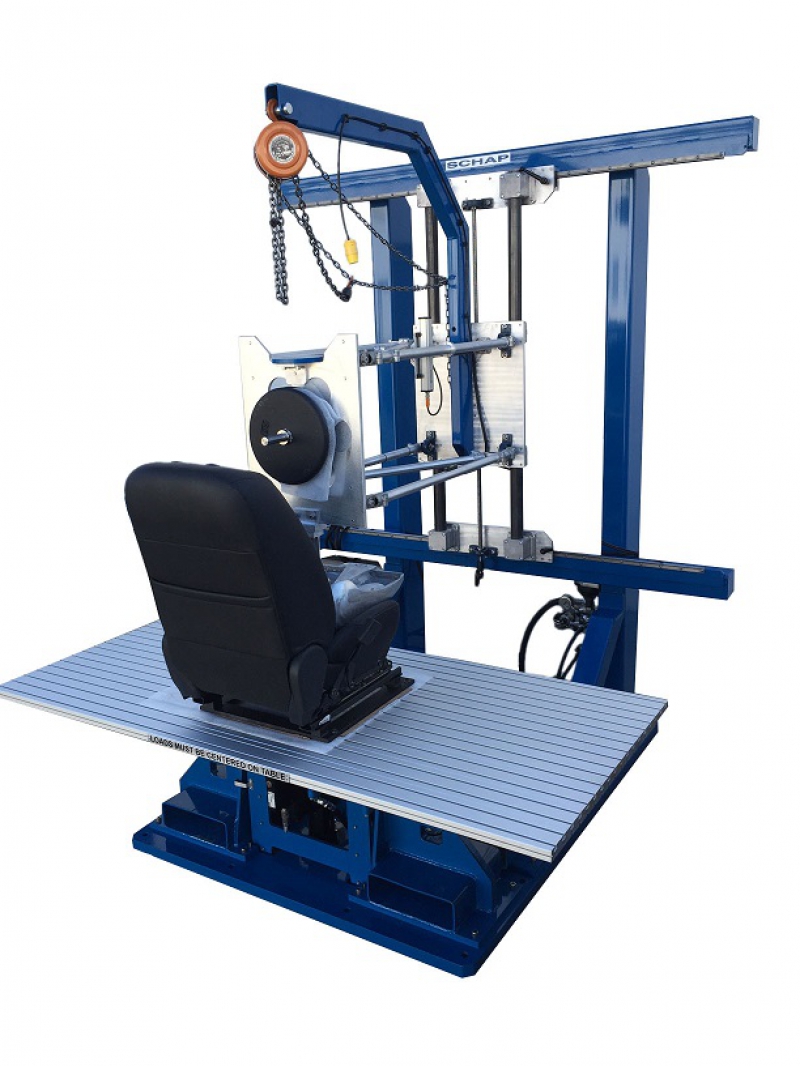
Core Application Areas of the Seat Jounce and Creep Test Rig
Durability and Fatigue Life Testing
Using a high-precision programmable actuation system, the tester repeatedly applies jounce and creep stress cycles that simulate real road conditions acting on the seat structure.
This process systematically verifies the fatigue resistance and long-term reliability of critical seat components, including:
Seat frame structures
Foam cushioning materials
Upholstery fabrics or leather coverings
Internal padding and support components
These tests ensure that throughout the product’s design life cycle, failures such as frame cracking, permanent deformation, foam collapse, or upholstery damage will not occur.
Dynamic Comfort and Ergonomic Evaluation
Under simulated dynamic loading conditions, the tester evaluates the vibration isolation and damping characteristics of the seat system, as well as the mechanical response and pressure distribution in areas where the occupant’s body contacts the seat (such as the hips and back).
The resulting data provide key references for optimizing:
Seat geometry and structure
Material combinations
System stiffness
These improvements enhance passenger comfort and reduce fatigue during long-distance driving.
R&D Support and Quality Control Throughout the Product Lifecycle
The equipment is an essential tool for product development and quality assurance systems, and is widely used for:
Prototype validation of newly designed seats
Feasibility evaluation of alternative materials or new manufacturing processes
Supplier component qualification and consistency comparison
Routine sampling inspection and quality monitoring on production lines
Because of its broad testing compatibility and high configurability, the test rig is widely used by:
Automotive manufacturers (OEMs)
Seat and component suppliers at all tiers
Third-party testing and certification organizations
Universities and research institutes
It supports testing for a wide range of vehicle seat types, from passenger vehicles (sedans, SUVs, MPVs) to commercial vehicles (light, medium, and heavy trucks).
Main Test Types and Operating Procedures
The core function of the Seat Jounce and Creep Test Rig is to accurately simulate the road-induced vibrations and long-term occupant-induced creep deformation experienced by automotive seats, thereby scientifically verifying the structural durability, material reliability, and overall performance stability of seat components such as the frame, foam, and upholstery.
1. Combined Jounce and Creep Durability Test
This test mainly verifies the fatigue life and structural integrity of the seat assembly under long-term repeated mechanical stress cycles.
Sample Installation and Positioning
First, the complete seat assembly to be tested is firmly fixed to the dedicated fixture of the test rig in the same installation orientation used in the actual vehicle.
Precise adjustment is required to ensure that the seat H-point (the theoretical pivot point of the occupant’s hip joint) aligns exactly with the center of the dummy buttock or dummy back loading device provided by the tester. This alignment ensures realistic load transfer paths corresponding to human seating behavior.
Test Parameter Configuration
According to relevant standards (such as corporate standards or QC/T 740), key operating parameters are set. Typical values include:
Loading frequency: typically 100 cycles per minute (reference standard)
Jounce amplitude: vertical reciprocating displacement of the seat, usually 30 mm peak-to-peak
Torsion angle: micro-torsional movement simulating turning conditions
Seat cushion: typically 21°
Seat backrest: sometimes 0° or no torsion applied depending on test requirements
Simulated load: applied using weights or servo loading systems
Front seat cushion: typically 68 kgf
Front seat backrest: typically 29 kgf
Test Operation and Monitoring
After the equipment is started, it operates automatically according to the preset program.
Typical cycle requirements include:
Seat cushion: 100.000 jounce-creep cycles
Seat backrest: 50.000 cycles
During the entire testing process, the system must operate continuously and stably without abnormalities.
Post-Test Inspection and Evaluation
After completion of the required cycles, the seat must undergo a comprehensive visual inspection and dimensional measurement.
Acceptance criteria typically include:
No visible cracks or permanent deformation in the metal frame
No irreversible collapse or plastic deformation in foam padding
No wear, tearing, or damage to the upholstery material
Seat H-point displacement must remain within the allowable tolerance defined by the standard
2. Dynamic Seat Entry and Exit Wear Simulation Test
This test is designed to evaluate the abrasion resistance of seat upholstery materials during repeated passenger entry and exit, as well as the durability of seat side bolsters and frame structures under repeated compression.
Test Indenter Preparation
A 50th percentile male dummy buttock model, compliant with SAE J826-2002. is used as the loading indenter.
The indenter surface must be covered with:
A standard foam layer (e.g., 12 mm thickness)
An outer covering made of a specified material (such as standard denim fabric)
The total mass of the indenter is typically 44.5 kg.
Seat Position Setup
The seat must be adjusted to the standard design seating posture (driver or passenger position). The motion trajectory simulating human entry and exit movements is then programmed into the test system to reproduce complex three-dimensional motion patterns.
Operational Procedure
The indenter slides horizontally onto the seat cushion, compressing the seat side bolsters and backrest bolsters by approximately 25 mm.
The indenter rotates about 30° around a vertical axis, simulating the sideways sitting motion of a person entering the seat.
The indenter continues sliding until its centerline aligns with the seat centerline.
A short stabilization and micro-movement period simulates the occupant adjusting their seating posture.
A vertical downward load is applied to the cushion (e.g., 445 N).
While maintaining the 445 N load, the indenter performs a 30° leaning creep motion against the backrest.
The load is maintained until the indenter moves outward to approximately half of the seat travel distance.
The indenter slides along the contour of the seat bolster and exits completely, during which the side bolsters experience significant compression and rebound.
Test Operating Conditions
The test is typically performed at a frequency of approximately 4.5 complete cycles per minute.
The total number of cycles can be set to:
15.000 cycles, or
25.000 cycles for more stringent requirements.
Acceptance Criteria
After the test is completed, the seat upholstery must be carefully inspected. The following conditions must be satisfied:
No tearing or rupture
No pilling or fiber aggregation
No fabric wear-through exposing the base layer
No yarn breakage or fiber separation
All stitching must remain intact without breakage
3.Key Operational Precautions and Equipment Management
Safety Protection Measures
The equipment must be equipped with comprehensive safety protection devices, including:
Emergency stop button
Mechanical overload protection system
Motion travel limit switches
Safety light curtains or protective enclosures
These measures ensure operator safety during testing.
Environmental Control
For high-precision testing requirements, the equipment may be installed inside an environmental chamber, or may include built-in temperature and humidity control systems to simulate extreme climate conditions such as:
High temperature
Low temperature
High humidity
These conditions help evaluate seat material performance under harsh environmental conditions.
Data Acquisition and Recording
Through an integrated network of high-precision sensors (such as accelerometers, displacement sensors, and force sensors), the system continuously monitors and records key physical parameters during testing, including:
Vibration acceleration
Structural deformation
Applied loading forces
All data are automatically collected and stored in a central database for further analysis and test report generation.
Benefits of the Single Station Jounce Tester to the Industry
The Seat Jounce and Creep Test Rig is an indispensable piece of equipment in automotive seat development, performance validation, and production quality control, playing a crucial role in improving both seat component manufacturing and overall vehicle quality.
1. Significantly Improving Product Reliability and Safety
Identification of Potential Structural Weaknesses
By realistically simulating complex road load spectra in a controlled laboratory environment, the system can efficiently reveal weaknesses in seat design, materials, or manufacturing processes, such as:
Potential loosening of welded joints or connection points
Local stress concentration or deformation in metal frames
Early fatigue behavior of polymer materials under cyclic loading
Scientific Verification of Lifecycle Durability
Accelerated life testing can simulate the mechanical stresses experienced by seats during years of real-world use or hundreds of thousands of kilometers of vehicle operation within a relatively short testing period.
2. Optimization of Design and Material Selection
By introducing quantifiable comfort metrics, combined with tools such as pressure distribution measurement systems and H-point mannequins, the tester enables more precise evaluation of:
Cushion rebound performance
Foam compression characteristics
Upholstery wear resistance
These data provide reliable support for refined seat design and engineering optimization.
Based on extensive test data, manufacturers can optimize material selection and manufacturing processes while ensuring performance compliance, achieving a balance between lightweight design and cost control.
3. Supporting New Technology Development and Certification
With the growing trend toward intelligent automotive seats, including features such as:
Electric seat adjustment
Massage systems
Active support mechanisms
modern test rigs can integrate multi-axis precision control systems to verify the long-term reliability and functional stability of these complex mechanical and electronic systems.Additionally, these testers comply with multiple international and industry standards such as:
ISO 7176-8
QC/T 740
Ford SDS standards
PSA standards
They help companies obtain national CNAS laboratory accreditation and meet strict OEM supplier qualification requirements.
4. Promoting Technological Advancement in the Industry
The development of this testing technology has significantly promoted the progress of domestic testing equipment manufacturing.The global market for seat jounce and creep test rigs is expected to maintain steady growth, with the Chinese market share continuing to increase, reflecting the automotive industry's growing demand for high-performance and highly reliable testing equipment.
In summary, the Seat Jounce and Creep Test Rig is no longer merely a quality inspection tool. It has become a core technical infrastructure and driving force that supports the automotive seat industry in advancing toward greater safety, comfort, and intelligent functionality.
Previous: What is Garment Electromagnetic Radiation Shielding Performance Testing System?
N e x t : What is evaluation of textile materials?
