





FAQs About Automatic Filter Performance Tester
2026/03/27
Share:

Do high-performance air filters truly provide a significant improvement in vehicle performance?
The answer is yes, high-performance air filters can effectively improve the airflow into the engine and optimize its efficiency.
However, for most everyday consumer vehicles, the actual impact of these filters on engine horsepower or overall power performance is usually very limited—typically offering only a very small, almost imperceptible gain in power, and in many real-world driving scenarios, the driver may not notice any obvious performance difference at all.
Although some controlled laboratory tests or specific operating conditions show that high-performance air filters can increase engine intake airflow by over 100%, this theoretical improvement rarely translates into a noticeable, tangible performance enhancement that drivers can clearly feel during normal road use.
That said, it is worth noting that, compared with many traditional disposable paper filters, high-performance air filters generally have the advantage of being washable and reusable over the long term. From both an economic and environmental perspective, this feature is a practical benefit worth considering.
What is the BPT Test for Filter Integrity?
The Bubble Point Test is a non-destructive, physics-based method for filter integrity verification. Its core operation involves precisely measuring the minimum critical pressure required to force air (or another specified gas) through a filter membrane that has been completely wetted with a suitable liquid (such as water or alcohol). This measurement effectively verifies the integrity and performance reliability of the filter.
This testing method is particularly critical in industries such as pharmaceuticals, biotechnology, microelectronics, and food and beverage, especially for applications with stringent sterile filtration requirements. It is capable of sensitive and accurate detection of defects such as physical damage, fiber breakage, seal failure, or abnormal enlargement of membrane pore sizes.
The underlying principle is based on capillary action: when the pores of the filter membrane are fully filled with a wetting liquid, the surface tension of the liquid creates capillary forces at the curved liquid meniscus in each pore. During the test, gas pressure is gradually applied and increased on the upstream side of the membrane. This pressure must first overcome the capillary force in the largest pore to displace the wetting liquid in that channel, forming a continuous gas passage and producing the first observable stream of bubbles on the downstream side.
This critical pressure is defined as the bubble point pressure, which is directly related to the maximum pore size of the membrane. By comparing the measured bubble point pressure with the standard or validation reference values provided by the filter manufacturer, one can determine whether the filter meets integrity requirements. This ensures that the filter can reliably retain target particles or microorganisms during actual filtration, safeguarding the safety and quality of the final product.
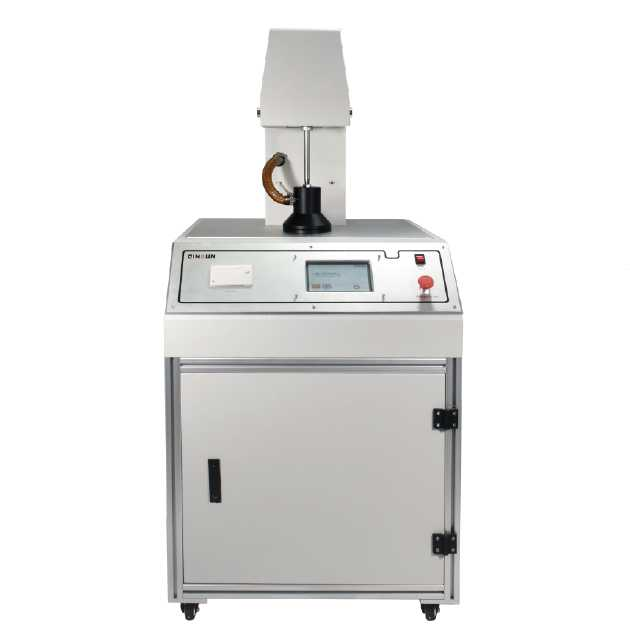
What Are the Uses of an Automatic Filter Performance Tester?
The Automatic Filter Performance Tester is primarily used to assess the physical integrity and filtration efficiency of filters and is widely applied in industries with strict sterility and safety requirements. Its core uses include:
Verifying Filter Integrity
Using internationally recognized methods such as bubble point, forward flow (diffusion), pressure hold (decay), and water intrusion tests, the tester can detect defective, leaking, or abnormal pore-size filter cartridges, ensuring compliance with GMP, pharmacopeia, and FDA regulations.
Ensuring Sterile Production Processes
In industries such as pharmaceuticals and biotechnology, the device is used to perform integrity testing of sterilizing-grade filters before and after use, preventing microbial contamination and ensuring the safety of sterile processes.
Checking Seal and Structural Integrity
The tester can identify leaks in O-rings, gaskets, and other sealing components, preventing filtration failure due to improper installation or aging.
Supporting Multiple Filter Types
It is suitable for testing disc membranes (Φ25–Φ300 mm), pleated/capsule/small cartridges (2.5"–40"), and air filters (e.g., tank breathers) across a variety of specifications.
Meeting Regulatory Compliance Requirements
Test data can be stored and printed, with Chinese/English interfaces, and complies with 21 CFR Part 11 data integrity requirements, facilitating audit tracking.
Optimizing Filter Selection and Quality Control
Provides performance verification methods for filter manufacturers, ensuring product consistency and reliability.
How Does an Automatic Filter Performance Tester Work?
The core operating principle of the Automatic Filter Performance Tester is based on a closed-loop logic of “aerosol generation → filtration interception → concentration and pressure drop measurement.”
Aerosol Generation
The device uses oil-based (e.g., DOP, DEHS) or salt-based aerosol generators to produce standardized aerosol particles with controlled size distribution, simulating particulate matter found in real-world environments.
Filtration Interception
The generated aerosol passes through the filter media under controlled airflow, allowing the system to test the filter’s particle capture efficiency.
Concentration Comparison
High-precision photometers (such as dual solid-state photometers) measure particle concentrations upstream and downstream of the filter media, and the filtration efficiency (Eₚₘ) is calculated as:
EPM=C0−C1C0×100%E_{PM} = \frac{C_0 - C_1}{C_0} \times 100\%EPM=C0C0−C1×100%
where C₀ is the upstream concentration and C₁ is the downstream concentration.
Pressure Drop Measurement
Electronic pressure sensors measure the pressure drop across the filter media (typically 0–15 cmH₂O), reflecting the filter’s airflow resistance.
Automated Control
The built-in program can automatically switch aerosol types, adjust airflow (15–100 L/min), record data, and support testing up to 5 samples per minute, enabling efficient, high-throughput evaluation.
Which Industries Are Suitable for the Automatic Filter Performance Tester?
The Automatic Filter Performance Tester is primarily used to evaluate the performance of filter materials or complete filters, including metrics such as integrity, filtration efficiency, pressure drop, and particle capture capability. Its main applications span the following industries:
Pharmaceutical Industry
Used for integrity testing of sterilizing-grade filters (e.g., bubble point, forward flow, water intrusion), compliant with GMP and pharmacopeia standards, ensuring sterility in production processes.
Biotechnology and Food & Beverage Industry
Employed for validation and routine testing of process filters, ensuring product purity and safety.
Medical Protective Equipment Manufacturing
Tests particulate filtration efficiency (PFE) and bacterial filtration efficiency (BFE) of medical masks, protective clothing, and respirators, compliant with GB, ASTM, EN, and other international standards.
Air Purification and HVAC Industry
Evaluates air filters and filter media (e.g., melt-blown fabric, glass fiber) for the removal efficiency of PM2.5 and aerosols.
Industrial Filter Material R&D and Manufacturing
Used for quality control and performance verification of cartridges, membranes, and filter bags.
Research and Third-Party Testing Institutions
Supports fundamental research on filter materials, compliance verification, and certification testing.
Why Is the Automatic Filter Performance Tester Important?
The Automatic Filter Performance Tester is important because it plays a core role in ensuring the safety, effectiveness, and regulatory compliance of filtration devices across multiple critical industries. Its significance can be summarized as follows:
Ensuring Filtration Efficiency and Safety
The tester can accurately measure particulate filtration efficiency (PFE) and bacterial filtration efficiency (BFE) of filters used in masks, respirators, and medical filter media, ensuring compliance with national and international standards such as GB/T 19083. YY/T 0469. NIOSH 42 CFR Part 84. EN 149. and others.
By simulating real-world conditions such as specific airflow rates and salt- or oil-based aerosol challenges, it provides an authentic reflection of the filter’s protective performance in practical applications.
Meeting Regulatory and Certification Requirements
In industries such as pharmaceuticals, food, and medical protective equipment, filter integrity and performance must be verified before products can be approved for market release.
The automatic tester supports recognized testing methods such as bubble point, forward flow, water intrusion, and pressure decay, which are accepted by GMP and pharmacopeia standards, making it an essential tool for sterilizing filter validation.
Authoritative organizations such as FDA, NIOSH, and TGA recommend or require the use of automated equipment for filter performance testing to ensure traceable and consistent data.
Enhancing Production Quality Control Efficiency
Automated testing can measure multiple parameters—filtration efficiency, pressure drop, penetration, and flow stability—with high precision in a single test and automatically generate reports, greatly improving testing efficiency and consistency.
Compared with manual operation, automation reduces human error and is suitable for online or offline quality control in large-scale production.
Supporting New Material Development and Innovation
During the development of melt-blown fabrics, nanofibers, and composite filter media, the tester provides repeatable and comparable performance data, helping optimize material structure and manufacturing processes.
It can also study the effects of pore size, thickness, and airflow velocity on filtration efficiency, providing a scientific basis for product design.
Protecting Public Health and Safety
In scenarios such as pandemics or air pollution, high-performance filters like N95 masks are critical protective equipment. The automatic tester ensures that these products truly meet their claimed protection levels, directly impacting user safety.
In summary, the Automatic Filter Performance Tester has far surpassed its original role as a simple quality control tool. In practice, it has proven to be a cornerstone for ensuring product compliance, enhancing system safety, and driving technological innovation.Its comprehensive role lies in precisely measuring key performance parameters of filter media and providing standardized, traceable test data that supports compliance with increasingly stringent global industry standards and regulations.Consequently, its applications have expanded and integrated deeply across industries, serving medical device manufacturing, precision industrial production, environmental monitoring and protection, and personal protective equipment, making it an indispensable element for ensuring product reliability, process safety, and sustainable development.
Previous: What is a flame spread?
N e x t : FAQs About Aluminum Foil Pinhole Tester
