





What is Flame Spread Index Tester?
2026/04/16
Share:

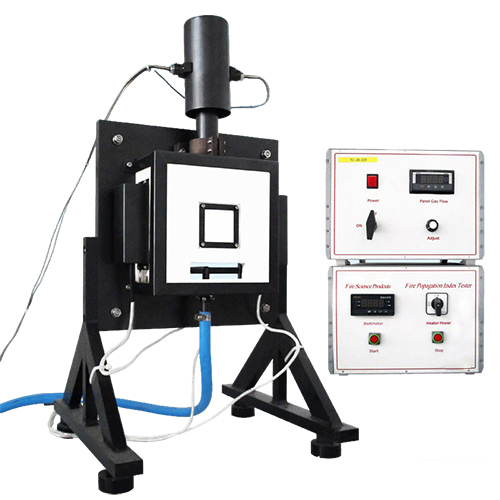
What is the Flame Spread Index Tester used for?
The Flame Spread Index Tester is primarily used to evaluate the surface flame propagation speed and behavior of building materials under fire conditions, thereby quantifying their combustion hazard level.
This instrument is widely applied in building fire safety assessment, material research and development, and regulatory compliance testing. Its main applications include:
Determination of the Flame Spread Index (FSI):
Measures the rate at which flame spreads across the surface of a material. A lower value indicates better flame-retardant performance.
Assessment of the Smoke Development Index (SDI):
Evaluates the concentration of smoke generated during combustion, which directly affects evacuation efficiency and rescue difficulty in fire scenarios.
Support for Building Code Compliance:
Enables standardized testing in accordance with ASTM E84. ISO 5658-2. GB/T 20284. and other relevant standards, providing regulatory basis for the use of materials in construction.
Guidance for Material Selection:
Assists architects and construction professionals in selecting fire-rated decorative materials for walls, ceilings, floors, and other building components.
Support for Research and Product Development:
Used for performance comparison of new flame-retardant materials and provides data support for formulation optimization and product innovation.
What standards does the Flame Spread Index Tester comply with?
The Flame Spread Index Tester complies with multiple international and industry standards, which vary depending on the application scenario and test material. The main applicable standards are as follows:
ASTM E84
Used to evaluate the surface burning characteristics of building materials using the “Steiner Tunnel” method to determine the Flame Spread Index (FSI) and Smoke Development Index (SDI).
FSI classification:
Class A: FSI ≤ 25 (for high fire safety requirements such as hospitals and schools)
Class B: 25 < FSI ≤ 75
Class C: 75 < FSI ≤ 200
ASTM E162
Uses a radiant heat source method to evaluate the surface flammability of materials. The Flame Spread Index is calculated as:
FSI = Is × Q / 10
Requirements typically include Is ≤ 25 or ≤ 35. This standard is widely used for testing interior materials of railway vehicles.
ISO 15025
Applicable to textile fabrics (such as coated fabrics and multilayer fabrics) for testing limited flame spread under small flame conditions. It is not suitable for materials that melt or shrink easily.
EN 45545-2
European fire safety standard for railway vehicles. It evaluates flame spread rate using a combustion tube method to ensure that interior materials do not contribute to fire propagation.
AS/NZS 1530.3
Australian/New Zealand standard that simultaneously measures combustibility, flame spread, heat release, and smoke production. The flame spread index is calculated based on the average flame propagation time.
EN 1869
A CE certification standard for fire blankets. It requires that the flame self-extinguishes within 2 seconds after removal of the ignition source, with no molten dripping that could ignite materials, and no flame spread beyond the sample boundary.
GB/T 20284 (equivalent to EN 13823)
A Chinese standard for single burning item (SBI) testing of building materials, used to evaluate flame spread performance.
What fields is the Flame Spread Index Tester used in?
The Flame Spread Index Tester is primarily used to evaluate the surface flame propagation rate and behavior of materials under fire conditions. The results are expressed as the Flame Spread Index (FSI). It is widely applied in multiple fields with strict fire safety requirements, including:
Building and decorative materials
Such as wall panels, ceilings, flooring, wallpapers, curtains, carpets, and insulation materials like polystyrene and polyurethane foam. It is used to assess the fire risk of interior building materials.
Transportation interior materials
Including seat fabrics, ceiling liners, floor coverings, and thermal/sound insulation materials used in automobiles, trains, aircraft, and ships, to comply with strict fire safety regulations in transportation systems.
Wire and cable insulation and sheathing materials
Used to test the longitudinal flame spread characteristics of materials such as PVC, polyethylene, and rubber in single or bundled cable configurations.
Electronics and electrical appliance housings and components
Such as plastic housings of televisions, computers, and household appliances, to evaluate flame propagation risk in case of internal ignition.
Furniture and filling materials
Including polyurethane foam, memory foam, and down materials used in sofas and mattresses, to assess burning rate and combustion behavior after ignition.
Pipes and industrial insulation materials
Used in HVAC systems and petrochemical equipment insulation layers to prevent flame propagation along pipelines or equipment systems.
Aerospace composite materials
Such as non-load-bearing cabin interior components and luggage compartment panels, which must meet extremely high fire safety standards.
Textiles and protective clothing
Including industrial flame-retardant fabrics and firefighter protective clothing layers, to evaluate self-extinguishing behavior and flame resistance.
Plastic sheets and films
Such as advertising lightbox panels, agricultural greenhouse films, and packaging films, used to study combustion behavior in open or semi-open environments.
Coatings and fire-retardant paints
Used to evaluate the effectiveness of intumescent or non-intumescent fire protection coatings in suppressing flame spread on substrates such as steel structures and wood.
Forest and wildland combustible material simulation
Used in laboratory simulations for wildfire prevention research.
These tests are typically conducted in accordance with international standards such as ASTM E84. ISO 5660-1. and GB/T 20284. ensuring scientific reliability and comparability of results.
What is the operating procedure of the Flame Spread Index Tester?
The operating procedure of the Flame Spread Index Tester is mainly based on international standards such as ASTM E84 or UL 723. which are used to evaluate the surface burning characteristics of building materials, with a focus on determining the Flame Spread Index (FSI) and Smoke Development Index (SDI). The detailed procedure is as follows:
1. Sample Preparation
Sample dimensions: 24 ft (approx. 7.3 m) in length and 20 in (approx. 0.5 m) in width, with thickness equal to the actual service thickness of the material.
Conditioning requirements: Condition the sample at 23 ± 2°C and 50 ± 5% RH for at least 24 hours.
Installation method: Mount the specimen horizontally at the top of the test tunnel, with the lower surface exposed downward.
2. Equipment Preheating and Calibration
Start the Steiner Tunnel and preheat it to the specified condition (typically ambient temperature or standard initial test temperature).
Ensure that the burner system, ventilation system, photoelectric smoke detectors, flame spread sensors, and all monitoring components are operating normally.
3. Ignition and Combustion
Two propane burners are installed at one end of the tunnel, providing a heat input of approximately 5000 BTU/min.
Ignite the burners to apply flame to the lower edge of the specimen.
Maintain combustion for 10 minutes.
4. Data Acquisition
Flame spread measurement:
Using a photodetector array or visual observation system, record the distance and time of flame front propagation along the surface of the specimen.
Smoke generation measurement:
The smoke concentration is continuously recorded using the light attenuation (optical density) method.
5. Result Calculation
Flame Spread Index (FSI):
Calculated by comparing the flame spread curve of the test specimen with reference materials:
Asbestos-cement board (FSI = 0)
Red oak (FSI = 100)
The result is obtained using an area comparison method between the curves.
Smoke Development Index (SDI):
Determined by integrating the optical density curve of smoke production and comparing it with heptane (SDI = 100) as the reference standard.
6. Classification (Based on IBC Code)
Class A / I: FSI ≤ 25 (suitable for hospitals, schools, and high fire safety areas)
Class B / II: 25 < FSI ≤ 75 (for offices and commercial buildings)
Class C / III: 75 < FSI ≤ 200 (limited to warehouses and industrial facilities with lower requirements)
FSI > 200: Generally considered non-compliant and not permitted for use in building applications.
What makes the Flame Spread Index Tester so important?
The importance of the Flame Spread Index Tester lies in its central role in fire safety assessment, material compliance evaluation, and the protection of life and property. Its key value is reflected in the following aspects:
Quantification of Fire Risk
By measuring the Flame Spread Index (FSI), the instrument provides an objective evaluation of the rate and extent of flame propagation across the surface of a material under fire conditions, thereby enabling accurate assessment of its potential fire spread risk.
Support for Regulatory Compliance in Construction and Products
Major global building and fire safety codes—such as IBC, NFPA 101. EN 45545-2. and AS/NZS 1530.3—use FSI as a mandatory criterion for determining whether interior decorative materials, transportation interior components, and electrical cables are permitted for use.
Guidance for Flame-Retardant Material Development
Test results provide essential scientific data for materials scientists to optimize formulations and develop new flame-retardant materials with reduced flame spread characteristics.
Ensuring Safety in Public Occupancy Spaces
In places with high occupant density such as hospitals, schools, subways, and aircraft, strict FSI requirements (e.g., Class A, FSI ≤ 25) are enforced to ensure sufficient evacuation time in the event of a fire.
Correlation with Smoke and Toxicity Evaluation
Flame spread testing is often combined with measurements of smoke generation rate and toxic gas release, enabling a more comprehensive assessment of hazards related to smoke and toxicity during fire events.
In summary, the Flame Spread Index Tester is not only a precision scientific instrument for research purposes, but also a critical component of modern fire safety regulatory systems in buildings and transportation. By accurately evaluating material flame propagation behavior, it provides essential scientific data for fire-resistant design and safety management, thereby contributing to the protection of public safety.We sincerely welcome inquiries regarding the instrument’s functions, operating procedures, or technical details, and we will respond carefully to each question to provide comprehensive support.
Previous: What is a Manikin Coughing System (Cough Simulator)?
N e x t : FAQs About kinematic viscometer
