





What is the significance of EV battery vibration and crash test dummies?
2026/04/30
Share:

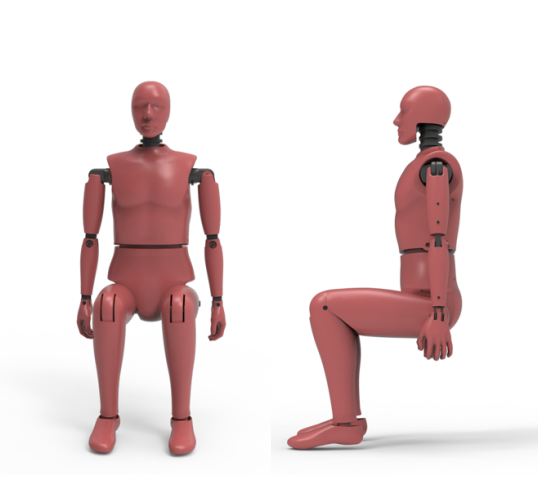
Functions and Applications of EV Battery Vibration and Crash Test Dummies
Electric vehicle (EV) battery vibration test dummies and crash test dummies are two distinct testing tools. They are respectively used to evaluate battery safety under different working conditions and to assess occupant protection performance in vehicle crash scenarios.
EV Battery Vibration Testing
Functions
This test simulates continuous or random vibration conditions caused by road irregularities and real-world driving. It is used to evaluate:
Structural integrity of the battery pack
Reliability of electrical connections
Thermal management stability under dynamic conditions
Applications
Verifying mechanical durability of battery packs under long-term vibration, preventing risks such as internal short circuits, electrolyte leakage, or insulation failure
Supporting vibration table testing during vehicle development
Complying with international standards such as ISO 16750-3 and SAE J2380
Integrating with shock, drop, and thermal cycling tests to form a complete battery abuse testing system, ensuring safety under extreme conditions
Crash Test Dummy for EV Safety
Functions
Crash test dummies simulate the biomechanical response of the human body during vehicle collisions. Equipped with sensors such as accelerometers and force transducers, they record:
Impact forces on the head, chest, and limbs
Acceleration responses
Deformation and load distribution data
Applications
Evaluating occupant protection performance in frontal, side, and rear collision scenarios
Providing safety design references for battery pack placement to ensure no fire, explosion, or electrolyte leakage occurs after impact
Supporting safety rating systems such as C-NCAP, E-NCAP, and C-IASI, particularly in EV battery safety evaluation modules
In conclusion, battery vibration test systems focus on durability and structural reliability, while crash test dummies focus on occupant protection and collision safety assessment. Together, they form a critical part of the electric vehicle safety validation system, ensuring both battery integrity and passenger protection under real-world and extreme conditions.
Industries Applicable to EV Battery Vibration and Crash Test Dummies
Electric vehicle (EV) battery vibration and crash test systems are widely used across the automotive and safety engineering ecosystem. Their primary purpose is to validate the structural safety, electrical integrity, and crashworthiness of battery systems under extreme conditions such as vibration, impact, and collision.
1. Electric Vehicle (EV) OEM Manufacturing
Used by automakers to verify the structural safety and electrical integrity of battery packs under vehicle crash and vibration conditions, ensuring compliance with internal design and safety requirements.
2. Power Battery System R&D and Manufacturing
Applied at the cell, module, and pack levels to conduct abuse testing and mechanical reliability evaluation, supporting the development of safer and more durable battery systems.
3. Automotive Safety and Crash Testing Service Providers
Used to perform full-vehicle and battery-level dynamic and static impact testing in compliance with regulations such as NCAP, ISO, and UN ECE standards.
4. Third-Party Testing and Certification Laboratories
Organizations such as UL and SGS provide battery safety, vibration, and mechanical testing services in accordance with international standards including UN and GB regulations.
5. Automotive Component Suppliers
Applied for validating supporting components such as Battery Management Systems (BMS), high-voltage connectors, and battery trays to ensure system-level compatibility and safety performance.
6. Government and Standardization Bodies
Used in regulatory development and safety standard updates for electric vehicles, including emerging requirements such as battery bottom impact (ball impact) tests and underbody scraping tests in GB standards.
The core purpose of these testing systems is to ensure that EV batteries do not experience fire, explosion, or electrolyte leakage under extreme conditions such as collision, vibration, or underbody impact, thereby guaranteeing occupant safety and regulatory compliance across the entire automotive industry value chain.
Technical Features of EV Battery Vibration and Crash Test Dummies
Technical Features of EV Battery Vibration Testing
Based on UL standards, GB standards, and industry practices, vibration testing of power batteries focuses on structural integrity and electrical safety under dynamic conditions.
Real-road simulation
Uses random vibration spectra (e.g., ISO or GB/T standards)
Simulates real driving conditions such as road irregularities and vehicle dynamics
Multi-axis excitation
Employs a tri-axial vibration system (X/Y/Z directions simultaneously)
Evaluates battery pack response under complex multi-directional loading
Key performance indicators
No mechanical damage (e.g., casing cracks, cell displacement)
No electrolyte leakage
Insulation resistance ≥ 100 Ω/V
Pass insulation withstand voltage test after vibration
Combined environmental stress testing
Often combined with thermal cycling and humidity exposure
Used to validate reliability under extreme environmental conditions
Technical Features of Crash Test Dummies for EV Safety
Modern crash test dummies used in electric vehicle safety evaluation emphasize biomechanical realism and high-precision data acquisition, especially for side-impact scenarios.
High biofidelity structure
Modular design replicating human body mass, stiffness, and damping characteristics
Rib cage constructed with steel elements, covered with foam and rubber to simulate soft tissue behavior
Multi-channel sensing system
Example: WorldSID-50M (50th percentile male dummy)
Equipped with up to 144 sensor channels
Measures:
3D rib deformation
Shoulder forces
Head acceleration
Supports Injury Assessment Metrics (DTI) compliant with ISO and UN-ECE regulations
Application scenarios
Widely used in C-NCAP, Euro-NCAP, and other new car assessment programs
Especially important in side-impact crash testing for EV safety evaluation
Synergy in EV Safety Validation System
Battery vibration testing and crash test dummies serve complementary roles in full-vehicle safety validation.
Complementary functions
Vibration testing evaluates battery structural durability and long-term reliability
Crash dummies assess occupant protection and biomechanical injury risk
Integrated safety scenarios
Underbody impact (scraping or bottom collision tests) evaluates both:
Battery pack resistance to shock/vibration loads
Occupant injury risk using dummy data
Thermal runaway risk prevention
Bottom impacts may trigger:
Separator puncture
Internal short circuit
Thermal runaway chain reaction
Dummy data helps optimize cabin structure to reduce secondary injury risk
EV battery vibration systems ensure battery durability and electrical safety, while crash test dummies provide occupant protection evaluation. Together, they form a critical integrated framework for electric vehicle safety validation, covering both energy system reliability and human injury prevention under extreme conditions.
Structural Composition of EV Battery Vibration and Crash Test Dummies
The structural composition of electric vehicle (EV) battery systems and crash test dummies differs significantly, as they serve entirely different purposes—energy storage safety evaluation and biomechanical injury assessment.
Structural Composition of EV Battery Pack Systems
A typical EV battery pack consists of five core subsystems:
1) Battery Module (Cell Module)
Composed of multiple individual cells connected in series and/or parallel
Serves as the primary energy storage unit
2) Structural Components
Includes enclosure housing, brackets, bolts, and support frames
Provides mechanical protection and structural rigidity
Ensures stability under vibration and crash loads
3) Electrical System
High-voltage busbars
Connectors
Fuses and relays
Responsible for energy transmission and circuit protection
4) Thermal Management System
Liquid cooling plates
Cooling channels
PTC heaters
Maintains optimal operating temperature and prevents thermal runaway
5) Battery Management System (BMS)
Monitors voltage, current, and temperature
Performs cell balancing and safety protection functions
Critical for preventing overcharge, over-discharge, and thermal events
Mechanical Load Requirements in Testing
During vibration and crash testing, battery packs must withstand:
Mechanical shock loads such as 25g / 15 ms half-sine pulse
Compression and impact forces
Without electrolyte leakage, housing rupture, or thermal runaway
Structural Composition of Crash Test Dummies
Crash test dummies are highly engineered biomechanical systems designed to replicate human response under impact conditions.
1) Skeleton System
Steel rib cage structures
Aluminum components for shoulders and limbs
Provides human-like structural stiffness
2) Soft Tissue Simulation Materials
Polyurethane, rubber, and foam composites
Mimic muscle, fat, and skin behavior during impact
3) Joint System
Rubber–foam composite joints
Designed to reproduce human joint damping and resistance characteristics
4) Sensor Network
Equipped with hundreds to thousands of sensors
Measures:
Acceleration
Force
Bending moment
Displacement and deformation
5) Biofidelic Design (Advanced Models)
THOR dummy: Highly advanced anthropomorphic model with spinal disc simulation and <1.5° spine curvature error
SET 50F female dummy: Designed with wider pelvis geometry and reduced joint stiffness for realistic female biomechanics
Dummy Classification by Application
Hybrid III
Standard frontal crash test dummy
Widely used in regulatory compliance testing
SID (Side Impact Dummy)
Designed for side collision evaluation
BioRID
Used for rear-end collision testing
Specifically evaluates whiplash (neck injury) mechanisms
THOR
Most advanced current generation dummy
Supports multi-posture testing and highly accurate biomechanical simulation
EV battery packs are engineered systems focused on energy storage, structural protection, thermal control, and electrical safety, while crash test dummies are advanced biomechanical devices designed to replicate human injury response under collision conditions. Together, they form the foundation of modern electric vehicle safety validation systems.
Importance of EV Battery Vibration Testing and Crash Test Dummies
Although EV battery vibration testing systems and crash test dummies belong to different technical domains, they both play indispensable roles in the electric vehicle safety development framework.
Importance of EV Battery Vibration Testing
Vibration testing is used to simulate the mechanical stresses experienced by electric vehicles during real-world road conditions or operational environments, ensuring the structural and electrical safety of battery systems under dynamic loads.
Ensuring structural reliability
Long-term vibration can lead to:
Cell loosening or displacement
Fatigue failure of connectors and fasteners
Leakage in cooling systems
These issues may ultimately trigger thermal runaway, making vibration testing a critical safety validation step.
Simulating real-world operating conditions
As reported in engineering practice, vibration excitation systems (such as dual electric shakers used in UAV testing) are capable of reproducing complex dynamic environments. These methodologies are also transferable to EV battery testing to ensure realistic evaluation of operational durability.
Regulatory compliance support
Although some standards such as GB do not explicitly define vibration test requirements for all EV scenarios, related mechanical shock and underbody protection tests indirectly cover dynamic load conditions, making vibration testing an essential part of compliance verification.
Importance of Crash Test Dummies
Crash test dummies are essential tools for evaluating occupant protection performance in vehicle collisions and have a significant impact on EV safety design.
Realistic human response simulation
Modern dummies are equipped with advanced sensor systems that measure:
Acceleration
Force and torque
Structural deformation
These data are used to optimize:
Battery pack placement
High-voltage system isolation
Post-crash electrical safety (e.g., preventing leakage or fire)
Inclusive safety design
Crash test dummy models have evolved from representing only adult males to including:
Female dummies
Child dummies
Elderly-specific models
This evolution ensures EV safety design accounts for diverse population groups, especially in the context of increasing elderly drivers worldwide.
Supporting regulatory evolution
Safety assessment programs such as C-NCAP and C-IASI integrate dummy-based biomechanical data into scoring systems, directly driving automakers to enhance crash safety performance, including battery system protection.
Synergistic Role in EV Safety Systems
Together, these two testing systems form a complementary safety framework:
Vibration testing ensures long-term durability and operational reliability of the battery system
Crash test dummies evaluate occupant protection and battery safety during sudden collision events
Integrated safety logic
They collectively establish a “prevention + response” safety chain:
Prevention: ensuring battery stability during daily operation
Response: ensuring passenger and battery safety during accidents
This aligns with the modern evolution of EV safety standards, which are shifting from single-component evaluation to full vehicle system-level validation.
EV battery vibration testing systems and crash test dummies, while serving different engineering purposes, are both essential pillars in the electric vehicle safety validation ecosystem. Their coordinated application ensures both battery reliability during operation and occupant safety during collisions, forming a complete and systematic EV safety assurance framework.We sincerely welcome any inquiries regarding technical specifications, testing standards, operating procedures, or application scenarios. Please feel free to leave a message or contact us directly so we can provide detailed product documentation, demonstration materials, or customized solutions tailored to your needs.
Previous: What is an Automotive Bed Liner Strength Tester?
N e x t : What is the scratch test method?
