





What is the scratch test method?
2026/05/06
Share:

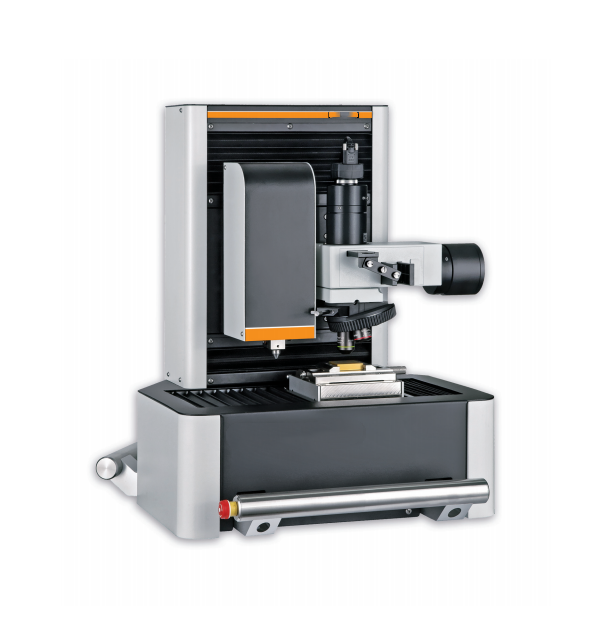
Functions and Applications of the Automatic Scratch Test Machine
Main Functions
Scratch Simulation:
Simulates the scratching process by driving a stylus (such as diamond, tungsten carbide, or steel) across the sample surface under controlled load and speed to produce scratches.
Multi-Path Testing:
Supports multiple preset motion paths, including linear, circular, elliptical, and triangular trajectories.
Real-Time Data Acquisition:
Records parameters such as contact impedance, circuit impedance, scratch patterns, and number of test cycles, and generates PDF or Excel reports with comparative curves.
Multiple Test Modes:
Click Test (load range: 0–10 N, optional weights: 100 g–250 g)
Scratch Test (adjustable speed range: 50–4500 mm/min)
Rolling/Compression Test (0–100 N, optional configuration required)
Pencil Hardness Scratch Test
High-Precision Control:
Positioning accuracy up to 0.05 mm, load resolution as low as 0.01 μN, and depth resolution up to 0.1 nm.
Automated Operation:
Equipped with PLC control and a touchscreen interface, enabling fully automated processes such as scratching, lifting, and multi-point testing.
Main Applications
Consumer Electronics:
Used for click and scratch durability testing of capacitive and resistive touchscreens in devices such as smartphones and tablets.
Material Research and Development:
Evaluates scratch resistance of coatings, thin films, polymers, plastics, rubber, and other materials.
Quality Control:
Verifies surface durability in industries such as automotive interiors, leather, textiles, and printing inks.
Scientific Research and Analysis:
Quantitatively measures coating/film adhesion strength to substrates, critical load, and tribological behavior.
Standards Compliance Testing:
Complies with international and domestic standards such as GB/T, ISO, and ASTM.
Applicable Industries of the Automatic Scratch Test Machine
The Automatic Scratch Test Machine is a precision instrument used to evaluate the scratch resistance of material surfaces. It is widely applied across multiple industries, including the following:
Coatings and Inks Industry:
Used to test the scratch resistance of paint films and coatings, in compliance with standards such as ASTM and ISO.
Plastics and Polymer Industry:
Evaluates the scratch behavior of plastic products, thin films, and polymer coatings.
Automotive Industry:
Applied to assess the scratch resistance of interior materials (such as leather, textiles, and plastic components), in accordance with standards such as PV.
Electronics and Electrical Industry:
Used to test the scratch resistance of surfaces such as smartphone screens, appliance housings, and circuit boards, meeting safety standards like GB and IEC.
Metals and Hard Coatings:
Evaluates the adhesion and scratch resistance of hard coatings such as PECVD TiN and TiC.
Packaging and Printing Industry:
Used to verify the wear resistance and concealment performance of surface coatings on scratch cards, anti-counterfeiting labels, promotional coupons, and similar products.
Research Institutes and University Laboratories:
Serves as a research-grade instrument for fundamental studies in tribology and surface performance of materials.
In addition, some configurations are also suitable for industries such as medical devices, composite materials, and glass products, depending on the instrument setup and applicable testing standards.
Technical Features of the Automatic Scratch Test Machine
The Automatic Scratch Test Machine is an automated device designed to evaluate the scratch resistance of material surfaces. Its technical features can be summarized as follows:
Core Technical Features
Multi-Axis Precision Motion Control
Equipped with high-precision servo motors or pneumatic systems, the instrument enables accurate positioning and movement of the stylus along the X/Y/Z axes. It supports a variety of preset trajectories, including linear, circular, elliptical, and triangular paths.
Programmable Load and Speed Control
Load range typically spans from 0.5 N to 400 N (up to 600 N for certain models);
Speed range is 1–400 mm/s, supporting both progressive and constant load modes;
Loads can be precisely applied באמצעות weights (e.g., 100 g, 200 g, 500 g) or pneumatic cylinders.
Multi-Mode Testing Functions
Supports composite actions such as tapping, linear scratching, rolling, circular scratching, and diagonal scratching;
Enables simultaneous acquisition of data including contact impedance, circuit impedance, scratch patterns, and offset linearity values;
Some models support multi-channel scratching (e.g., generating 6–11 scratches simultaneously) and crosshatch testing.
High-Precision Sensing and Real-Time Data Acquisition
Normal load resolution can reach up to 10 nN (nano-scratch tester level);
Scratch depth resolution of 5 μm, with a maximum depth of 600 μm;
Data sampling rate up to 2000 points per second, allowing real-time recording of friction force, acoustic emission, optical images, and more.
Automation and Intelligent Control
Equipped with an industrial computer or PLC control system, supporting touchscreen operation;
Automatically generates PDF test reports including test time, operator, equipment model, and comparison curves;
Provides secondary development interfaces for easy integration into production lines or customized testing processes.
Environmental and Standards Compatibility
Complies with multiple international standards such as ASTM and ISO;
High-end models feature temperature and humidity control to ensure stable and reliable test results.
Wide Material Applicability
Suitable for testing a broad range of materials, including smartphone screens, coatings, thin films, plastics, rubber, leather, metal coatings, and composite materials.
Working Principle of the Automatic Scratch Test Machine
The Automatic Scratch Test Machine is a precision instrument used to evaluate material surface properties such as coating adhesion, wear resistance, and coefficient of friction. Its working principle is based on applying a controlled scratch to the material surface while continuously monitoring relevant mechanical parameters in real time.
Overview of the Working Principle
Scratch Process Control
A motor drives a stylus (or indenter) to move across the material surface at a preset speed while applying a normal load (either constant or progressively increasing), thereby generating a controlled scratch on the surface.
Real-Time Parameter Monitoring
High-precision sensors are used to continuously measure parameters such as friction force, applied load, and displacement throughout the test process.
Data Analysis and Output
The control system processes the collected data to calculate key surface performance indicators, including the coefficient of friction, critical load (the point at which coating failure occurs), and wear rate.
Operating Procedure of the Automatic Scratch Test Machine
Basic Operating Process
Sample Preparation
Fix the test specimen (such as coatings, plastics, leather, etc.) onto the fixture or testing platform, ensuring the surface is flat and clean;
Confirm the sample thickness (typically 0.5–20 mm) in accordance with standards such as PV, GB, and ISO.
Installation of Stylus and Weights
Install the specified stylus (commonly a 1 mm steel ball);
Apply the required weights or set the normal load according to the test requirements (typically ranging from 50 g to 2500 g, or 1–50 N).
Parameter Settings
Set the following parameters via the touchscreen or software:
Scratch speed: commonly 1 m/min (≈16.7 mm/s) or 40 mm/s; some equipment supports custom speeds;
Scratch length/travel: e.g., 25 mm or 40 mm;
Number of scratches or path type: such as single-direction scratching or crosshatch (two directions required for cross-cut tests);
Environmental conditions (for high-precision equipment): control temperature and humidity to ensure result consistency.
Test Execution
After starting the machine, the stylus moves across the surface under the preset load to complete the scratch;
Most systems support automatic operations such as scratching, stylus lifting, and reset.
Result Evaluation
After testing, evaluate the results using the following methods:
Visual assessment: compare color changes and scratch visibility between scratched and unscratched areas;
Tape adhesion test: apply standard adhesive tape and peel it off to observe coating detachment;
Instrumental measurement: advanced systems can automatically measure scratch width, depth, coefficient of friction, and other parameters.
Cleaning and Shutdown
Clean the stylus and sample stage;
Turn off the power supply.
Importance of the Automatic Scratch Test Machine
The importance of the Automatic Scratch Test Machine is primarily reflected in its critical role in evaluating material surface performance, especially in quality control, R&D validation, and industrial standardization. Its core value can be summarized as follows:
Improved Testing Efficiency and Consistency
Compared with manual scratch testing, automated equipment precisely controls parameters such as stylus speed, applied load, and travel through programmed settings. This ensures identical test conditions for every run, effectively reducing human error and significantly improving the repeatability of results.
High-Precision Quantitative Analysis
By integrating image recognition or optical measurement technologies, the Automatic Scratch Test Machine can accurately measure scratch width, depth, color variation, and coating delamination area. This provides objective data support for evaluating wear resistance, adhesion strength, and other material properties.
Compliance with Multi-Industry Standards
Such equipment widely complies with international standards such as ASTM and ISO, making it suitable for compliance testing of materials including plastics, rubber, coatings, leather, and automotive interior components, thereby facilitating successful certification.
Advancement of Intelligent and Automated Manufacturing
In the context of Industry 4.0. the system can be integrated with PLC control, touchscreen operation, and data upload functions. It supports connectivity with factory MES/ERP systems, enabling real-time monitoring and full traceability of testing data.
Reduction of Long-Term Operating Costs
Although the initial investment may be relatively high, automation reduces manual intervention, shortens testing cycles, and minimizes rework or scrap caused by human error. In the long run, it significantly lowers overall operational costs.
In summary, the Automatic Scratch Test Machine, as an advanced material performance testing device, plays an indispensable role in material science research and new product development. It serves as a core tool for ensuring material performance and product quality, while also driving the transformation of modern manufacturing toward intelligence and automation, and enabling high-precision and high-reliability testing.We sincerely invite professionals, partners, and potential users to share your specific requirements and application scenarios. We also welcome your inquiries or direct contact so that we can provide comprehensive technical documentation, customized solutions, and professional pre-sales support tailored to your needs.
Previous: What is the significance of EV battery vibration and crash test dummies?
N e x t : What is a Shoe Peeling Strength Tester?
