





What is a Shoe Peeling Strength Tester?
2026/05/06
Share:

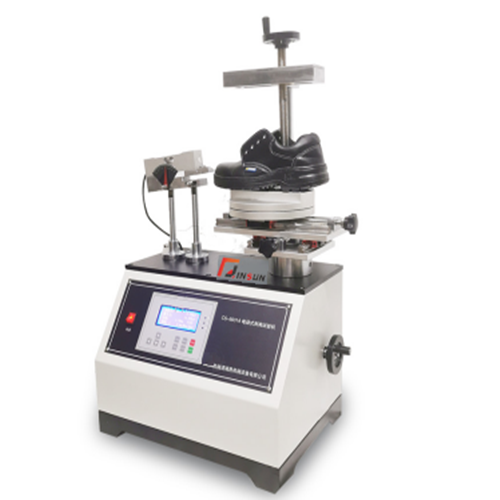
Functions and Applications of the Shoe Peeling Strength Tester
Core Functions
Peel Force Measurement:
The tester peels the shoe upper from the sole at a standard angle (such as 90° or 180°) and a constant speed (typically 20 mm/min), while continuously recording the maximum force, average force, and the force–displacement curve.
Compliance with International Standards:
Conforms to standards such as GB/T, BS, and SATRA, ensuring that test results are comparable and authoritative.
High-Precision Force Measurement:
Equipped with strain gauge sensors or high-precision load cells, offering a resolution as high as 0.01 N and accuracy within ±0.5%.
Adjustable Parameters:
Peel angle (adjustable from 0–20°)
Test speed (20±2 mm/min or selectable from 10–50 mm/min)
Blade width (commonly 10 mm or 22 mm)
Shoe fixture rotation (360° rotation to accommodate different shoe types)
Data Processing and Output:
Features a touchscreen or computer software that automatically calculates peel strength (unit: N/mm), generates reports, and supports data export.
Main Applications
Quality Control:
Used on finished shoe production lines for batch sampling inspection of bonding strength between uppers and soles in products such as leather shoes, sports shoes, and fabric shoes.
R&D Validation:
Evaluates the impact of new adhesives, materials, or processes on bonding performance.
Compliance Testing:
Meets mandatory requirements of domestic and international standards (such as GB/T) for footwear peel strength, especially for export certification.
Failure Analysis:
Analyzes bonding defects (e.g., stick-slip behavior, delamination location) through force–displacement curves, helping to optimize manufacturing processes.
Industries Applicable to the Shoe Peeling Strength Tester
The Shoe Peeling Strength Tester is primarily used to measure the bonding strength between the outsole and upper (or between the outsole and midsole) of footwear. Its application scope is highly specialized and focused on the footwear testing and quality assurance sectors. The main industries are as follows:
Footwear Manufacturing Industry:
Suitable for finished shoes produced through molding, vulcanizing, injection molding, casting, and adhesive bonding processes. It is used to test the peel strength between the sole and upper to ensure bonding quality meets required standards.
Sports and Casual Footwear Manufacturing:
Applied in quality control of everyday footwear such as sports shoes, casual shoes, canvas shoes, and leather shoes.
Professional Footwear R&D and Testing:
Used for specialized athletic footwear such as ice skates, football shoes, basketball shoes, etc., performing mechanical performance testing in accordance with standards such as GB/T series specifications.
Third-Party Testing Laboratories:
Used for quality supervision, certification testing, and compliance evaluation of footwear products.
Shoe Material and Adhesive Suppliers:
Assists in the development and validation of shoe adhesives and composite materials by evaluating bonding performance.
In summary, the Shoe Peeling Strength Tester is mainly applied in the footwear manufacturing and quality inspection sectors, focusing on quantitative evaluation and quality control of bonding strength in finished shoes.
Technical Features of the Shoe Peeling Strength Tester
The Shoe Peeling Strength Tester is a professional testing instrument used to measure the peel strength at the bonding interface between the outsole and upper of finished footwear. It is widely applied in quality control within the footwear manufacturing industry.
Main Technical Features
Peel Blade Width:
Common specifications are (20±0.2) mm or (10±0.2) mm. High-precision models can achieve (20±0.1) mm and (10±0.05) mm accuracy.
Blade Travel Speed:
Standard speed is 20±2 mm/min. Some models support adjustable upward/downward speed control.
Maximum Peel Force Capacity:
Typically 100 kg (approximately 980 N). Certain models such as the XK-3066 can reach up to 500 N or higher depending on configuration.
Force Accuracy:
Most models offer ±1% accuracy, while high-end versions can reach ±0.5% or even ±0.1%.
Displacement Resolution:
High-precision systems can achieve a resolution of 0.001 mm.
Display System:
Equipped with LCD screens, U20 controllers, or digital force meters. Some models support real-time force–displacement curve display.
Power Supply:
Generally AC 220V, 50Hz.
Functional and Structural Features
Clamping System:
Features a 360° rotatable shoe fixture, allowing testing at different positions such as toe, side, and heel.
Position Adjustment:
The distance between the positioning rod and pulling rod can be adjusted within 50–70 mm to accommodate different shoe types.
Automatic Control:
High-end models use microcomputer control with PVC operation panels, membrane keypads, and power-off memory function.
Low-Noise Operation:
Some models are designed for quiet operation during friction and testing processes.
Safety Protection:
Includes overload protection and limit protection. Hot-seal peel testing models may also feature anti-scald (heat protection) design.
Working Principle of the Shoe Peeling Strength Tester
The Shoe Peeling Strength Tester determines the adhesive strength of footwear by simulating the peeling force experienced between the outsole and upper (or adhesive layer) during actual use. Its core working principle is as follows:
Clamping and Peeling:
The shoe specimen is fixed in a fixture, and the peeling area between the outsole and upper is securely clamped by the grips.
Constant-Speed Tensile Loading:
A driving mechanism (such as a servo motor or mechanical loading system) applies a constant pulling speed (typically 20 mm/min), peeling the upper or sole at a specified angle (such as 90° or 180°).
Force Acquisition:
During the peeling process, a force sensor mounted on the moving clamp continuously measures changes in peeling force. The sensor converts mechanical deformation into a millivolt-level electrical signal via a strain gauge bridge circuit, which is then converted into a readable force value through an A/D (analog-to-digital) converter.
Data Output:
The instrument automatically records and calculates the maximum force or average peeling strength during the test. The results are directly displayed in Newtons (N) without the need for additional conversion.
Operating Procedure of the Shoe Peeling Strength Tester
1. Pre-Test Preparation
Environmental Conditioning:
Place the test specimens in a standard temperature and humidity environment (typically 23±2°C and 50±5% RH) for at least 24 hours.
Specimen Preparation:
Cut a strip of specified width (e.g., 10 mm or 20 mm) from the finished shoe, ensuring the adhesive interface is included;
Alternatively, use the whole shoe with a shoe last installed for fixation if required.
Initial Peel Opening:
Use a cutting tool to create an initial peeling section of approximately 20–30 mm at the bonded area.
Equipment Calibration:
Confirm that the force sensor is calibrated, fixtures are clean, and limit switches are functioning properly.
2. Installation and Parameter Setup
Specimen Clamping:
Fix the unpeeled end in the upper grip and the peeled layer in the lower grip, ensuring the peeling angle meets the standard requirement (typically 90° or 180°).
Parameter Configuration:
Peeling speed: Usually set to 20 mm/min (commonly used in national standards) or 100±10 mm/min; some universal testing machines use 6 mm/min.
Peeling angle: Select 90° or 180° depending on the testing standard.
Force zeroing: Reset the force measurement system before starting the test.
3. Test Execution
Start the machine to perform constant-speed peeling while automatically recording the force–displacement curve.
Continue the test until a valid peeling length is reached (typically at least 70 mm).
Observe and record any abnormal phenomena during testing, such as adhesive failure or material tearing.
4. Data Recording and Analysis
Record the peak force and average peeling force (usually calculated from the stable peeling section).
Calculate peeling strength using the formula based on force and blade width (unit: N/mm or N/10 mm).
Test multiple specimens from the same sample and take the average value as the final result.
5. Shutdown and Maintenance
After testing, return the machine to its initial position and turn off the power supply.
Clean the fixtures and cutting blades, and regularly calibrate the force sensor to ensure measurement accuracy.
Importance of the Shoe Peeling Strength Tester
The importance of the Shoe Peeling Strength Tester is mainly reflected in its critical role in ensuring footwear safety, durability, and quality control.
1. Ensuring Consumer Safety and Product Durability
Preventing delamination accidents:
Sole separation is one of the most common quality issues in footwear. Poor bonding may cause sudden outsole detachment during walking or sports, potentially leading to slips, falls, or injuries.
Improving wearing experience:
Peel strength directly reflects the bonding strength between the upper and outsole, which significantly affects the service life and comfort of the shoe.
2. Supporting Quality Control and Process Optimization in Manufacturing
Full-process quality monitoring:
The test is applied throughout the entire production chain—from raw material inspection, in-process control, to final product testing—serving as a key “quality safeguard” for manufacturers.
Guiding material and process selection:
Quantitative peel strength data helps optimize adhesive formulations, material compatibility, and bonding processes.
3. Meeting Regulatory and Market Access Requirements
Compliance with mandatory standards:
Many national and international standards (such as GB/T, SATRA, BS, etc.) require peel strength testing as a compulsory inspection item.
Overcoming trade barriers:
Exported products often require third-party test reports to meet the technical regulations of importing countries.
4. Driving Industry Upgrading and Standardization
Promoting equipment standardization:
Industry standards such as T/GDBX 016-2019 Footwear Peel Testing Machine Technical Specifications define requirements for accuracy and testing methods, improving consistency in testing results.
Supporting R&D innovation:
In the development of new footwear types (such as sports shoes, children’s shoes, and safety shoes), peel strength data serves as a key reference for structural reliability validation.
In summary, the Shoe Peeling Strength Tester is far more than a routine quality inspection instrument in footwear manufacturing. It is a critical technical tool that ensures product safety, enhances brand reputation, and supports companies in expanding into both domestic and international markets.By accurately measuring bonding strength, it effectively prevents safety risks caused by poor adhesion and helps safeguard consumer safety at the source. At the same time, stable product quality strengthens brand trust and competitiveness in the global market.We welcome industry partners, potential clients, and interested readers to leave messages or contact us directly for more detailed technical information, application solutions, and professional support tailored to your needs.
Previous: What is the scratch test method?
N e x t : FAQs About Heat Extension Tester
