





What is a scratch test for coatings?
2026/09/15
Share:

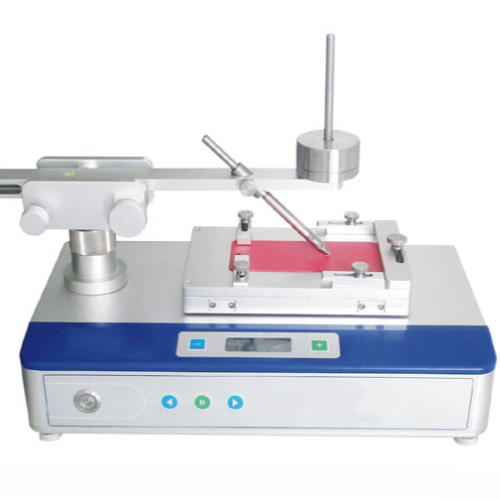
Core Purpose: Quantifying the “Damage Resistance” of Coatings
The primary purpose of a Coating Scratch Resistance Tester is to simulate friction and scratching behavior under actual service conditions and scientifically evaluate the coating’s resistance to scratching, hardness, and adhesion through standardized testing procedures. Its specific application value can be demonstrated in the following areas:
Evaluating Abrasion Resistance and Service Life
The instrument applies controlled pressure and a specified number of friction cycles to simulate the wear that coatings experience during prolonged contact and use. For example, in the printing industry, it can be used to evaluate the abrasion resistance of ink layers, helping prevent printed graphics and text from becoming blurred or detached due to friction. In the electronics industry, it can be used to evaluate the abrasion life of buttons and painted or coated housing surfaces, ensuring that products maintain a good appearance even after frequent use.
Determining Coating Hardness and Scratch Resistance
Some high-precision testers use a diamond indenter or a scratching stylus with a specified hardness to move across the coating surface under a constant or progressively increasing load. By observing whether visible scratches, peeling, or coating failure occurs, the hardness level and critical scratch resistance of the coating can be evaluated. This is particularly important for optical coatings on eyeglass lenses, camera lenses, and other optical components, as coating durability directly affects the user experience.
Evaluating Coating Adhesion
Scratch resistance is often closely related to the bonding strength between the coating and the substrate. Through cross-cut or unidirectional scratch testing, the instrument can evaluate whether the coating delaminates or peels when subjected to mechanical stress. The results can therefore provide an indication of coating-process quality and help manufacturers optimize surface pretreatment and curing parameters.
Supporting Research and Development and Quality Control
During the development of new materials, the tester provides quantitative data for formulation optimization, helping engineers balance coating flexibility, hardness, and abrasion resistance. On production lines, it serves as an important quality-control tool to ensure that each batch of products meets applicable domestic and international standards, thereby helping reduce customer complaints and after-sales issues.
Wide Range of Applications of the Coating Scratch Resistance Tester
The Coating Scratch Resistance Tester has a wide range of applications, covering almost every industry involving surface coatings and finishes:
Automotive Industry:
Used to evaluate the scratch resistance of automotive clear coats, dashboards, center consoles, and interior door panels, helping ensure that vehicles maintain their appearance throughout long-term use.
Consumer Electronics:
Used to assess the ability of smartphone screen covers, laptop housings, headphone coatings, and other coated surfaces to resist scratches caused by hard objects such as keys and coins during daily carrying and use.
Building and Interior Decoration:
Used to evaluate the scrub resistance and abrasion resistance of interior wall emulsion paints, wood coatings, and wear-resistant flooring layers, helping ensure long-term durability of interior finishes.
Optical Industry:
Used to evaluate the abrasion resistance of anti-reflective coatings and hard coatings applied to eyeglass lenses, camera lenses, display panels, and other optical components, helping ensure that optical clarity is not compromised by surface wear.
Packaging and Printing Industry:
Used to evaluate the rub resistance of food packaging films, printed labels, and ink layers, helping prevent printed patterns and text from becoming blurred or detached during handling and transportation.
Core Advantages of the Coating Scratch Resistance Tester
The core advantage of the Coating Scratch Resistance Tester is its ability to accurately quantify a coating’s resistance to scratching and abrasion while evaluating the bonding strength between the coating and its substrate. It provides reliable and objective data for product development and quality control.
The main advantages of this type of instrument include the following:
Accurate Testing and Reliable Data
Precise Load Control:
The tester applies force precisely through a lever-and-weight system or a servo motor. The load can be adjusted and maintained consistently, while some high-end models offer measurement resolutions down to the micro-Newton level, ensuring excellent test repeatability.
Objective Failure Determination:
The moment a coating is penetrated can be identified through electrical circuit conduction, acoustic emission signals, or sudden changes in friction force. This minimizes errors associated with visual judgment and makes the test results more objective.
Comprehensive Functions and Compatibility with Multiple Standards
Multiple Testing Modes:
The tester can support constant-load testing for qualitative comparisons of scratch resistance, progressive-load testing for determining the critical load at which coating failure occurs and quantitatively evaluating adhesion, as well as cyclic scratch testing to meet different testing requirements.
Compliance with International and National Standards:
The testing methods and results can be compared with various applicable domestic and international standards, providing broad applicability and supporting authoritative test reports.
Wide Application Range and High Practical Value
Suitable for Various Materials:
The tester can be used to evaluate automotive paint films, appliance housing coatings, furniture wood coatings, plastic coatings, decorative layers on engineered wood panels, and many other coated surfaces.
Supporting R&D and Quality Control:
The instrument can not only determine whether a coating meets the required specifications but also help improve coating formulations and optimize production processes by analyzing scratch morphology and critical loads. It is therefore an important tool for both material research and production-line quality inspection.
Overall, the Coating Scratch Resistance Tester is more than a precision laboratory instrument; it serves as a bridge between product development and market quality. Through objective and quantitative data, it transforms the abstract concept of “durability” into measurable technical indicators, helping manufacturers improve product competitiveness while providing consumers with a longer-lasting and more aesthetically pleasing user experience.With the continued advancement of materials science, intelligent and automated scratch-resistance testing technologies will continue to evolve, providing increasingly accurate solutions for the field of surface engineering.
Previous: What is environmental stress cracking resistance?
N e x t : the last page
