





What is the purpose of a helmet tensile tester?
2026/09/17
Share:

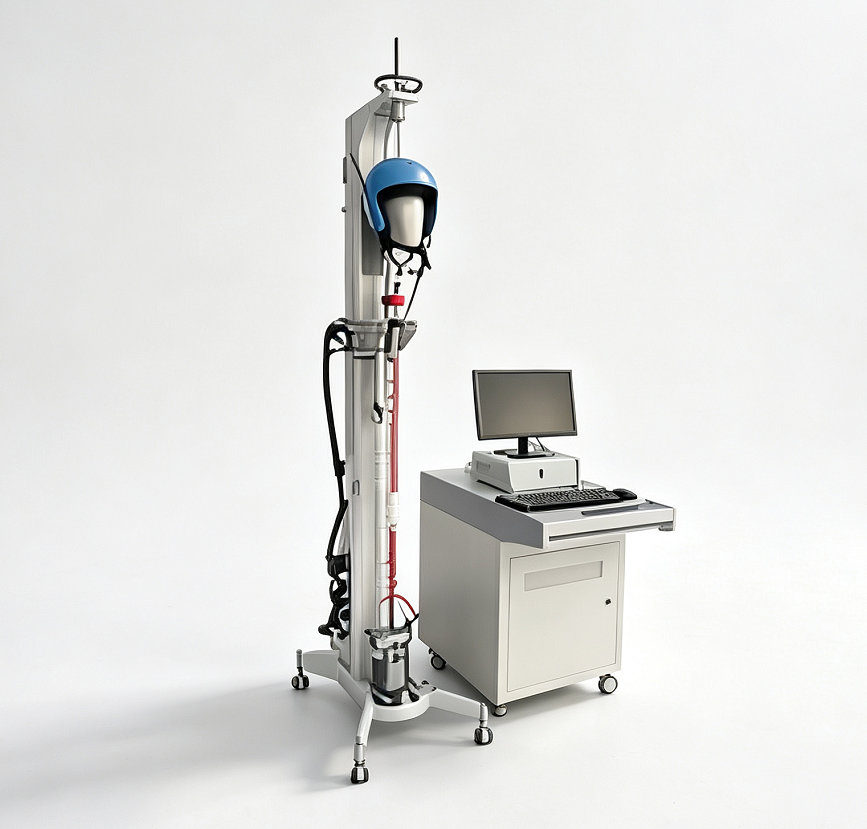
Structure of the Helmet Chin Strap Tensile Testing Machine
1. Integrated Rigid Steel Frame
The entire machine adopts an integrated square-steel frame with high rigidity, ensuring no deformation during long-term tensile testing. A servo motor is combined with a precision ball screw to convert rotary motion into linear displacement of the lower fixture. With minimal transmission backlash and smooth speed adjustment, the system ensures a stable and controllable tensile rate, providing the core hardware for uniform-speed loading.
2. Specialized Fixtures
The machine is equipped with two types of specialized fixtures: an arc-shaped anti-slip webbing fixture and a dedicated buckle positioning fixture. The arc-shaped webbing fixture increases the clamping friction on the strap to prevent slipping during tensile testing. The buckle positioning fixture is designed to accommodate various shapes of side-release buckles, adjustment buckles, and other fastening components. It precisely secures the buckle assembly and ensures that the loading point and force application position are consistent with actual installation and use conditions, preventing test deviations caused by improper fixture positioning.
3. High-Precision Force and Displacement Measurement System
The measurement system consists of a high-precision load cell and a displacement encoder, which are respectively installed on the upper crossbeam and the movable platform. The system collects force and displacement data in real time and transmits the signals to the main control system, providing a critical guarantee for accurate and reliable test results.
4. PLC Control and Safety Protection System
The machine is equipped with a touchscreen and PLC-based control program, with commonly used national-standard test parameters and quick-test programs built in. Standardized tests can be performed by simply selecting the corresponding program. The system can store more than 10.000 sets of test data and supports data export and report printing, meeting the requirements of quality-system audits and certification report preparation.
For operational safety, the equipment is equipped with upper and lower travel limit switches, an emergency stop button, and a protective shield against specimen fragments in the event of breakage. When an abnormal condition occurs, the machine can stop immediately, helping protect both the equipment and operators.
Applications of the Helmet Chin Strap Tensile Testing Machine
1. Quality Control in Helmet Manufacturing
During the incoming inspection of webbing and buckle materials, manufacturers can conduct batch sampling tests to evaluate the tensile performance of these components and reject raw materials that fail to meet the required strength specifications, thereby controlling product defects at the source. After semi-finished processing, tensile tests can be performed on stitching points to optimize stitch spacing and sewing techniques. Before finished helmets leave the factory, the complete chin strap assembly can undergo tensile testing to ensure that the finished product complies with applicable national standards before shipment. This can significantly reduce the risk of strap breakage and related safety incidents during actual use while lowering the risk of after-sales compensation.
2. Product Research and Development
R&D personnel can use the testing machine to compare the tensile performance of nylon webbing made from different materials and buckles made from modified plastics, optimizing strap thickness, weaving density, and buckle structural design. By testing the joint strength achieved with different sewing processes, manufacturers can identify the optimal stitching method. This enables the required tensile strength specifications to be met while controlling production costs and shortening the development and finalization cycle of new products.
3. Incoming Inspection by Vehicle Manufacturers
Vehicle manufacturers can implement an incoming inspection system for supporting helmets. In accordance with applicable national standards, samples can be selected for chin strap tensile and load-retention tests. Only helmet products that pass the required tests can be included in the approved procurement list. This helps standardize the quality of components throughout the supply chain and ensure the safety of helmets supplied with finished vehicles.
4. Market Supervision and Quality Inspection
Market supervision authorities and fire safety quality inspection departments can conduct special helmet inspections in the circulation market. Samples of helmets currently on sale can be randomly purchased and subjected to chin strap tensile testing to identify substandard helmets and products without proper manufacturer or quality information. Products whose strap strength fails to meet the applicable requirements can be removed from sale and required to undergo corrective action in accordance with relevant regulations. These inspections help improve the quality of helmet products in the domestic market and protect the safety of riders and passengers.
5. Failure Analysis and Material Research
In response to helmet detachment incidents in traffic accidents, manufacturers can take samples of chin straps from the same production batch and reproduce tensile tests to accurately identify the cause of failure, whether it is related to raw material defects, process deficiencies, or unreasonable structural design, and then implement targeted corrective measures and design improvements. Research institutes can also use large volumes of test data to conduct research into new chin strap materials, contributing to the improvement and upgrading of helmet safety standards.
Advantages of the Helmet Chin Strap Tensile Testing Machine
The greatest advantage of the Helmet Chin Strap Tensile Testing Machine is that it transforms the helmet chin strap, a seemingly small but safety-critical component, into a quantifiable and repeatable testing parameter, allowing non-conforming products to be identified and eliminated at the source.
Core Advantages
1. Accurate Quantification of Strap Strength
Equipped with a high-precision force sensor and displacement measurement system, the machine can accurately determine key performance parameters such as the maximum tensile force before strap breakage, elongation, and buckle fastening strength. This provides objective test data instead of relying on subjective assessment by hand or visual inspection.
2. Simulation of Real-World Loading Conditions
The equipment can perform static loading tests to simulate continuous pulling forces, as well as dynamic impact tests to simulate the instantaneous forces generated during collisions. These testing methods provide a closer representation of potentially hazardous conditions encountered during actual use.
3. Automatic Data Recording and Analysis
The system can automatically record and calculate parameters such as maximum force, elongation, and yield strength, while also generating stress-strain curves and test reports. This facilitates quality traceability, test-result management, and production process improvement.
4. Simple Operation and High Testing Efficiency
Most machines are equipped with computer or touchscreen control systems, allowing tests to be started with a simple operation. After testing is completed, the machine can automatically return to its initial position. With basic training, ordinary production personnel can operate the equipment efficiently without relying heavily on experienced technicians.
5. Wide Range of Applicable Standards
The testing machine can be configured to perform tests according to various applicable national and international standards. This allows helmets intended for different markets and regions to be evaluated using the same testing equipment, improving testing flexibility and efficiency.
Conclusion
Overall, the Helmet Chin Strap Tensile Testing Machine plays an important role in improving helmet safety and serves as an essential testing tool for protecting the safety of riders and passengers while enhancing helmet product quality. Accurate evaluation of the tensile performance of chin straps can help identify potential safety risks associated with strap breakage or loosening, ensuring that the helmet can provide effective protection when it matters most.For more information about the Helmet Chin Strap Tensile Testing Machine and our other testing equipment, please feel free to contact us directly.
Previous: Automated Cleanliness Analysis System: From Particle Extraction to AI Analysis
N e x t : the last page
