





How Does a Helmet Xenon Aging Tester Evaluate Helmet Weathering Resistance?
2026/09/20
Share:

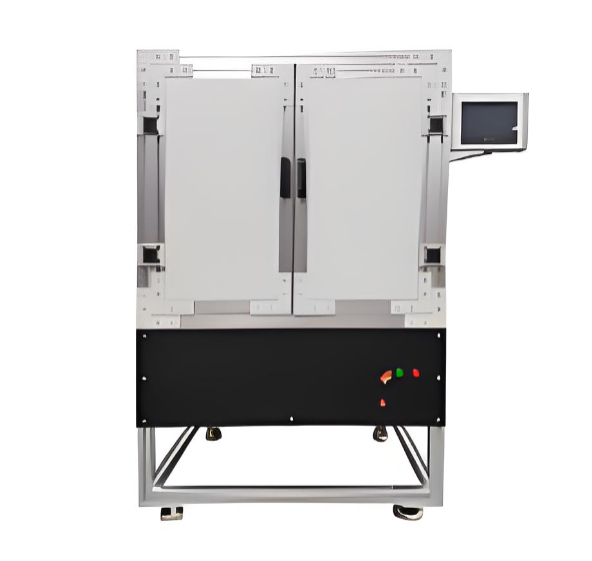
Working Principle of the Helmet Xenon Arc Aging Tester
The Helmet Xenon Arc Aging Tester operates based on the coupling of photochemical reactions and environmental stresses. Its core component is a xenon arc lamp, which emits full-spectrum light covering ultraviolet (UV), visible, and infrared (IR) wavelengths, with a spectral distribution that closely resembles natural sunlight. By incorporating a specific filter system, such as daylight filters or window glass filters, the equipment can precisely tailor the spectrum to simulate lighting conditions in different geographical regions or sunlight transmitted through glass.
In addition to light exposure, the equipment integrates temperature and humidity control systems, as well as a spray system. It can simulate intense daytime sunlight exposure, nighttime darkness and condensation, and the washing effects of rainfall. By programming the cycling periods of light exposure, temperature, humidity, and water spraying, the tester can reproduce, within days or weeks, aging processes that helmets may experience over months or even years of outdoor exposure.
This accelerated aging technology enables manufacturers to identify material defects in advance and optimize formulation and product design, helping improve the weathering resistance and long-term durability of helmets.
Key Technical Features of the Helmet Xenon Arc Aging Tester
Designed specifically for helmet testing, the dedicated Xenon Arc Aging Tester offers the following key technical features:
1. Precise Spectral Control
The tester uses a high-purity xenon lamp as its light source, combined with daylight or window glass filters to precisely control irradiance at critical wavelengths, such as 340 nm or 420 nm. This helps ensure that test data complies with applicable international and national standards.
2. Intelligent Environmental Control
The equipment features a built-in microcomputer control system that allows independent adjustment of the black panel temperature (BPT) or black standard temperature (BST), typically within a range from ambient temperature +10°C to 80°C, along with precise relative humidity control. Advanced "Solar Eye" irradiance control systems can monitor irradiance in real time and automatically compensate for light intensity attenuation caused by lamp aging, ensuring consistent testing conditions.
3. Dedicated Specimen Fixture Design
Taking into account the irregular shape of helmets, dedicated testers are typically equipped with height-adjustable supports or rotating specimen holders to ensure uniform light exposure across different areas of the helmet surface. Some models support simultaneous testing of multiple helmets, improving testing efficiency.
4. Multiple Safety Protection Features
The equipment is equipped with over-temperature protection, leakage protection, low-water alarms, and emergency stop functions to ensure laboratory safety during extended operation.
Applications and Value
The Helmet Xenon Arc Aging Tester is widely used in the production and research and development of various types of sports protective equipment, including bicycle helmets, motorcycle helmets, ski helmets, and roller skating helmets.
For R&D Departments: By comparing the performance differences of various material formulations after accelerated aging, the tester helps identify new materials with superior weathering resistance and shorten product development cycles.
For Quality Control Departments: As a reliability verification tool before product shipment, the equipment supports batch sampling inspections and helps prevent potential product recall risks caused by insufficient material weathering resistance.
For Third-Party Testing Organizations: It provides scientific and impartial weathering resistance evaluation reports, offering data support for market supervision and consumer purchasing decisions.
Technological Trends: Smarter, More Precise, and More Durable
AI and Digital Twins: Testing equipment is evolving beyond simply running preset cycles. Through AI-based adaptive algorithms, future systems may automatically match light exposure, temperature, humidity, and spray parameters according to material characteristics and testing objectives. Combined with digital twin technology, these developments may enable the prediction of material performance throughout its entire life cycle, rather than simply providing a "pass or fail" result.
Data Traceability and Reproducibility: The industry is moving from qualitative pass/fail evaluations toward quantitative, traceable testing. Some leading manufacturers claim equipment reproducibility rates of over 98%. Key performance indicators, such as spectral deviation, irradiance uniformity, black standard temperature fluctuations, and spectral attenuation rates over 1.000 hours, are expected to become standard considerations. Testing equipment should be capable of providing complete closed-loop calibration logs.
More Realistic Spectral Simulation: The spectral coverage of xenon arc light sources is expected to extend from 280–800 nm or even beyond, with spectral matching to the AM1.5 standard solar spectrum potentially exceeding 95%. Dynamic filter systems may help maintain spectral deviations within 3% over extended periods, reducing the risk of inaccurate aging mechanisms.
Combined Environmental Simulation: Single-factor light exposure testing is no longer sufficient for all testing objectives. Equipment capable of simultaneously simulating combined light–heat–humidity or even light–heat–chemical environments is expected to become increasingly common, providing a more realistic representation of material aging under extreme outdoor conditions.
Improved Hardware Durability: Lamp service life is expected to increase to more than 2.000 hours, while high-performance models with a spectral attenuation rate of ≤5% over 1.000 hours may help reduce the costs and testing interruptions associated with frequent lamp replacement.
Conclusion
The Helmet Xenon Arc Aging Tester is not merely a testing tool for materials science; it also plays an important role in supporting the safety of protective equipment. Through high-precision environmental simulation, it compresses the destructive effects of time into a controlled laboratory environment, helping manufacturers develop high-quality helmets capable of withstanding challenging weather conditions.As intelligent technologies continue to advance, future testing systems are expected to integrate AI-based adaptive algorithms and data traceability functions more extensively, providing stronger technical support for improving the quality and reliability of sports protective equipment.
Previous: What is the purpose of the aluminium foil test?
N e x t : the last page
