





Why Does Perforated Leather Start to Fuzz After Just Six Months of Use?
2026/09/29
Share:

The Most Vulnerable Part of Perforated Leather Is the Hole Itself
As perforated leather is increasingly used in automotive seats, steering wheels, and door panels to improve breathability, a critical weakness has also become more apparent. The punching process directly exposes the fiber cross-sections around each perforation. On an intact leather surface, the fibers are protected beneath the finishing layer. Around the edge of a perforation, however, the fibers are essentially exposed, with their ends facing outward and susceptible to being pulled and turned outward under repeated friction.
This creates a very typical failure scenario: the entire leather surface may pass a conventional abrasion-resistance test, yet after six months of use in a vehicle, a ring of fuzzing may begin to appear around the perforations. Because this defect is both visible and tactile to users, it can quickly lead to customer complaints.
More importantly, this type of failure is difficult to detect in advance using conventional abrasion-testing equipment. Martindale and Taber abrasion tests primarily evaluate wear on relatively flat surfaces and do not adequately reproduce friction against the inner walls and edges of perforations. A dedicated reciprocating friction test for perforated leather is therefore needed to expose this potential failure mode under controlled laboratory conditions.
What Exactly Does TIS 01208-00F21 Test
Toyota's TIS 01208-00F21 specification is not primarily concerned with whether the leather has been worn through. Instead, it focuses on surface fuzzing and changes in the appearance of the fibers or nap.
The testing concept is straightforward: the leather specimen is securely mounted flat on a polished stainless-steel plate. A specified load is applied using a prescribed pressure plate, and a nylon brush or specified abrasive is moved back and forth across the specimen surface. Under the specified speed and number of cycles, the repeated friction causes the surface fibers to become raised and fuzzy. After testing, the specimen is evaluated under specified lighting conditions by comparing it with standard reference specimens, and the degree of fuzzing is then rated.
The key distinction lies in what the test evaluates: it assesses changes in appearance rather than material mass loss. This is fundamentally different from the Taber abrasion test, which evaluates wear through mass loss, and the Martindale test, which is commonly used to evaluate abrasion leading to visible damage or fabric breakdown. These represent three different evaluation approaches.
Therefore, a conventional rotary abrasion tester should not simply be expected to replace a test conducted according to this specification. If the test parameters and friction mechanism do not correspond to the specified method, the resulting data will not necessarily be directly comparable.
How Is a Test Completed
Step 1: Prepare the Specimen
Cut the leather specimens according to the requirements of the specification. Avoid areas with creases, surface damage, defects, or irregularly positioned perforations.
Step 2: Mount the Specimen
Secure the specimen flat onto the polished stainless-steel plate using double-sided adhesive tape. Although this step appears simple, it can be a major source of measurement variation. Misalignment, wrinkles, or lifted edges can result in uneven frictional loading during the test.
Step 3: Install the Pressure Plate
Install the aluminum-alloy pressure plate and confirm that its position and applied load comply with the specified requirements. The pressure plate can be removed for convenient specimen mounting and for periodic verification of its weight.
Step 4: Set the Test Parameters
Set the reciprocating speed and target number of cycles according to the applicable specification.
Step 5: Start the Test
Start the instrument and observe whether the reciprocating motion remains smooth and stable. Confirm that there is no abnormal vibration, lateral movement, or displacement.
Step 6: Automatic Stop
Once the preset number of cycles has been completed, the instrument automatically stops, eliminating the need for manual cycle counting or continuous operator supervision.
Step 7: Grade and Record the Results
Remove the specimen and compare it with the standard reference specimens under the specified lighting conditions. Evaluate and record the surface fuzzing grade and other required test data.
Three Frequently Asked Questions
Can it only be used to test perforated leather?
The tester is primarily designed for perforated leather, but it can also be used for evaluating similar surface fuzzing and napping tendencies, including surface changes in suede leather, microfiber synthetic leather, and textile fabrics.
What is the relationship between this tester and Martindale and Taber abrasion testers?
The three instruments use different evaluation approaches and are not interchangeable. The Martindale test evaluates textile abrasion and pilling, while the Taber test focuses on mass loss and abrasion characteristics. This tester is designed to evaluate surface fuzzing of perforated leather. For comprehensive automotive interior-material testing, laboratories will typically use different instruments for different performance requirements.
Are standard reference specimens required?
Yes. The grading process relies on comparison with standard reference specimens under specified lighting conditions. When selecting the equipment, it is recommended to confirm the availability and configuration of the required reference specimens and lighting conditions.
The Technical Specifications Behind the Tester
In terms of standards, the instrument is designed and manufactured in accordance with Toyota TIS 01208-00F21. “Test Method for Abrasion and Fuzzing of Perforated Leather,” and is intended to meet the testing requirements specified for automotive interior materials under this method. As supplementary references for establishing a laboratory testing system, commonly used standards in the field of leather and textile abrasion testing include ISO 12947. ISO 17704. GB/T 21196. and GB/T 13775.
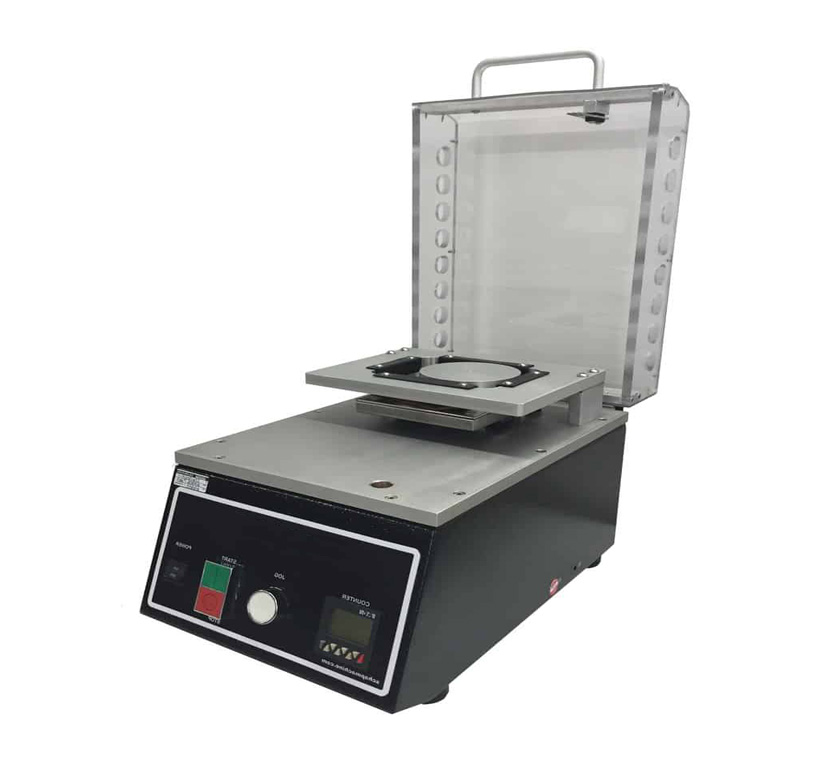
In terms of configuration, the tester features a single-station reciprocating friction mechanism with a 20 mm stroke and an adjustable speed of 70 CPM. The specimen is subjected to a 0.5 kg load, applied through a removable 95 mm-diameter aluminum-alloy pressure plate, allowing the load to be conveniently verified when required.
The specimen platform is made of polished stainless steel, and the specimen is secured using double-sided adhesive tape. An overhead pressure-plate retaining structure helps maintain the pressure plate in position, making specimen mounting and positioning convenient and efficient.
A programmable cycle counter is used for counting the reciprocating cycles, and the instrument automatically stops when the preset number of cycles is reached. The entire tester is constructed from precision aluminum-alloy and stainless-steel components, with surfaces treated by powder coating and anodizing. Its compact structure makes it suitable for laboratory bench-top installation.
Industry Value and Future Outlook
In a highly competitive market, small details can determine the overall quality and user experience of a product. The Leather Perforation Abrasion Tester is more than just a testing instrument; it can serve as an important technical tool for automotive brands seeking to maintain interior quality and protect the user experience.
By helping manufacturers control material quality at the source, the tester supports efforts to extend the service life of automotive interior components and reduce potential after-sales maintenance and replacement costs.
As new material technologies continue to emerge, including microfiber synthetic leather and more environmentally oriented leather alternatives, higher requirements are being placed on the accuracy, flexibility, and adaptability of testing equipment. In the future, more intelligent and highly automated abrasion-testing systems are expected to become increasingly important, further supporting the automotive interior industry in improving product quality and pursuing more sustainable development.
Previous: Why Is an In-situ Expansion Analysis System Important for Material Research?
N e x t : the last page
