





What Does a Catheter Vacuum Leak Tester Actually Test?
2026/09/29
Share:

A Catheter Leak Is Not Just an Air Leak—It Is a Clinical Safety Issue
For most people, the immediate reaction to a “leak” is simply that the product has a defect. However, when it comes to medical catheters, the implications are very different.
If a suction catheter leaks air, the required negative pressure may not be established properly, preventing secretions from being effectively aspirated. If a drainage catheter or drainage tube leaks, drainage performance may be compromised, potentially leaving fluid inadequately drained. If an endotracheal tube or anesthesia catheter leaks, the actual ventilation volume and delivered medication or anesthetic concentration may deviate from the intended levels. These are not merely issues of product performance or user experience; they can represent genuine clinical safety risks.
What makes these leaks even more challenging is that they are often difficult to detect using conventional methods. Tiny leakage points may show no obvious signs under normal atmospheric pressure. After assembly, the leakage point may also be enclosed within the tubing system or connectors, making visual inspection and manual checking unreliable.
In the early stages, some manufacturers have relied on informal methods—for example, using a syringe to create negative pressure and visually checking for bubbles or pressure changes. Such approaches generally lack quantitative data recording, repeatability, and batch-level traceability. During quality-system assessments, regulatory submissions, or registration testing, these informal methods may therefore be insufficient when a validated and standardized test method is required.
What Exactly Does a Vacuum Leakage Test Measure
Taking the “resistance to suction or vacuum leakage” method described in Appendix D of GB/T 15812.1 as an example, the basic approach is as follows: the test specimen is connected according to the manufacturer's intended method of use and filled with water. It is then connected to a negative-pressure source and measuring instruments. A specified negative pressure is applied and the system is allowed to stabilize. During the specified holding period, the entire assembly is inspected for leakage. The acceptance criteria are based on whether air bubbles or water droplets appear. The specific test pressure is generally specified separately in the applicable product standard.
Another commonly used approach is the residual vacuum method, which is often applied to products such as suction catheters. Under a specified flow condition, a vacuum is generated and then the system is isolated from the vacuum source. The residual vacuum remaining in the system is subsequently measured. In this type of test, a lower residual vacuum value generally indicates better sealing performance. For respiratory suction catheters, for example, the residual vacuum may be required to remain below a specified limit, such as 0.33 kPa (approximately 3.4 cmH₂O), depending on the applicable product requirements.
Two details are particularly important. First, the test medium should be degassed distilled water or deionized water, and the water temperature may also be subject to specified requirements. Air bubbles themselves can interfere with leakage determination and therefore need to be controlled.
Second, the operating procedures for open systems and closed systems are different. For a closed system, the measuring instrument may need to be disconnected before the vacuum is generated and then reconnected to measure the residual vacuum. If the sequence is incorrect, the resulting measurement may no longer represent the actual sealing performance of the test assembly.
Technical Architecture: Coordinated Operation of Precision Components
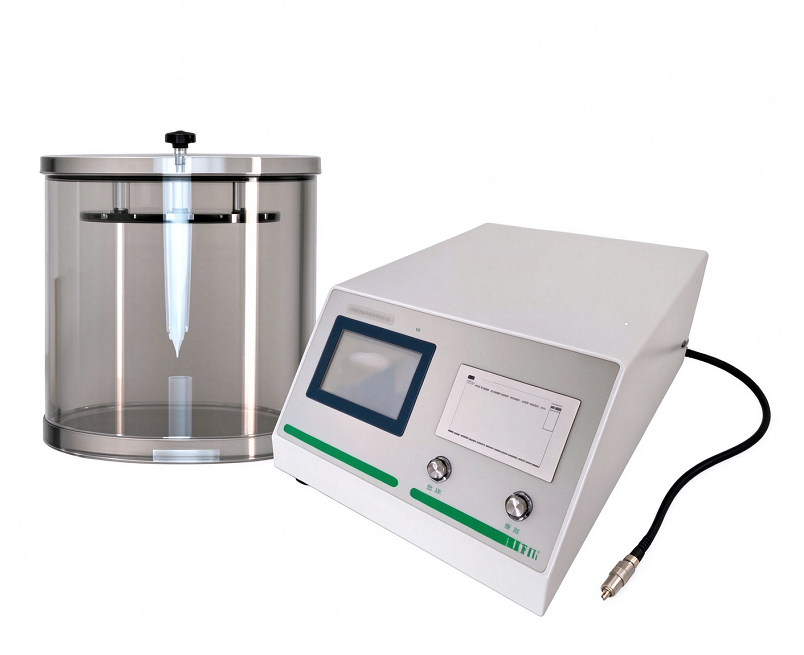
A professional Catheter Vacuum Leakage Tester is a sophisticated integration of mechanical, electronic, and software technologies. Its core architecture typically consists of several key components working together:
Vacuum Generation System:
The system typically consists of an oil-free vacuum pump and a speed-control knob, which are responsible for rapidly evacuating air and maintaining a stable negative-pressure condition. Advanced equipment may support stepless adjustment of the negative-pressure level, allowing the test conditions to be adapted to catheters made from different materials and with different specifications.
High-Precision Pressure Sensing Unit:
A high-resolution pressure sensor is used to detect subtle changes in pressure during the test. This sensing unit is fundamental to measurement accuracy and helps reduce the risk of incorrect judgments caused by sensor drift or measurement instability.
Intelligent Control Unit:
Serving as the “brain” of the instrument, the control unit executes the test program, processes sensor signals, and performs logical evaluation of the test results. It can support user-defined parameters such as target vacuum level, pressure-holding time, and allowable leakage rate. An automatic pressure-maintaining function can also help ensure consistent testing conditions throughout the test.
Human-Machine Interface:
Modern testers are often equipped with a touchscreen interface featuring a clear and intuitive layout. Operators can set test parameters, start tests, view results, and export data directly through the touchscreen. Some advanced models also support multiple languages and historical data traceability, facilitating digital recordkeeping and quality-management activities.
Future Outlook: Toward Greater Intelligence and Integration
With the advancement of Industry 4.0. Catheter Vacuum Leakage Testers are evolving toward greater intelligence and system integration. Future equipment is expected to incorporate Internet of Things (IoT) technologies more deeply, enabling functions such as remote monitoring, automatic fault diagnosis, and cloud-based data synchronization.
The introduction of artificial intelligence algorithms may further enhance testing capabilities, allowing instruments to identify leakage patterns automatically and detect potential quality trends based on accumulated test data. At the same time, multifunctional integration is expected to become an increasingly important trend. A single testing system may combine leakage testing, flow calibration, residual vacuum measurement, and other functions, helping improve testing efficiency while reducing equipment investment and operating costs.
Although the Catheter Vacuum Leakage Tester does not directly participate in clinical treatment, it plays an important role in the medical safety and quality-control chain. By providing objective and repeatable verification of catheter integrity, it helps manufacturers identify potential defects before medical devices reach clinical use.
As quality and safety requirements for medical devices continue to become increasingly stringent, the role of this “invisible guardian” in ensuring catheter reliability and supporting patient safety is expected to become even more significant.
Previous: What is color fastness to rubbing?
N e x t : the last page
