





How can you determine whether a carpet has good anti-static properties?
2026/10/23
Share:

Why Must Testing Be Conducted by Walking?
Static electricity has an especially troublesome characteristic: its behavior depends heavily on environmental conditions and how a material is used. The same carpet may perform very differently during the humid rainy season in southern China and in a centrally heated room in northern China. Walking across it barefoot can also produce results quite different from those obtained when wearing rubber-soled shoes.
In other words, static electricity measurements have little practical value if they are disconnected from real-world conditions of use.
This is precisely the principle behind the walking test method. Both international standards and Chinese national standards adopt a similar approach: a test subject walks across the carpet under evaluation along a prescribed route and with a specified walking pattern, wearing the test footwear required by the applicable standard. Under controlled atmospheric conditions, the electrical potential of the human body relative to ground is measured during the test.
The underlying physics is worth examining more closely. As a person walks, the shoe soles repeatedly contact and separate from the carpet. This process of triboelectric charging causes electrical charges to accumulate on the carpet. In accordance with the principle of charge conservation, the human body acquires a corresponding charge of opposite polarity.
Therefore, measuring the electrical potential of the human body provides an indirect but useful way to evaluate the electrostatic behavior of the carpet. The human body effectively acts as a moving “detector,” revealing the carpet’s electrostatic characteristics through the voltage generated during walking.
Generally, the higher the electrostatic voltage of the human body, the greater the potential for unpleasant electrostatic shocks and discomfort during use.
The Technical Principles Behind a Precision Instrument
At this point, some people may wonder: Is this not simply a matter of measuring voltage? Why is specialized equipment necessary?
The answer lies in the unique challenges of electrostatic measurement.
Electrostatic charges are easily disturbed or lost through leakage. If an ordinary voltmeter is connected to the measurement circuit, its own electrical characteristics may provide a discharge path, allowing the charge being measured to dissipate and causing the reading to become inaccurate.
For this reason, the electrostatic voltmeter and hand-held electrode used in this type of tester must have an extremely high input resistance, while the input capacitance of the electrode and measurement system must be kept sufficiently low.
High input resistance minimizes charge leakage through the measuring instrument, while low input capacitance reduces the extent to which the measurement system itself affects the electrical potential of the object being measured.
These two characteristics are fundamental to the precision of the instrument and distinguish specialized electrostatic measuring equipment from ordinary voltage-measurement devices.
The measurement range is also carefully designed to cover high positive and negative electrostatic potentials, with sufficiently fine resolution to display the readings accurately. After all, when evaluating the risk of electrostatic shocks, even relatively small differences in voltage can be important when determining whether a product meets the applicable performance requirements.
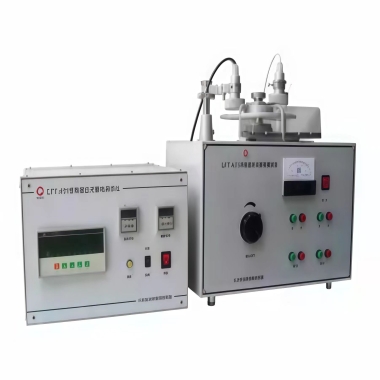
The testing setup itself is equally important. The instrument is equipped with a grounded metal plate covered by an insulating rubber sheet of a specified thickness. The carpet specimen is placed on this standardized grounding arrangement.
The metal plate provides a stable electrical reference potential, while the rubber sheet helps isolate the specimen from unwanted electrical influences associated with the underlying floor. Together, these components establish a controlled electrical environment for testing.
The selection of test footwear, walking frequency, walking path, and duration are also specified by the applicable standard. By controlling these variables, the test can produce results that more reliably reflect the electrostatic performance of the carpet rather than random variations in the testing environment.
Another easily overlooked but critically important factor is the environmental condition. Testing must be conducted under carefully controlled temperature and relative humidity conditions, with humidity being particularly significant.
Moisture in the air can form a thin, weakly conductive layer on fiber surfaces. As relative humidity increases, electrical charges may dissipate more readily, potentially reducing the measured electrostatic voltage. Consequently, results obtained under different humidity conditions may not be directly comparable.
For this reason, the applicable test standard specifies a controlled atmospheric environment, including a defined relative humidity range. Maintaining these conditions ensures that the test is conducted consistently and, where required by the standard, under relatively demanding conditions for evaluating a carpet’s antistatic performance.
Who Needs This Instrument, and What Does It Protect?
The range of users who benefit from this instrument is much broader than many people might expect.
Carpet manufacturers and fiber producers use it to evaluate formulations and manufacturing processes. Has an antistatic fiber been incorporated into the material? Is the arrangement of conductive filaments appropriate? How long will the antistatic finishing treatment remain effective?
These questions can be investigated through practical walking tests that simulate the relevant conditions of use.
Testing and certification laboratories also rely on this equipment to evaluate carpet performance in accordance with applicable national and international standards. The resulting data provide an objective basis for technical assessments and support product quality verification.
The aviation and automotive interior industries deserve particular attention.
Aircraft cabins and vehicle interiors are typical examples of enclosed spaces where people and synthetic textile materials are in frequent contact. Friction between occupants, synthetic carpets, and seat fabrics can generate static electricity, while onboard electronic equipment may be sensitive to electrostatic discharge.
If a carpet or floor mat fails to meet the relevant antistatic performance requirements, the consequences may range from passenger discomfort to potential interference with sensitive electronic equipment.
In such applications, data obtained through an appropriate walking test can serve as an important criterion for product evaluation, quality assurance, and compliance with customer or industry requirements.
Research institutes also depend on this type of equipment. The development of new conductive fibers, innovative antistatic finishing technologies, and improved textile structures requires reliable and repeatable measurements. A specialized carpet static electricity tester provides the experimental data needed to compare different materials, investigate performance changes, and support further research.
From an Unexpected Shock to Reliable, Measurable Results
Static electricity is invisible and difficult to perceive until it produces a noticeable effect, yet it can quietly influence product quality, user comfort, and operational safety.
The value of the Carpet Static Electricity Tester lies in its ability to transform this unpredictable phenomenon into stable, quantitative, and comparable measurements of human-body electrostatic potential. It replaces the subjective impression that a carpet “does not seem to generate much static” with an objective assessment based on measured data and the requirements of applicable national and international standards.
It ensures that antistatic performance is no longer merely a claim in a product brochure, but a measurable property that can be evaluated through laboratory testing.
For manufacturers, the instrument serves as a guide for improving materials and manufacturing processes. For purchasing departments, it provides an objective reference for product selection and quality control. For end users, it acts as an often-unnoticed safeguard, helping reduce the likelihood of unpleasant electrostatic shocks when walking across a carpet and reaching for a doorknob.
A good carpet must withstand not only the mechanical stresses imposed by repeated footsteps, but also the challenges associated with electrostatic charging.
And long before the carpet leaves the factory, its electrostatic performance can already have been evaluated, step by step, in a laboratory where temperature, humidity, and testing conditions are carefully controlled.
Previous: What is a carpet dynamic load tester used for?
N e x t : the last page
