





Why does adhesion testing involve both "pulling" and "impacting"?
2026/10/23
Share:

Why Is Adhesion Testing So Challenging?
The difficulty in evaluating the reliability of bonded components lies in the complexity of the forces they experience.
During vehicle operation, wiring harnesses and bonded components are rarely subjected to gentle, uniform tensile forces. Hitting a speed bump produces a sudden impact. Emergency braking introduces unexpected shear forces caused by inertia. Meanwhile, the same adhesive may behave very differently in an outdoor parking lot during a northern winter and in an engine compartment exposed to the blazing summer sun. Low temperatures can make an adhesive layer brittle, while high temperatures can cause it to soften and undergo creep deformation.
In other words, an adhesive that performs exceptionally well in a static tensile test at room temperature may not withstand a sudden impact under low-temperature conditions.
Traditional static peel tests can answer one basic question: How much force is required to separate a bonded joint gradually? However, real-world conditions pose a much more demanding challenge: Can the bond remain intact under sudden impact at low temperatures?
When the test requirements change, the testing equipment must evolve accordingly.
One Instrument, Two Testing Approaches
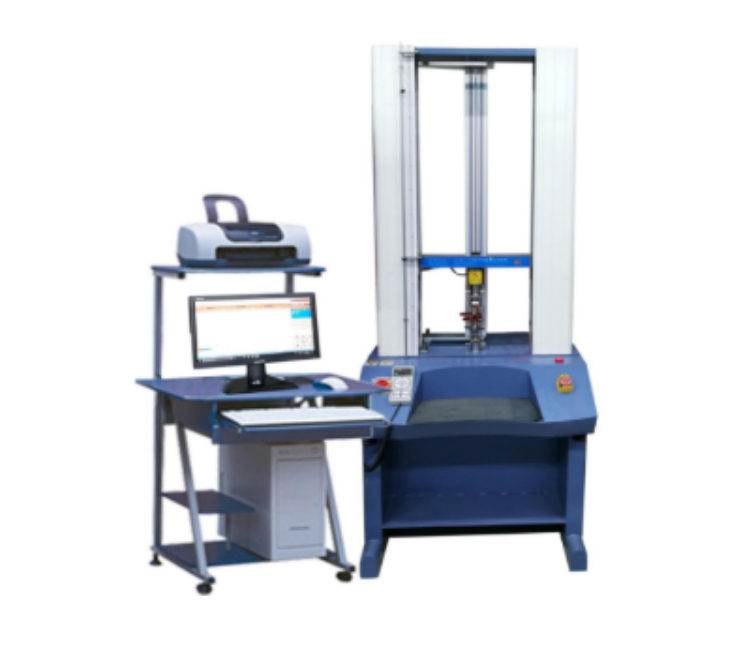
The core design concept of a modern Automotive Wire Adhesion Tester is to evaluate bonding performance through two complementary testing methods.
The first is dynamic impact testing, based on the internationally used wedge-peel impact testing principle. The instrument uses a pneumatic drive system to deliver an impact to the specimen with precisely adjustable energy. A wedge-shaped impactor rapidly penetrates the bonded interface, simulating the dynamic loads experienced by adhesive joints during severe operating conditions, such as collisions and vehicle jolts.
The impact energy can be adjusted across a broad range of levels, from relatively mild impact conditions to more severe loading approaching those associated with collision scenarios. This enables manufacturers to investigate the impact resistance limits of different adhesive bonding systems and determine how well they withstand sudden mechanical loading.
The second method is quasi-static tensile testing of bonded joints. Driven by a servo motor, the instrument applies a smooth, controlled load across a wide range of testing speeds. Combined with a high-precision force sensor, the system captures the mechanical response of the adhesive layer throughout the entire process, from initial loading to eventual failure.
Weak bonding points that are invisible to the naked eye, as well as internal inconsistencies within the adhesive layer, may be revealed through subtle variations in the measured force curve.
Even more importantly, the instrument introduces temperature-controlled testing. An integrated environmental chamber maintains stable conditions across a broad temperature range, from extreme cold to elevated temperatures. Specimens are first conditioned at the specified temperature before undergoing impact or tensile testing.
As a result, the test produces more than a performance report obtained under comfortable laboratory conditions. It provides a more realistic assessment of how bonded components may perform in demanding environments, such as the freezing winters of northeastern China or the scorching summer heat of Turpan.
High Precision and Intelligent Control: Data Speaks for Itself
Another major advantage of this instrument is its emphasis on data quality.
The force measurement system offers a high level of accuracy and is combined with a high-speed data acquisition system. Force variations during every impact and each stage of the peeling process are recorded in detail and displayed in real time as force-displacement curves.
Does the adhesive layer fail through brittle fracture or ductile peeling? Does the failure occur at the interface between the adhesive and the substrate, or within the adhesive itself?
These are critical questions for research and development engineers, and the shape of the force-displacement curve can provide valuable insights into the failure process.
After testing, the software can automatically generate reports. The system can also support remote monitoring through network connectivity, enabling quality management to move beyond reviewing historical records after a test and toward monitoring test processes and results in real time.
The fixture design also reflects careful engineering. Quick-change fixtures accommodate wires of different diameters and specimens of various sizes. Larger components, such as door modules and bumper assemblies, can also be accommodated when the instrument's configuration and fixture capacity permit.
The entire testing process and mechanical movement are controlled centrally through computer software. Impact acceleration can be programmed to help ensure that each test is conducted under consistent conditions.
This is how the fundamental principles of testing science—repeatability, comparability, and traceability—are translated into practical operation.
Its Test Requirements Are Closely Linked to Automotive Safety Regulations
For the automotive industry, the significance of this instrument extends far beyond research and development.
The reliability of automotive wiring harnesses and bonded structural components is directly related to vehicle crashworthiness and occupant protection. Relevant automotive safety regulations and technical requirements address the integrity and performance of various vehicle structures and components.
The instrument can be configured with appropriate test procedures and parameter settings to support testing in accordance with applicable standards. Depending on the specific test method and equipment configuration, these may include relevant ISO adhesive testing methods, ASTM standards, European and American automotive safety requirements, and Chinese automotive bonding test standards.
This allows the resulting test data to support supplier audits, product qualification, quality assurance, and regulatory verification conducted by automotive manufacturers, provided that the selected methods and procedures meet the applicable requirements.
The instrument's potential users are equally clear.
Wire harness and cable manufacturers can use it to evaluate the bonding or adhesion performance of insulation layers and conductors, where applicable to the product design and test method.
Adhesive research and development organizations can use it to investigate the performance limits of new formulations under different temperatures and impact conditions.
Automotive manufacturers and component suppliers can incorporate it into incoming material inspection, production quality control, and ongoing reliability monitoring.
Third-party testing laboratories can also use the instrument to provide customers with technical evaluation reports in accordance with the relevant testing standards.
Reliability Comes from Routine Maintenance; Safety Begins with the Details
Even the most sophisticated instrument depends on careful maintenance to ensure reliable performance.
The impactor assembly, temperature-controlled chamber, and fixtures should be kept clean and free from debris. Force sensors must be calibrated at appropriate intervals. Pneumatic and temperature-control systems should be checked before testing begins. Software and data acquisition systems should be maintained and updated as necessary.
Safety guards and interlock devices must also remain in proper working condition at all times.
These routine tasks may seem minor, but they provide two essential safeguards: reliable test data and operator safety.
Let us return to the question raised at the beginning: What protects the safety built into the countless bonded joints hidden inside a vehicle?
The answer lies in a scientific approach that subjects every critical bonding interface to repeated evaluation under demanding conditions, including extreme temperatures, static loading, and dynamic impact.
The Automotive Wire Adhesion Tester is a dedicated instrument for putting this approach into practice. Standing quietly in the laboratory, it performs precise impact and tensile tests, helping identify potential weaknesses before they become real-world failures.Ultimately, automotive safety begins with taking the smallest details seriously—even those hidden beneath the surface, where a single bond can make a significant difference.
Previous: How can you determine whether a carpet has good anti-static properties?
N e x t : the last page
