





How Does a Mask Field of Vision Tester Work?
2026/10/23
Share:

Why Field of Vision Must Be Measured
To understand this instrument, it is first necessary to understand how the field of vision is defined.
The human field of vision is a three-dimensional area centered on the eyes. When a mask is worn, its edges, frames, and viewing windows may obstruct part of this area. The remaining visible range is known as the field of vision while wearing the mask.
In respiratory protection standards, field of vision is generally assessed in terms of left and right fields of vision and the total field of vision. The left and right fields evaluate the wearer's ability to see toward either side, while the total field of vision measures the overall visible range. Relevant standards establish specific acceptance criteria for different types of respiratory protective products. Gas masks naturally face more stringent requirements than everyday protective masks because their applications often involve life-threatening situations.
The challenge is that the field of vision is a spherical concept. How can it be measured accurately? The answer lies in an elegant geometric approach: measuring the spherical field on a curved surface.
A Hemisphere, a Row of Light Points, and an Ingenious Design
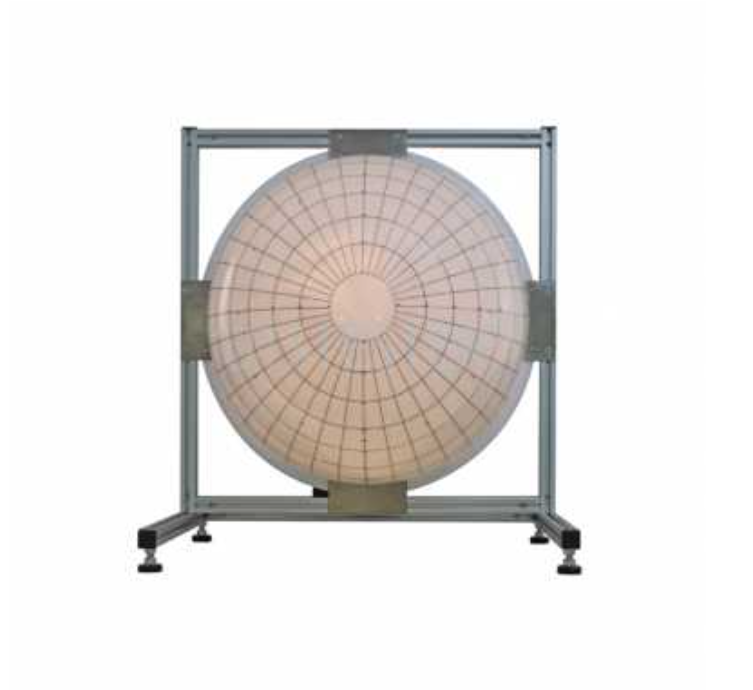
The core structure of a Mask Field of Vision Tester consists of a semicircular field-of-vision measuring panel with a standardized radius, together with a standardized headform. During testing, the mask is fitted onto the headform. This is not an arbitrary model: the distance between its eyes is precisely designed to correspond to the standard interpupillary distance, helping ensure that the mask fits the headform in a manner representative of its intended wearing configuration.
The measurement process has something of an optical trick to it. Small electric bulbs that can be switched on and off are installed at the eye positions of the headform. Imagine these bulbs acting as point light sources, projecting light from the positions of the eyes toward the hemispherical surface. Areas blocked by the mask prevent the corresponding light points from being seen, while points within the visible field remain clearly observable.
In this way, the obstruction caused by the mask is translated into a distribution of visible light points across the hemispherical surface. A complex three-dimensional visual problem becomes something that can be observed, marked, and measured in angular terms on a curved panel. By identifying the boundaries of the visible field along the hemispherical surface, the tester can determine the left and right field-of-vision angles as well as the total field of vision.
Another thoughtful feature is that the headform can move horizontally to the left and right. This design simulates subtle changes in head position and mask fit during actual use. Wearers do not always maintain a perfectly standardized posture, and changes in facial movement and mask positioning can affect visibility. The headform's horizontal movement allows the instrument to examine field-of-vision performance under different wearing positions, bringing laboratory testing closer to real-world wearing conditions.
An Objective Measuring Tool for Different Types of Masks
The applications of this instrument cover a broad range of respiratory protective products.
In respiratory protection, self-contained filtering gas masks and particulate respirators may be required to undergo separate assessments of their left and right fields of vision and total field of vision. These evaluations can be essential parts of product certification. When rescue personnel move through smoke wearing protective masks, every degree of peripheral vision can matter.
In the medical field, field-of-vision verification for medical surgical masks and medical protective masks helps support safe working conditions for healthcare professionals who wear protective equipment for extended periods. Maintaining adequate visibility is particularly important during tasks requiring sustained visual concentration.
In occupational safety, verifying the field of vision of industrial dust masks is directly related to workers' ability to perceive surrounding hazards accurately in potentially dangerous environments. Even everyday protective masks intended for consumers may be subject to technical requirements concerning visibility. A mask is a consumer product, but it is also a product with important safety implications.
For research and development engineers, the tester serves as a design guide. The size of the viewing window, the width of the mask edges, and the curvature of the lens or visor can all be evaluated through measurable data during successive design iterations. This helps engineers seek an optimal balance between protective performance and visibility.
For quality control departments and testing and certification organizations, the instrument provides a standardized measuring tool. By following applicable national standards for respiratory protective equipment and protective masks in China, users can obtain objective, verifiable test results, giving a measurable basis for determining whether a product meets the relevant field-of-vision requirements.
Proper Maintenance for Accurate Measurements
Although the instrument is not particularly complex, accurate measurements depend on careful routine maintenance.
After each use, the headform and hemispherical panel should be wiped clean to prevent dust from interfering with the identification of light points. The bulbs and control switches should be inspected regularly, since a failed light point could lead to an incorrect determination of the field-of-vision boundary.
The hemispherical panel must be protected against impacts, pressure, and deformation. Its geometric accuracy is fundamental to the reliability of the entire instrument. The tester should be stored in a clean, dry environment, and complete calibration records should be maintained to ensure that each measurement can be traced to a consistent reference standard.
Conclusion
Returning to the question raised at the beginning: Can a mask obstruct the wearer's view of the world? Yes, it can—particularly when its field-of-vision performance is not adequately controlled through standards and testing.The purpose of the Mask Field of Vision Tester is to transform the subjective experience of seeing clearly into an objective engineering parameter that can be measured, evaluated, and improved. Every illuminated point on the hemispherical panel helps verify that future wearers can benefit from respiratory protection without unnecessarily sacrificing visibility.Protection and visibility should never have to be a zero-sum trade-off. When engineers weigh design options at the drawing board, this instrument provides a practical way to measure the balance between the two. Truly human-centered safety design is achieved through careful measurement, one degree of visibility at a time.
Previous: Who gets to decide whether automotive wiring can withstand ozone?
N e x t : the last page
