





What Determines Whether Upholstery Fabric Can Withstand Ten Years of Friction?
2026/10/26
Share:

Friction Is the Most Honest Test of Fabric Performance
For automotive interiors and upholstery fabrics, abrasion resistance is almost synonymous with service life. Automotive manufacturers are known for their stringent requirements when evaluating interior materials. Seat fabrics must withstand years of repeated rubbing against occupants' clothing, steering wheel coverings must endure daily abrasion from the hands, and interior materials must maintain stable performance even under demanding conditions, such as low temperatures at high altitudes.
The same applies to the furniture industry: whether a sofa fabric can withstand everyday use directly affects its reputation among consumers.
Although there are many ways to evaluate abrasion resistance, industry testing generally centers on two classic methods. One is the widely recognized Martindale method, which produces a figure-eight rubbing pattern and is commonly used for apparel and home textiles. The other is the subject of this article: the Wyzenbeek method, also known as the oscillatory cylinder method.
Its distinctive feature is that the test specimen is stretched and secured in a frame while the rubbing medium moves back and forth in straight lines along the warp and weft directions of the fabric. Each complete back-and-forth movement constitutes one cycle.
This straightforward, linear rubbing motion follows the yarn directions and closely simulates the friction that occurs when people stand up or shift position on a seat. As a result, the Wyzenbeek method is widely used by automotive manufacturers and the furniture industry to evaluate the abrasion resistance of interior and upholstery fabrics.
The two methods assess abrasion resistance under different testing conditions. Passing one does not necessarily mean passing the other. For companies seeking to enter the automotive supply chain, investing in an oscillatory abrasion tester that complies with the applicable ASTM testing requirements is an important step toward meeting automotive manufacturers' qualification requirements.
How Does It Simulate Ten Years of Friction
The operating principle of this instrument is straightforward, but its strength lies in the rigor of the testing process.
A cylindrical abrasion head moves back and forth along an arcuate path, rubbing against the tensioned test specimen using a standardized abrasive medium. Depending on the test method, the abrasive medium may be standard abradant fabric or wire mesh. The specimen is subjected to controlled tension and pressure throughout the test.
Both tension and pressure can be adjusted and calibrated using dedicated weights, ensuring that every specimen is tested under consistent loading conditions. This repeatability forms the foundation for comparing results across different laboratories.
The instrument also supports both dry and wet abrasion testing. For wet testing, the abrasive medium must be preconditioned in accordance with the applicable test method. This allows the fabric's abrasion performance and colorfastness to be evaluated under conditions involving moisture, perspiration, or water exposure, bringing the test closer to the complex conditions encountered in actual use.
Once the preset number of cycles has been reached, the inspector evaluates the specimen under standardized lighting using standard gray scales to assess color change and staining of the abradant. The specimen is also examined for pilling, holes, and other visible damage.
The number of reciprocating abrasion cycles a fabric can withstand provides a quantifiable measure of its performance. These results serve as valuable technical evidence when presenting products and quoting to automotive manufacturers and brand owners.
Four Test Stations in One Instrument: Four Times the Testing Capacity
With a single-station instrument, waiting times can significantly reduce laboratory throughput when large numbers of specimens need to be tested.
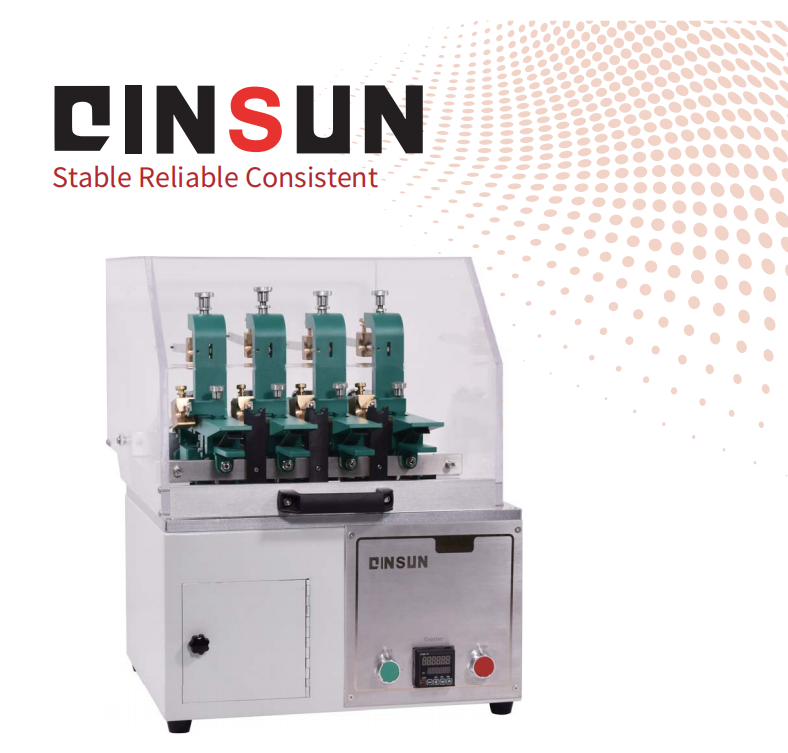
This tester can accommodate four specimens simultaneously, allowing multiple tests to be conducted in parallel and substantially increasing testing efficiency.
A precision electronic counter automatically records and controls the number of cycles. The instrument stops automatically when the preset count is reached, eliminating the need for inspectors to monitor the process continuously and making unattended overnight testing more convenient.
Its enclosed transmission mechanism ensures smooth, stable, and quiet operation, minimizing noise in the laboratory. An optional dust extraction device removes abrasion debris as it is generated, helping keep the rubbing interface clean and reducing the risk of contamination affecting test results. A protective cover encloses the moving components, providing an additional safety barrier for operators.
The instrument features a stainless-steel construction that offers a modern appearance and good corrosion resistance. Its curved abrasion platform and adjustable fixtures simplify specimen mounting and improve operating convenience.
Standard accessories, including abrasive media, fixtures, weights, and calibration tools, are supplied to support routine testing and setup.
From Automotive Interiors to Electronic Screens: A Wide Range of Applications
The instrument's applications extend far beyond automotive interiors. It can be used to evaluate abrasion resistance across a wide range of industries.
Automotive interiors: Evaluating the abrasion resistance of seat fabrics, upholstery materials, steering wheel coverings, and other interior components.
Aerospace interiors: Assessing the abrasion resistance of interior materials intended for demanding service environments.
Furniture and upholstery: Verifying whether sofa fabrics, chair upholstery, and other furnishing materials can withstand everyday use.
Material research and development: Comparing the abrasion performance of new fibers, coatings, and functional finishes, including water-repellent and flame-retardant treatments.
Electronic products: Evaluating the abrasion durability of mobile phone screen protectors, touchscreen coatings, and keyboard coatings, where compatible fixtures and test methods are available.
Packaging and labeling: Assessing the abrasion resistance of labels and packaging films during transportation and handling, where the selected test method is suitable.
Third-party testing laboratories: Supporting commissioned abrasion-resistance testing and, with the appropriate fixtures and procedures, related seam and yarn slippage evaluations under applicable standards.
For third-party testing laboratories, the instrument can also support testing services required by customers working with ASTM-based specifications. Its versatility makes it a valuable asset for laboratories seeking to expand their testing capabilities.
It is worth noting that the instrument's capabilities are not necessarily limited to abrasion testing. When equipped with the appropriate fixtures and configured according to the relevant test procedures, it may also be used to evaluate yarn slippage and seam slippage in upholstery fabrics. These properties are particularly important because stitching areas can be potential points of failure in seat fabrics.
For companies with limited testing budgets, an instrument capable of supporting both abrasion and slippage testing can offer greater equipment utilization and help reduce the need for separate testing systems, provided that the required standards and configurations are supported.
Conclusion
Whether a fabric can withstand ten years of friction should not remain unanswered until the product has been installed in a vehicle or brought into a home.The Oscillatory Abrasion Tester brings years of simulated wear into the laboratory through controlled reciprocating cycles, allowing every fabric specimen to demonstrate its abrasion resistance before the material leaves the factory.With efficient testing, quiet operation, reliable safety features, and versatile testing capabilities, the instrument provides a practical solution for evaluating abrasion resistance in automotive supply chains and furniture manufacturing and export industries worldwide.By transforming long-term wear into measurable test results, the Wyzenbeek Abrasion Tester helps manufacturers evaluate material durability, improve product quality, and provide reliable performance data to automotive manufacturers, furniture brands, and other customers.
Previous: How Does a Mask Field of Vision Tester Work?
N e x t : the last page
