





What can a Nasal Oxygen Cannula Tester do?
2026/11/03
Share:

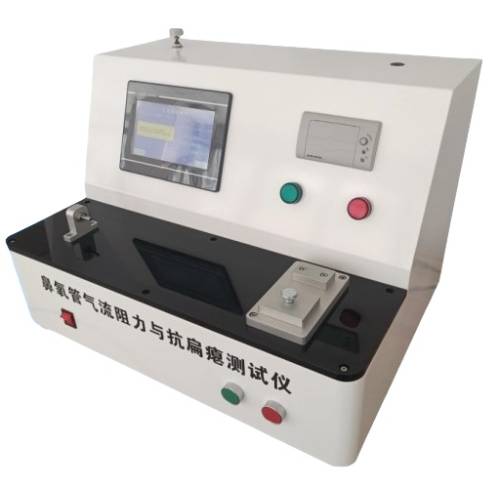
What Problems Does the Nasal Oxygen Cannula Anti-Collapse Tester Solve
Nasal oxygen cannulas are generally made of flexible polymer materials and must possess a certain degree of flexibility to minimize discomfort during wearing and use. However, if the tubing material is excessively soft, the wall thickness is insufficient, or the structural support is inadequate, the cannula may easily collapse under external forces, resulting in a reduction in the internal flow passage area.
The fact that a nasal oxygen cannula appears intact externally does not necessarily mean that its internal airflow remains unaffected. Some products may remain structurally intact after compression while experiencing a significant reduction in actual flow rate.
The Nasal Oxygen Cannula Anti-Collapse Tester quantitatively evaluates the cannula's resistance to compression and collapse, reducing errors associated with visual inspection alone.
This test helps manufacturers identify issues such as inappropriate material formulations, variations in wall thickness, uneven extrusion molding, and insufficient tubing recovery performance.
Working Principle of the Nasal Oxygen Cannula Tester
Airflow Resistance Testing
Airflow resistance testing generally adopts the flow rate–pressure difference method. A stable gas source supplies a specified flow rate of gas through the nasal oxygen cannula. High-precision pressure sensors measure the pressure difference between the two ends of the cannula, and airflow resistance is calculated based on relevant principles of fluid mechanics.
Anti-Collapse Testing
Anti-collapse testing primarily involves simulating compression conditions encountered during actual use by applying a specified external force to the nasal oxygen cannula while monitoring changes in airflow inside the tubing.
For example, specially designed fixtures are used to compress the nasal oxygen cannula to different degrees. During compression, the tester monitors whether airflow is obstructed and evaluates the extent of obstruction, thereby assessing the cannula's anti-collapse performance.
Operating Procedure of the Nasal Oxygen Cannula Tester
1. Preparation Stage
Before testing begins, ensure that the test equipment, namely the Nasal Oxygen Cannula Anti-Collapse Tester, is in normal operating condition. Conduct a comprehensive inspection of the instrument's power supply, sensing components, and other relevant parts.
Next, randomly cut a 0.5 m section from the test specimen, namely the nasal oxygen cannula. Accurately measure and record its outer diameter, d.
If the nasal oxygen cannula is not circular, its average diameter should be calculated.
2. Sample Conditioning
Place the nasal oxygen cannula specimen in a test environment maintained at 23°C ± 2°C and allow it to stand for 1 hour to simulate environmental conditions encountered during actual application.
3. Connection to the Test Apparatus
Securely connect the nasal oxygen cannula to the Nasal Oxygen Cannula Anti-Collapse Tester, ensuring that the connection is tight and that the cannula remains in a straight condition.
4. Initial Flow Rate Setting
Adjust the initial flow rate of the tester to 10 L/min ± 0.5 L/min to ensure that the flow rate complies with the rated flow specified by the nasal oxygen cannula manufacturer.
5. Bending the Nasal Oxygen Cannula and Conducting the Test
Bend the last 100 mm of the nasal oxygen cannula into a U-shaped configuration and place it between the parallel jaws.
Adjust the distance X between the parallel jaws to 3d to ensure that the nasal oxygen cannula maintains a stable bent configuration throughout the test.
Subsequently, maintain the flow meter settings unchanged. After allowing the system to stabilize for 10 minutes, record the displayed flow rate and calculate the corresponding change in flow rate.
6. Data Recording and Analysis
Based on the test results, thoroughly record the changes in flow rate of the nasal oxygen cannula under the bent condition and compare them with the initial state.
Through an in-depth analysis of these data, the anti-collapse performance of the nasal oxygen cannula can be accurately evaluated.
By following the above operating procedure, flow rate variation data can be obtained for nasal oxygen cannulas under different bending conditions.These data help provide a deeper understanding of the cannula's anti-collapse performance and offer valuable recommendations for product design improvements.
Conclusion
In conclusion, the Nasal Oxygen Cannula Anti-Collapse Tester is an important medical device testing instrument.By strictly following the prescribed operating procedures, accurate test data can be obtained, enabling the scientific evaluation of the anti-collapse performance of nasal oxygen cannulas.This plays a significant role in improving the overall quality of medical products and ensuring the safety and reliability of respiratory support equipment.
Previous: What are the functions of a catheter sliding performance tester?
N e x t : the last page
