





How to Use a Surgical Needle Elasticity and Toughness Tester?
2026/11/05
Share:

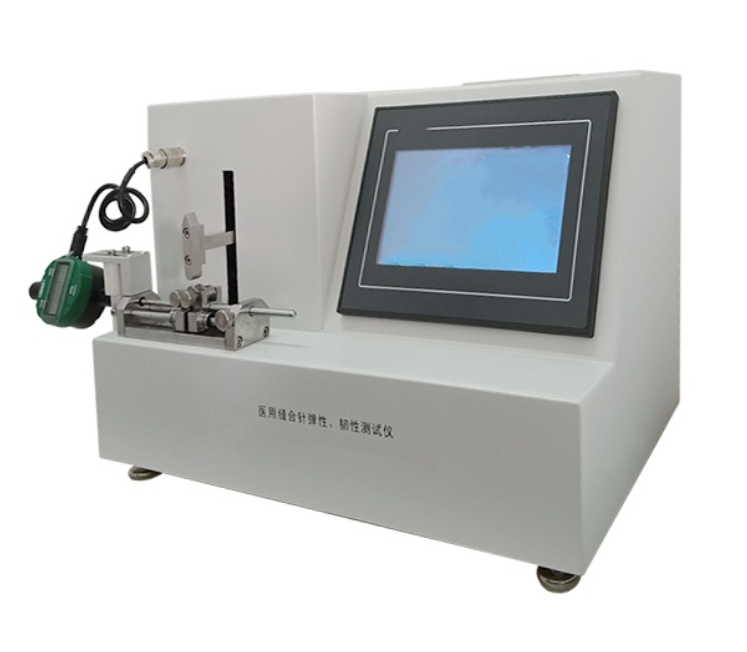
Testing Principles and Environmental Control of the Surgical Needle Elasticity and Toughness Tester
1. Design Principles for Simulating Clinical Conditions
Loading Methods:
Elasticity Testing: The three-point bending method is adopted. The two ends of the needle body are secured using high-precision fixtures, while a controlled displacement is applied at the midpoint at a rate of 0.1–1 mm/s to simulate the dynamic deformation experienced during tissue suturing.
Toughness Testing: Rotational bending or dynamic fatigue testing is employed to simulate repeated needle penetration movements and evaluate the fatigue life of the needle body after multiple bending cycles.
Medium Selection: A biomimetic silicone membrane compliant with ISO 10993. with a hardness of 30 ± 5 Shore A, is used to simulate the human dermal layer, ensuring that the test results closely reflect actual tissue penetration conditions.
2. Precise Control of Environmental Parameters
Temperature and Humidity:
The testing environment should be maintained at 22°C ± 2°C and a relative humidity of 50% ± 10%. The specimens should be conditioned in this environment for one hour to eliminate the influence of temperature and humidity on material properties.
Performance verification after low-temperature exposure, such as −20°C, or high-temperature and high-pressure sterilization should be conducted using an environmental conditioning chamber to ensure mechanical stability under extreme conditions.
Loading Rate: The loading rate for elasticity testing is generally 0.01–1 mm/s, while the loading rate for toughness testing is 50 mm/min, matching the mechanical response characteristics of different testing scenarios.
Operating Procedure of the Surgical Needle Elasticity and Toughness Tester
1. Preparation Before Testing
Equipment Inspection: Place the instrument on a stable workbench. Connect the power supply and switch on the instrument to perform a self-diagnostic check. Confirm that the sensors, fixtures, display screen, and other components are free from looseness or damage. Allow the instrument to warm up in advance until it reaches a stable operating condition.
Specimen Preparation: Select the surgical needles to be tested. Clean any oil, dirt, or other contaminants from the needle surface and ensure that the needle body has no pre-existing damage, such as scratches or corrosion.
Parameter Setting: According to the applicable standard, enter the needle type (such as 1/2-circle or 3/8-circle), needle body diameter, deformation rate (5–8 mm/min), target bending angle, and other relevant parameters.
2. Core Testing Operations
Elasticity Testing: Horizontally secure the surgical needle in the three-point bending fixture. The loading head moves downward at the preset speed until the target bending angle, such as 45°, is reached. Maintain the load for 5–10 seconds before slowly releasing it. Record the residual deformation of the needle body. The specimen passes if no plastic deformation occurs.
Toughness Testing: Clamp and secure both ends of the surgical needle. Apply repeated bending forces to the needle body according to the preset bending angle and frequency. Record the number of bending cycles completed before the needle fractures. The specimen passes if no fracture or cracks occur within the number of cycles specified by the applicable standard.
3. Test Completion and Maintenance
Data Processing: After testing, the instrument automatically exports data such as force-displacement curves and elastic modulus values and generates a test report containing the conformity assessment results. The report can be printed or archived.
Instrument Maintenance: Carefully remove the tested specimen, clean the fixtures and instrument surfaces, and periodically calibrate the sensors to prevent component aging from affecting subsequent testing accuracy.
Maintenance Recommendations for the Surgical Needle Elasticity and Toughness Tester
Maintenance of the Surgical Needle Elasticity and Toughness Tester should focus on four key aspects: cleaning, calibration, fixtures, and environmental conditions. Proper routine maintenance can prevent most accuracy deviations and equipment failures.
1. Regular Cleaning
Cleaning is the foundation of instrument maintenance.
After each use, switch off the power supply and allow the instrument to cool down. Gently wipe the instrument housing with a clean, soft, damp cloth to remove surface dust and stains.
Pay particular attention to critical components, such as fixtures and sensors. Use dedicated cleaning tools, such as small brushes, to carefully remove debris from gaps and openings, preventing dust accumulation from affecting instrument accuracy.
2. Regular Inspection of Components
Regular inspection of all instrument components is essential.
Check the fixtures for wear. If obvious scratches or deformation are found on the fixture surfaces, replace them promptly to avoid affecting the clamping performance of the surgical needle and causing inaccurate test results.
At the same time, inspect sensor connections to ensure they are secure and check whether any cables are damaged.
If cable problems are detected, repairs or replacements should be carried out by qualified technical personnel. Do not attempt to handle electrical repairs yourself, as this may cause safety hazards.
3. Regular Instrument Calibration
Calibration is a critical step in ensuring the reliability of test results.
According to the instrument manufacturer's recommendations, calibrate the Surgical Needle Elasticity and Toughness Tester at regular intervals.
The calibration process should use standard reference specimens and strictly follow the procedures specified in the operating manual.
If deviations are found during calibration, adjust the instrument parameters accordingly or contact the manufacturer's technical support personnel for assistance.
4. Proper Storage Environment
The storage environment has a significant impact on the performance and service life of the instrument.
The instrument should be placed in a dry and well-ventilated room, away from direct sunlight and humid environments.
Significant fluctuations in temperature and humidity may damage internal components and affect normal operation.
In addition, the instrument should be placed on a stable workbench to prevent vibration and mechanical impact.
5. Regular Operator Training
Regular training should be provided to operators to ensure that they are familiar with the correct operating procedures and maintenance requirements of the instrument.
This helps reduce equipment damage caused by improper operation and improves the overall reliability of the testing process.
By implementing the above maintenance measures, the Surgical Needle Elasticity and Toughness Tester can remain in good working condition and provide accurate and reliable test results for the medical device industry.
Conclusion
In summary, the Medical Surgical Needle Elasticity and Toughness Tester is an indispensable instrument in the field of medical device testing and plays a crucial role in ensuring the quality and safety of medical surgical needles.To ensure the accuracy of test results, the instrument must undergo regular maintenance and calibration, and damaged components must be replaced promptly.Meanwhile, relevant operating procedures should be strictly followed during use to ensure the safety and reliability of the instrument.
Previous: How to Use a Medical Injection Needle Tubing Rigidity Tester?
N e x t : the last page
