





What is a suture needle sharpness/penetration force tester?
2026/11/05
Share:

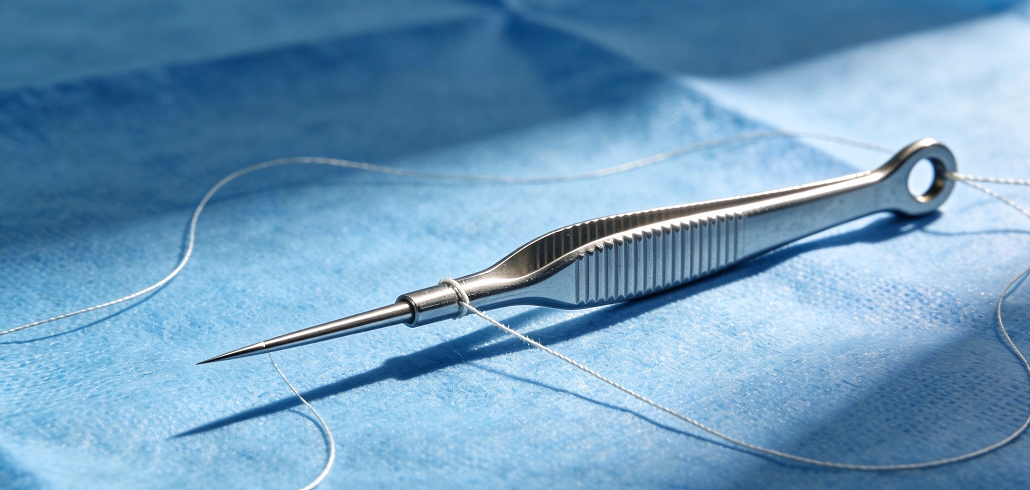
Testing Principles of the Surgical Needle Sharpness and Strength Tester
Performance testing of surgical needles mainly covers two core aspects: penetration force, which reflects sharpness, and needle tip strength, which reflects durability and safety.
1. Penetration Force Testing Principle
Penetration force testing is designed to evaluate the resistance encountered by a surgical needle when penetrating human soft tissue.
The tester uses a high-precision displacement control system to drive a securely clamped surgical needle vertically through a standardized simulated medium at a constant speed.
Commonly used simulated media include aluminum foil of specified thicknesses or polyurethane films. These materials have stable hardness and elasticity and can accurately simulate the penetration response of human skin or fascia.
During penetration, the built-in high-sensitivity force sensor continuously collects data and captures the maximum peak force at the moment the needle tip breaks through the medium.
This peak force is defined as the penetration force of the surgical needle. A lower penetration force indicates a sharper needle tip, resulting in less tissue tearing and damage during surgery.
2. Needle Tip Strength Testing Principle
Needle tip strength testing primarily evaluates the ability of a surgical needle to resist deformation or fracture under applied force.
Although some specialized instruments focus primarily on sharpness testing, integrated testing systems can evaluate the physical stability of the needle tip under extreme loading conditions through specific fixture designs and loading methods.
This helps identify potential fracture risks caused by uneven material stress distribution or defects in heat treatment processes, thereby preventing medical incidents resulting from needle bending or breakage during surgery.
3. Cutting Force Testing for Triangular Cutting-Edge Needles
For surgical needles with triangular cutting edges, the testing principle differs slightly.
In this test, the cutting edge of the surgical needle is positioned vertically to cut through a suspended standard suture thread, and the maximum force required to sever the thread is measured.
This process simulates the cutting behavior of a surgical needle when passing through dense tissue and serves as an important indicator for evaluating the sharpness of triangular cutting needles.
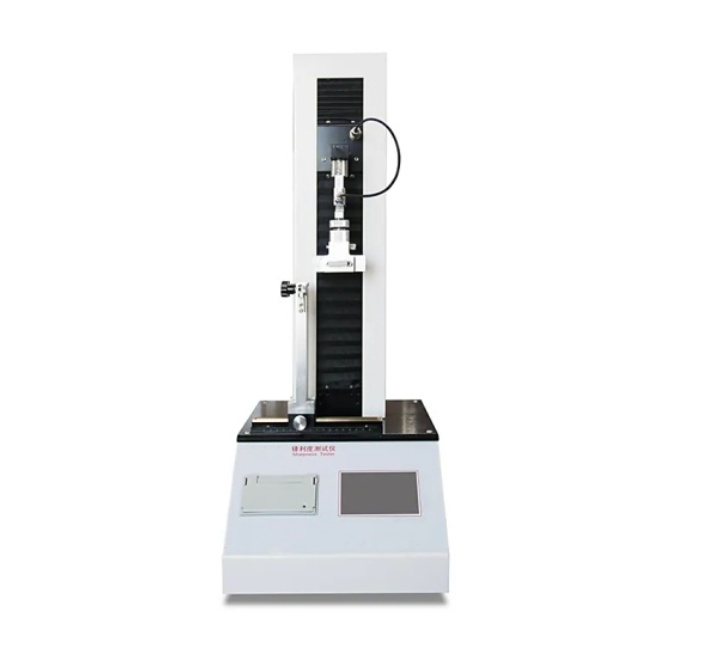
Key Advantages of the Surgical Needle Sharpness and Strength Tester
As a critical instrument for medical device quality control, the Surgical Needle Sharpness and Strength Tester offers several key advantages in measurement accuracy, clinical simulation, and operational efficiency.
First, the instrument features high-precision mechanical sensing capabilities, enabling it to detect minute variations in resistance during needle penetration or cutting-edge slicing with millinewton-level resolution.
By quantifying peak force and average force, it objectively evaluates needle tip sharpness and cutting performance, effectively identifying manufacturing defects that are difficult to detect through visual inspection alone and ensuring reliable test data.
Second, the testing process closely reproduces actual clinical operating conditions. The instrument uses standardized biomimetic media to simulate human tissue and performs penetration or cutting at a constant, controlled speed, avoiding structural damage to specimens caused by instantaneous impact.
This design not only preserves the original physical characteristics of surgical needles but also ensures that test results closely correspond to the actual loading conditions encountered during surgical procedures. It provides a scientific basis for reducing postoperative pain and minimizing tissue damage.
Furthermore, intelligent and automated designs significantly improve testing efficiency. The equipment is generally equipped with an intuitive human-machine interface, supporting one-touch operation and automatic data archiving, thereby reducing the technical requirements for operators.
Its stable operating performance and convenient maintenance requirements make it suitable for both large-scale production quality inspection and research and development testing, helping manufacturers optimize production processes and ensure medical safety from the source.
Looking Ahead: Technological Innovation Driving Progress
With the rapid advancement of science and technology, surgical needle tip sharpness and strength testers are continuously evolving.
In the future, these instruments are expected to achieve significant breakthroughs in the following areas.
1. Intelligent Testing and Technological Innovation
Testing instruments will become increasingly intelligent. With the assistance of artificial intelligence and machine learning algorithms, they will be capable of automatically analyzing test data and rapidly determining whether surgical needles meet quality requirements.
Furthermore, by analyzing extensive historical data, these instruments may predict potential product defects and provide manufacturers with forward-looking recommendations for quality improvement.
Meanwhile, sensor technology will continue to advance, enabling higher-precision force and displacement measurements and further improving the accuracy and reliability of test results.
2. Expanded Application Fields
Beyond existing applications in medical device manufacturing and hospital-related testing, these instruments are expected to play a greater role in medical research.
For example, during the development of new suture materials, researchers can use these testers to evaluate how different materials affect the sharpness and strength of surgical needles, thereby developing needles with superior performance and providing patients with better treatment experiences.
As witnesses to and contributors to the development of medical technology, we should all pay attention to the progress of these seemingly inconspicuous testing instruments.
Although small in size, they carry an enormous responsibility for medical safety and serve as a solid foundation for protecting human life and health.
Conclusion
With continued technological advancement, the Surgical Needle Tip Sharpness and Strength Tester will continue to improve, injecting new vitality into the medical industry and making every surgical procedure safer and more efficient while supporting patients throughout their recovery journey.
Previous: How to Use a Surgical Needle Elasticity and Toughness Tester?
N e x t : the last page
