





What is a prefilled syringe plunger force tester?
2026/11/12
Share:

Why Is Plunger Force So Important
The plunger force of a prefilled syringe is influenced by multiple factors:
Uniformity of Silicone Oil Lubrication: Insufficient lubrication increases friction and results in excessive plunger force, while excessive lubrication may contaminate the drug solution.
Elastomeric Stopper Material and Design: Hardness, taper, and surface treatment directly affect sliding resistance.
Surface Smoothness of Glass or Plastic Barrel Walls: Even microscopic defects can significantly increase plunger force.
Storage Conditions: After prolonged storage, stopper adhesion may occur, resulting in a substantial increase in break-loose force.
Excessive plunger force may lead to the following problems:
Hand fatigue among healthcare professionals, particularly during large-scale vaccination campaigns.
Difficulty with self-injection for elderly patients or individuals with limited hand strength.
Inaccurate dosing or splashing risks caused by sudden changes in resistance during rapid injection.
Conversely, excessively low plunger force may cause accidental activation during transportation, resulting in drug wastage or even safety incidents.
Plunger Force Testing Methods and Technical Considerations
Plunger force testing methods and technical considerations are of great significance for ensuring the quality of prefilled syringes and improving user experience. Plunger force testing is not simply a measurement of physical force; rather, it is a scientific process that requires clinical-use simulation and strict control of testing variables. Its core procedures include simulating clinical operations, precisely controlling test parameters, and conducting scientific measurements and data analysis.
Sample Preconditioning
Samples should be stored under refrigerated conditions at 2°C to 10°C to simulate the temperature-controlled conditions encountered during actual distribution and storage. This step helps ensure that the product characteristics during testing are consistent with those under intended storage conditions.
Subsequently, the samples should be equilibrated to room temperature to eliminate the potential influence of low temperatures on sample viscosity. Low temperatures may increase the viscosity of gel-like formulations, resulting in higher measured plunger forces and affecting data accuracy. Therefore, conducting tests under standardized room-temperature conditions is essential.
Preparation for Testing Under Simulated Clinical Conditions
Before formal testing, the actual usage process should be carefully simulated, including attaching the injection needle and expelling a small amount of air from the needle tip to ensure medication safety and testing accuracy.
Expelling air ensures that the syringe is adequately filled with the drug solution and that the starting position of the plunger stroke remains consistent, thereby avoiding abnormal fluctuations in the force-displacement curve caused by residual air.
Instrument Testing
During testing, securely mounting the syringe in the tester's fixture is essential. A professional testing instrument should be used to ensure standardized testing procedures and accurate data acquisition.
This prevents non-axial displacement or vibration from interfering with the test results and ensures that the applied force is fully directed toward expelling the drug solution.
Constant-speed plunger movement, set at 30 mm/min, is a critical testing parameter. This constant low speed enables accurate capture of the complete dynamic force curve from the beginning to the end of the plunger stroke.
Technical Features of the Syringe Plunger Force Tester
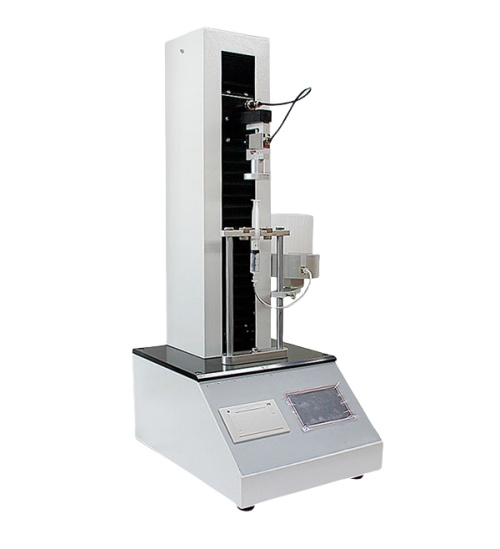
To perform plunger force testing efficiently and accurately, selecting a professional testing instrument is essential. The MED-01 Syringe Plunger Force Tester, carefully developed by Jinan Chenchi Instrument, is an ideal solution for meeting these testing requirements.
High-Precision Measurement and Control System
The tester is equipped with imported force sensors and displacement encoders, offering excellent force resolution. Its high-precision measurement and control system ensures testing accuracy, with force resolution reaching 0.001 N and displacement accuracy reaching 0.01 mm.
Convenient and Intelligent Operation
The tester features a color touchscreen interface, making it easy to configure key parameters such as test speed and stroke limits. Its intuitive interface and convenient operation further simplify testing procedures and effectively reduce errors caused by manual operation.
Comprehensive Data Management
The tester automatically calculates key statistical values, including maximum plunger force and average force, and generates intuitive force curve graphs.
Its comprehensive data management, storage, and export functions clearly present test results. In addition, the instrument supports data storage, traceability, and export in customized report formats, fully meeting stringent data integrity requirements.
Versatile Fixture Options
The tester is equipped with multiple adapters capable of securely holding prefilled syringes of different specifications, ranging from 1 mL to 20 mL.
These versatile adapters accommodate various syringe sizes and meet the diverse testing requirements of laboratories handling different types of syringes.
Importance and Far-Reaching Impact of Plunger Force Testing
Plunger force testing plays a pivotal role in quality control.
Improving Product Design and User Experience
During product development, plunger force testing enables the evaluation of the effects of different formulations, needle specifications, and inner-wall coatings.
This process helps identify the optimal product combination to ensure smooth operation and effortless injection, thereby significantly improving user satisfaction.
Ensuring Production Process Stability and Consistency
Plunger force testing is particularly critical during manufacturing. Its sensitivity and monitoring capabilities make it highly responsive to variations in production processes.
Issues such as excessively tight stopper-barrel fitting, uneven silicone coating, and deviations in product filling volume may cause plunger force to exceed predetermined limits.
Ensuring Regulatory Compliance and Market Access
To meet registration requirements, successfully pass quality system audits, and obtain market access approvals, manufacturers must recognize the importance of plunger force testing in regulatory compliance and market access.
They must also submit objective and accurate test data reports to demonstrate product performance and quality.
Conclusion
In conclusion, the Syringe Plunger Force Tester is an essential medical device testing instrument. Its application can effectively improve the quality of medical syringes, ensure patient health and safety, and provide important support for the sustainable development of the medical device industry and quality supervision.
Previous: What is a pressure-transmission flow meter test instrument?
N e x t : the last page
