





How to Ensure Accurate Blood Collection?
2026/11/18
Share:

Challenges in Vacuum Pressure and Collection Volume Control and Limitations of Traditional Testing Methods
Several factors can cause vacuum decay in blood collection tubes, including fluctuations during the vacuum-filling process, leakage around the rubber stopper, slight gas permeability of the tube material, changes in storage temperature and humidity, and vibration during long-distance transportation. These factors can result in inconsistent vacuum levels between production batches.
Another easily overlooked variable is atmospheric pressure variation caused by altitude. Blood collection tubes that meet quality requirements when manufactured and tested in low-altitude regions may experience reduced pressure differentials in high-altitude environments, resulting in significantly lower blood collection volumes. Therefore, manufacturers supplying products to different regions across the country must conduct simulated high- and low-altitude validation tests.
Traditional manual water-absorption and weighing methods have several limitations:
Complicated and time-consuming procedures: The entire process relies on manual puncturing, liquid-level adjustment, and repeated weighing, making testing labor-intensive and inefficient.
Poor testing consistency: Puncture depth, liquid level, and equilibrium time are difficult to standardize manually, resulting in significant data variation.
Lack of standardized atmospheric pressure simulation: Traditional methods cannot accurately reproduce high-altitude operating conditions.
Insufficient data traceability: Paper-based records are easily lost, and continuous pressure and volume data are unavailable for process analysis and review.
These limitations make traditional methods inadequate for routine quality control in mass production and for providing supporting evidence in medical device registration documentation.
Testing Principle
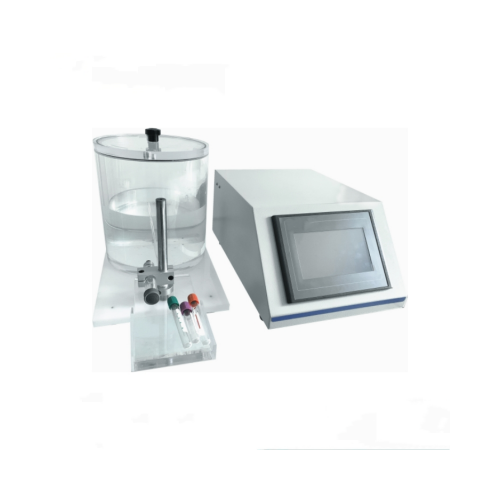
This Vacuum Blood Collection Tube Volume Tester is developed based on the applicable testing standards and adopts a combination of the negative pressure equilibrium method and gravimetric analysis.
The equipment is equipped with a PID closed-loop pressure control system, allowing users to set the target ambient atmospheric pressure and simulate operating conditions at different altitudes.
During testing, a standardized puncture assembly penetrates the rubber stopper of the blood collection tube and connects it to a water storage system. Under the pressure differential, purified water is drawn into the collection tube. The process automatically stops once fluid equilibrium is reached.
The system then automatically reads the data from the weighing module and calculates the aspirated volume based on the difference in weight before and after testing (1 g of water ≈ 1 mL).
The instrument automatically calculates the volume deviation and determines whether the result falls within the acceptable range of ±10%. Meanwhile, it records the vacuum pressure curve and equilibrium time.
The entire testing process is automated, effectively minimizing errors caused by manual operation and improving testing accuracy and consistency.
Key Advantages of the Equipment
1. Altitude and Atmospheric Pressure Simulation for Multi-Region Product Validation
The equipment incorporates an altitude-to-atmospheric-pressure conversion model, allowing users to set environmental pressure corresponding to altitudes ranging from 0 to 5.000 meters.
It can simulate both low-altitude and high-altitude operating environments, addressing the challenge of insufficient blood collection volume under high-altitude conditions. This feature supports product development and type testing for manufacturers supplying products across different geographical regions, including domestic and international markets.
2. Standardized Automatic Puncturing for Improved Testing Consistency
A dedicated positioning fixture ensures stable and consistent puncture depth, replacing manual puncturing operations.
This eliminates testing deviations caused by differences in manual puncture force and angle, improving repeatability and consistency between production batches.
3. High-Precision Weighing and Dual-Sensor Pressure Measurement
High-precision pressure sensors and a weighing module work together to collect data simultaneously, providing both vacuum pressure parameters and aspirated volume measurements.
Rather than simply determining whether a sample passes or fails, the equipment enables users to trace the relationship between vacuum decay and collection volume, providing valuable data for adjusting and optimizing the vacuum-filling process.
4. Compatibility with Multiple Tube Specifications
Replaceable positioning fixtures allow the equipment to accommodate common blood collection tube capacities, including 1 mL, 2 mL, 3 mL, 4 mL, 5 mL, and 10 mL.
It is suitable for testing various types of blood collection tubes, including anticoagulant tubes, clot activator tubes, serum separator tubes, and sodium citrate coagulation tubes.
5. Automatic Data Analysis and Reporting for Medical Device Quality Management
The instrument automatically calculates statistical parameters such as the average value, range, and coefficient of variation.
It can generate test reports and supports data storage, export, and printing. Testing logs can also be retained for traceability.
These functions support medical device GMP quality management, registration testing, annual quality reviews, and customer audits.
6. Preset Testing Programs for Efficient Operation
Multiple testing templates can be configured and saved for different tube specifications and altitude conditions.
Operators can quickly retrieve preset parameters when switching between products, eliminating repetitive setup procedures and simplifying daily testing operations.
This makes the equipment suitable for routine production inspections and batch sampling in laboratory environments.
7. Compliance with National and Industry Standards
The equipment is designed to meet the method requirements of ISO 6710 and WS/T 224-2018.
Its testing procedures can be used for test method verification and validation, while the generated reports can provide supporting documentation for third-party testing and medical device registration submissions.
Typical Applications
The Vacuum Blood Collection Tube Volume Tester is suitable for aspirated volume testing of various types of disposable vacuum venous blood collection tubes.
Typical applications include:
Blood Collection Tube Manufacturers
Online sampling inspection of the vacuum-filling process
Finished product inspection and factory release testing
Vacuum decay stability evaluation during shelf-life studies
Validation of new formulations and rubber stopper selection
Special validation of products designed for high-altitude environments
Other Application Areas
Medical device packaging material manufacturers
Third-party medical device testing laboratories
Hospital clinical laboratories for incoming consumable inspection and periodic performance verification
Conclusion
The accuracy of clinical laboratory testing begins with a qualified blood sample, and the foundation of a qualified sample is the stable and controlled vacuum pressure and blood collection volume of the collection tube.The Vacuum Blood Collection Tube Volume Tester standardizes and automates the traditionally complicated water absorption and weighing procedure while providing simulation capabilities for both sea-level and high-altitude conditions.By accurately monitoring vacuum pressure and blood collection volume compliance, the instrument helps blood collection tube manufacturers optimize and stabilize their vacuum-filling processes, control batch-to-batch variations, and reduce the risk of unqualified clinical specimens.Ultimately, it helps safeguard pre-analytical sample quality, reduce clinical risks, and support compliance with medical device quality inspection and regulatory requirements.
Previous: How Does a Blood Bag Drainage Tester Ensure Safety?
N e x t : the last page
