





What is a fabric blood penetration test?
2026/01/06
Share:

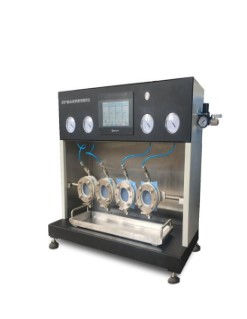
Testing Principle
The core principle of fabric blood penetration testing is to simulate real-world scenarios such as human blood pressure and blood splashing by controlling parameters such as pressure, spray speed, and contact time, to detect the critical conditions for synthetic blood to penetrate the fabric. During the test, the fabric to be tested is fixed to the test device, and synthetic blood with a surface tension of (0.042±0.002) N/m (simulating the viscosity and surface tension of human blood) is sprayed horizontally onto the target area at a specific pressure. The presence of penetration on the other side of the fabric is then observed.
This technology employs a visual judgment principle: if no visible wetting or color transfer is observed in the underlying absorbent material, the sample is considered to have passed the test. For example, in testing medical protective clothing, it is necessary to record the time point of penetration, the penetration area, and morphological characteristics. For samples in a critical state, auxiliary methods such as fluorescence detection can be used for precise analysis.
Technical Standards
Major global standard systems have proposed differentiated requirements for blood penetration testing of fabrics, forming a complete protection level covering low-risk exposure to extreme scenarios:
Chinese Standard (GB 19082-2009)
Requires key parts of protective clothing to pass a test of Level 2 (3.5 kPa) or higher, suitable for most medical procedures. The standard specifies five test pressure levels: 1.75 kPa, 3.5 kPa, 7 kPa, 14 kPa, and 20 kPa, corresponding to different risk scenarios:
Level 1 (1.75 kPa): Low-risk exposure environments (e.g., outpatient care)
Level 2 (3.5 kPa): Routine medical procedures (e.g., intravenous puncture)
Level 3 (7 kPa): High-risk surgical scenarios (e.g., orthopedic surgery)
Level 4 (14 kPa): Aerosol-generating procedures (e.g., bronchoscopy)
American Standard (ASTM F1670/F1671)
ASTM F1670 tests the ability of protective materials to resist the penetration of synthetic blood, while ASTM F1671 further evaluates the material's barrier performance against permeate containing Phi-X174 bacteriophage (a simulated bloodborne pathogen). Both use a test procedure of 13.8 kPa pressure for 1 minute, but the latter requires the addition of a fluorescent marker to the permeate to enhance detection sensitivity.
European Standard (EN 14126)
classifies protective clothing performance into 6 levels, with the highest level (Type 6) requiring the material to remain impermeable under 20 kPa pressure, suitable for protection against highly pathogenic pathogens such as Ebola.
Equipment Composition
The fabric blood permeability tester consists of four core components: a pressure control system, a spray device, a sample fixation module, and a data acquisition unit. Their technical parameters directly affect the accuracy of the test results:
Pressure Control System
The test pressure is regulated using compressed air, covering a range of 0-20 kPa with an accuracy of ±0.001 kPa. For example, one model uses a precision pressure reducing valve to achieve stepless pressure adjustment, ensuring pressure stability under different standards.
Spray Device
The nozzle diameter is Φ0.84 mm, and the spray speed is divided into three levels: 450 cm/s, 550 cm/s, and 635 cm/s, simulating different spray scenarios. One model uses a positioning target design to ensure that only the steady-state flow portion is sprayed onto the sample, resulting in a repeatability error of less than 2% for the spray speed.
Sample Fixation Module
A convex clamp is used to simulate actual use, leaving a 100 mm × 100 mm test target area while avoiding clamping force that could damage the material structure. For example, one device eliminates the risk of edge leakage through mechanical end-face sealing technology, ensuring an effective test area accuracy of ±0.1 cm².
Data Acquisition Unit
Integrating a high-resolution camera and image processing system, it automatically identifies penetration traces and calculates the penetration area. Some devices are also equipped with pressure-time curve recording functions, allowing traceability of pressure fluctuations throughout the testing process.
Industry Applications
Product Development Optimization
A company discovered through testing that its polylactic acid antibacterial nonwoven fabric achieved a penetration time of 120 seconds under 3.5 kPa pressure, three times faster than traditional materials. Based on this data, the company optimized the material's pore structure, enabling the product to pass Level 4 (14 kPa) certification and successfully enter the high-end surgical gown market.
Production Quality Control
A mask manufacturer introduced an automated testing line, achieving a high-speed sampling inspection of 5 masks per minute. By providing real-time feedback on pressure difference and penetration data, the defect rate was reduced from 0.8% to 0.05%, saving over 2 million yuan in quality costs annually.
Market Supervision and Spot Checks
During the nationwide spot check of protective clothing in 2025. regulatory authorities used portable testing equipment to conduct on-site testing on 300 batches of products, identifying 12 batches of products that failed to meet the permeation pressure standard, thus preventing substandard products from entering medical institutions.
Export Compliance Verification
A company developed a new type of protective clothing for the EU market. By adjusting the material coating thickness, the product simultaneously met the EN 14126 (20kPa) and ASTM F1671 (13.8kPa) standards, increasing the export clearance rate to 99%.
Technological Trends
With breakthroughs in new materials and IoT technologies, fabric blood permeability testing is evolving in the following directions:
Intelligent Compensation Algorithms
Machine learning is being used to correct the effects of temperature and humidity on synthetic blood viscosity, improving testing accuracy in complex environments. For example, one device can control pressure error within ±0.5% even at 35℃.
Multi-Parameter Integrated Detection
The development of composite devices that simultaneously test blood permeability, bacterial filtration efficiency (BFE), and particulate filtration efficiency (PFE) shortens the R&D cycle. A new instrument has achieved simultaneous detection of these three parameters, reducing single test time from 45 minutes to 8 minutes.
Cloud Platform Data Management
A global test data sharing platform is being established, supporting multi-device networking and quality traceability. One system has connected over 500 devices, storing over 10 million test data entries, providing data support for standard revisions.
From the laboratory to the production line, from the domestic market to global trade, fabric blood permeability testing technology has become a key tool for ensuring medical safety and driving industrial upgrading. With the continuous improvement of standards and the constant innovation of technology, this field will continue to build a more sophisticated technological defense for human health.
Previous: What is the instrument for measuring differential pressure?
N e x t : What is Maeser Water Penetration Tester?
