





What is the instrument for measuring differential pressure?
2026/01/06
Share:

Technical Principles
The core principle of this type of instrument is based on a dual mechanism of differential pressure sensing technology and constant airflow control. During the test, the instrument generates a stable airflow through a suction pump, penetrating the mask sample at a constant rate of 8L/min. At this time, a high-precision differential pressure sensor monitors the pressure difference between the inside and outside of the mask in real time and converts the data into a digital signal for display. If the pressure difference exceeds the preset range (usually 0-500Pa), the system will automatically trigger an alarm and terminate the test to ensure data accuracy.
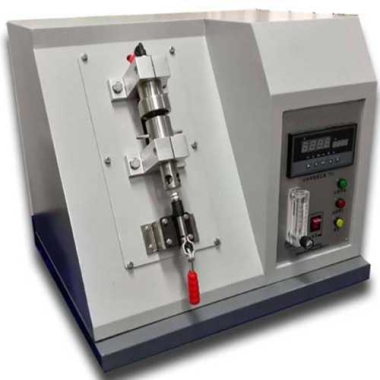
Taking a certain model of equipment as an example, it adopts a four-link self-locking clamping device and end-face sealing technology, with a sample clamping diameter of Φ25mm, which can be adapted to various samples such as surgical masks, KN95 masks, and textile materials. The equipment eliminates the risk of edge leakage through a mechanical seal structure and, combined with the low-power control technology of the digital display gas flow meter, achieves a flow accuracy of ±1%, ensuring the reproducibility of test results.
Core Parameters
According to international standards and industry requirements, the medical mask gas exchange pressure difference tester must meet the following technical parameters:
Gas Source System: Employs a suction-type vacuum pump, overcoming space limitations and supporting flexible deployment in laboratories and production sites.
Flow Control: A constant airflow rate of 8L/min, complying with YY 0469-2011 "Technical Requirements for Medical Surgical Masks" and EN 14683:2014 standards.
Sensing Accuracy: The differential pressure sensor has a range of 0-500Pa and a resolution of 0.1Pa, capable of capturing minute pressure fluctuations.
Sealing Design: Dual protection with O-rings and mechanical end face seals ensures the accuracy of the effective test area.
Human-Machine Interaction: A 60° tilted operating panel and digital display screen, ergonomically designed for enhanced operating comfort.
For specific application scenarios, some devices support parameter customization. For example, masks exported to the United States must meet the ASTM F2100 standard, requiring a pressure difference ≤50Pa/cm² under an airflow of 30L/min; while the Japanese market follows the JIS T8151 standard, testing an airflow rate of 60L/min. This type of customization makes the instrument a preliminary check for export compliance.
Application Scenarios
Large-Scale Production Quality Inspection
In mask production lines, this instrument can achieve high-speed sampling inspection of 3-5 masks per minute. One company, by introducing an automated testing system, increased the efficiency of manual inspection by 40%, while reducing the missed detection rate of products with excessive breathing resistance from 15% to 0.5%. Its children's medical masks, with breathing resistance as low as 12Pa, quickly gained a market share exceeding 15% after their market launch.
Market Supervision and Sampling Inspection
Portable devices (weighing 3-5kg, equipped with lithium batteries) support rapid on-site testing. In a nationwide sampling inspection campaign in 2025. regulatory authorities used this type of instrument to complete testing in 30 cities and 200 stores within a week, identifying 6 batches of substandard products and preventing inferior masks from entering the market.
R&D Optimization and Verification
The instrument can simulate extreme conditions such as high humidity and prolonged wear to evaluate mask performance degradation. A research team found through testing that seaweed fiber masks, under 85% humidity, only experienced an 8% increase in pressure difference compared to dry conditions, providing data support for material improvement.
Export Compliance Testing
Cross-border e-commerce companies have increased the customs clearance rate of masks exported to the United States from 88% to 99% by using instruments for pre-testing. This proactive identification of pressure differential exceeding limits avoids cargo delays and fines.
Industry Impact
Filling Domestic Technological Gaps
Early, domestic mask testing relied on imported equipment, which was costly and difficult to maintain. The successful development of domestically produced instruments has reduced testing costs by 60% and promoted the implementation of standards such as YY 0469-2011. laying the foundation for standardized industry development.
Promoting Innovation in Niche Markets
For derivative products such as sports masks and medical protective clothing, instrument manufacturers have developed multi-parameter testing modules that can simultaneously test pressure differential, filtration efficiency, and synthetic blood penetration performance. One sports brand optimized its mask structure using this technology, reducing breathing resistance by 30% during exercise.
Supporting Public Health Emergency Response
During sudden outbreaks of epidemics, the rapidly expanding mask production capacity placed higher demands on quality inspection efficiency. A company reduced the testing time of a single device from 5 minutes to 90 seconds through modular design, meeting the quality inspection needs of a daily production capacity of one million pieces.
Technological Trends
With the development of Industry 4.0 and IoT technologies, medical mask gas exchange pressure difference testers are evolving in the following directions:
Intelligent Compensation Algorithms: Using machine learning to correct the impact of temperature and humidity on pressure difference values, improving testing accuracy in complex environments.
Digital Twin Applications: Combining finite element analysis to build virtual test models, reducing the number of physical prototype tests and shortening the R&D cycle.
Cloud Platform Integration: Achieving multi-device data networking, supporting remote monitoring and quality traceability, and providing tools for global supply chain management.
From the laboratory to the production line, from the domestic market to global trade, medical mask gas exchange pressure difference testers have become core equipment for ensuring mask performance. Their technological iterations not only drive the upgrading of testing standards but also profoundly influence the sustainable development path of the medical protective equipment industry. With continuous breakthroughs in materials science and sensing technology, this field will continue to build more sophisticated technological barriers for human health and safety.
Previous: How to measure clamping force?
N e x t : What is a fabric blood penetration test?
