





What is a Mask Visual Field Tester?
2026/01/16
Share:

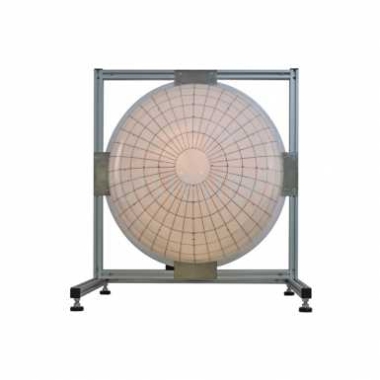
What is a Mask Visual Field Tester?
The Mask Visual Field Tester is a laboratory device specifically designed to measure the visual field range when wearing protective respiratory equipment. It can quantitatively evaluate the size and extent of the wearer’s field of vision after donning protective gear. The device is applicable to various types of respiratory protection products, including daily protective masks, face shields, and gas masks.
By simulating the spatial relationship between the human visual field and the test specimen, and utilizing a standard headform combined with a semicircular arc frame, the instrument measures visual coverage at different angles. This allows for an objective evaluation of whether the wearer’s visible field meets relevant standard requirements.
Testing Objectives
When wearing protective masks or respiratory devices, product structure may obstruct vision, potentially affecting the wearer’s work efficiency and safety. Therefore, the main purpose of the Mask Visual Field Tester is to measure the visual field under standardized conditions and determine the extent of visual restriction caused by different protective equipment.
Through this test, the following can be achieved:
Measurement of visual field range – quantitatively recording visual width and visual angle area after wearing protective equipment.
Assessment of visual obstruction – identifying the severity of vision blockage and potential blind spots.
Support for product design and improvement – providing data to optimize both protection performance and wearer comfort.
Verification of regulatory compliance – helping manufacturers and testing institutions confirm that products meet national or industry standards regarding visual field requirements.
Testing Principle
Mask visual field testing generally follows a method combining geometric projection with a standard headform model to measure the visual field range when wearing protective equipment. The core approach includes:
Using a standard headform built according to specified dimensions and interpupillary distance, onto which the test sample (mask or respirator) is mounted.
Employing a semicircular arc frame marked with angle scales to measure visual range in different directions.
Simulating natural line of sight by rotating the arc frame and aligning visual boundaries to determine the visible field.
Using dedicated software to automatically calculate visual field area based on recorded angles and generate comparable data.
1. Semicircular Arc and Visual Measurement
The semicircular arc frame is centered around the headform position and marked with angle increments, typically every 15 degrees or finer. It allows measurement of visual range in left, right, upward, and downward directions. During testing, the headform wearing the protective device is positioned at the center of the arc frame, and the maximum visible angles are recorded.
2. Standard Headform and Light Points
The standard headform represents an average adult head with correctly positioned eye points. Small light bulbs are installed at the eye positions to simulate the origin of vision. Their placement relative to the arc frame follows relevant respiratory protection standards, facilitating accurate visual projection and software recognition of visual boundaries.
3. Visual Field Area Calculation
Specialized software records visible angles in all directions and converts them into a two-dimensional visual field map. The final visual field area is typically expressed in square millimeters (mm²), allowing comparison among different protective devices.
Technical Specifications and Standards
Key technical parameters of the Mask Visual Field Tester include:
Arc radius: typically 300–305 mm, capable of rotating around the horizontal axis with marked angle scales.
Standard headform with light sources: positioned according to national standards to ensure accurate projection.
Automated visual field calculation system: computer software records angles and calculates visual area in mm².
The instrument is commonly used in accordance with the following standards:
GB/T 32610-2016 – Technical specification for daily protective masks.
GB 2890-2009 – Respiratory protection – Self-priming filter gas masks.
GB 2626-2006 – Respiratory protection – Self-priming filtering respirators against particles.
GB 21976.7-2012 – Building fire escape equipment – Part 7: Filtering self-rescue respirators.
These standards ensure consistency, comparability, and reliability of visual field testing across different products.
Instrument Structure
A typical Mask Visual Field Tester consists of:
Semicircular arc frame and support stand
Used to measure visual angles and stabilize the system.
Standard headform assembly
Holds the tested protective equipment in a standardized position.
Light source system
Simulates eye position and enables visual projection.
Data acquisition and analysis system
Uses computer software to record angles and compute visual field area automatically.
Applications
The Mask Visual Field Tester is widely used in:
Protective mask manufacturers – for quality control and product optimization.
Testing and certification institutions – providing objective visual field evaluation.
Research and clinical studies – analyzing ergonomic comfort and visual impact.
Regulatory authorities – assessing product compliance with national standards.
Development Trends
Future development of visual field testing technology is expected to include:
Higher automation and intelligent data processing.
Integration with 3D visualization and image analysis for clearer results.
Enhanced support for ergonomic and comfort studies through dynamic headform simulation.
The Mask Visual Field Tester is an essential tool for evaluating the visual performance of masks and respiratory protection equipment. Through standardized methods and precise measurements, it provides objective data for product design, quality control, and regulatory compliance. As testing technology continues to evolve, this instrument will play an increasingly important role in improving the safety, usability, and comfort of protective equipment.
Previous: Protective Clothing Vertical Flame Spread Tester,BS EN ISO 15025:2002
N e x t : Dry microbial penetration resistance tester,ISO 22612
