





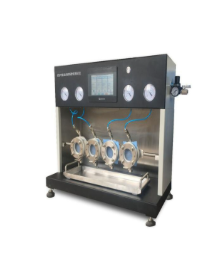
Anti Synthetic blood penetration tester, ASTM F1671
2026/01/20
Share:

Why Synthetic Blood Testing Matters
Protective equipment such as gowns, face masks, aprons, gloves, and coveralls are intended to serve as barrier layers that prevent blood and other potentially infectious materials from reaching the wearer’s skin or underlayers of clothing. Bloodborne pathogens such as hepatitis B, hepatitis C, and HIV can be transmitted through direct contact with infected blood or body fluids. Personal protective equipment (PPE) that fails to block fluids under exposure can endanger both healthcare workers and patients or laboratory staff. (疾病控制与预防中心)
To ensure these materials perform as expected, synthetic blood penetration tests are used as standardized screening methods to measure how resistant materials are to liquid penetration under pressure. Synthetic blood is formulated to have surface tension and viscosity properties similar to human blood and other body fluids, making it an appropriate surrogate for testing barrier performance. (疾病控制与预防中心)
Standards
Two of the most widely recognized standards governing synthetic blood penetration testing are ASTM F1670 and ISO 16603:2004. These standards define how testing should be conducted, what constitutes penetration, and how results are evaluated. (ASTM International | ASTM)
ASTM F1670 (American Society for Testing and Materials) specifies a test method for determining the resistance of materials used in protective clothing to penetration by synthetic blood under conditions of continuous liquid contact. This test is typically a qualitative evaluation: material specimens are exposed to synthetic blood under a defined hydrostatic pressure, and penetration is determined by visual inspection of the opposite side of the material. (ASTM International | ASTM)
ISO 16603:2004 (International Organization for Standardization) describes a laboratory test method to measure penetration resistance of protective clothing materials to synthetic blood and body fluids. Unlike some single‑pressure methods, ISO 16603 often involves multiple pressure levels to classify material performance into different categories, offering more nuanced insight into how well a material resists fluid under a range of pressures. (国际标准化组织)
Both ASTM and ISO methods are commonly used as preliminary screening tests to determine whether materials warrant further evaluation with more sophisticated protocols, including tests for viral penetration. (ASTM International | ASTM)
How the Tester Works
An Anti‑Synthetic Blood Penetration Tester is engineered to apply controlled pressure to a specimen while a supply of synthetic blood is applied to one side of the material. The tester includes a sealed chamber, adjustable pressurization system, and sample clamping mechanism. A typical tester may support several test stations and a range of pressure points, often from 0 kPa up to around 30 kPa or more. (labtesting-equipment.sell.everychina.com)
Before a test, material samples—typically cut into standard sizes such as 75 × 75 mm—are mounted securely within the device. Synthetic blood is then introduced on the external side of each sample. Compressed air or another pressurizing medium applies consistent pressure behind the fluid so that it contacts the material’s surface. The tester maintains that pressure for a predetermined duration. (SKYLINE INSTRUMENTS CO.,LTD)
Penetration is observed directly: if synthetic blood appears on the inner side of the material or passes through to a collection surface, the material is considered to have failed at that pressure and time condition. The equipment often features digital timing, pressure gauges, and controls for precise adjustment and repeatability. (labtesting-equipment.sell.everychina.com)
Test Parameters and Performance Classification
Standardized bodies of testing define specific pressure level sequences and durations to assess penetration resistance. For instance, ISO 16603 uses a series of stepwise pressures—starting from minimal values up to 20 kPa or higher—to categorize materials into different resistance levels. A material that blocks synthetic blood penetration at higher pressures is considered to have a higher performance class. (Pacific Certifications)
ASTM methods typically involve pressurizing the test cell to a representative pressure (e.g., 13.8 kPa, equivalent to about 2 psi), holding that pressure for a specific time, and then visually inspecting for penetration. Because these tests do not simulate all real actions that might occur in use, they provide comparative rather than absolute measures of performance. (ASTM International | ASTM)
Applications
The Anti‑Synthetic Blood Penetration Tester has applications across multiple fields:
Healthcare and Clinical PPE: Hospitals and clinics rely on barrier garments to protect surgeons, nurses, and emergency responders from blood and bodily fluid exposure. Testing ensures that gowns, gloves, and face shields used in high‑risk procedures meet required safety standards before deployment. (Google Sites)
Personal Protective Equipment (PPE) Manufacturing: During product development and quality control, manufacturers use penetration testers to validate material choices and production processes. This helps reduce product failures and ensures consistent performance across production batches. (GESTER INTERNATIONAL CO.,LTD)
Regulatory and Certification Processes: Regulatory agencies and inspection centers often require synthetic blood penetration test results as part of certification for protective clothing intended for clinical or laboratory use. Compliance with standards such as ISO 16603 and ASTM F1670 helps products gain market access and regulatory approval. (疾病控制与预防中心)
Other High‑Risk Environments: Beyond healthcare, synthetic blood penetration testers are used for protective clothing assessments in emergency response, security, chemical processing, and research laboratories where workers may encounter hazardous fluids. Ensuring reliable barrier performance enhances worker safety in numerous industries. (Google Sites)
Challenges and Considerations in Testing
While synthetic blood penetration testing provides essential data on fluid resistance, it is important to recognize the limitations of any single test method. For example, real blood and bodily fluids have complex biochemical compositions, and their behavior under pressure may differ from the synthetic solutions used in laboratory testing. Moreover, actual exposure can involve mechanical stresses, abrasion, or flexing of materials that are not fully simulated in static pressure tests. (uafl.co.uk)
Also, selecting the appropriate pressure range, test duration, and environmental conditions is crucial to ensure that results are relevant for intended use scenarios. Some materials may perform well at one pressure but fail at higher pressures or when combined with other stressors such as moisture or temperature extremes. (uafl.co.uk)
Integrating Testing into Safety Assurance
In a comprehensive protective clothing evaluation program, synthetic blood penetration testing is one component of a larger set of performance criteria. Other tests may include viral penetration assays, seam integrity evaluations, abrasion resistance, wetting performance, and material durability under repeated use or laundering. Together, these assessments provide a holistic picture of how a material or garment performs in real use conditions. (PMC)
Future
As safety standards evolve and materials technology advances, synthetic blood penetration testers are becoming more automated, precise, and integrated with digital data systems. Testing laboratories increasingly implement sensors, data logging, and software analysis to ensure consistent results and traceability in quality assurance workflows. Advances in synthetic blood formulations and more sophisticated test protocols aim to better mimic real use conditions and provide deeper insights into material performance. (LinkedIn)
An Anti‑Synthetic Blood Penetration Tester is a critical tool in the evaluation of protective clothing materials, providing standardized, repeatable assessments of fluid resistance under controlled pressure conditions. Guided by internationally recognized standards such as ASTM F1670 and ISO 16603. this testing method helps manufacturers, regulatory bodies, and safety professionals ensure that protective garments provide reliable barriers against blood and body fluid penetration. Whether in healthcare, emergency response, laboratory research, or industrial applications, synthetic blood penetration testing enhances safety, supports compliance, and drives innovation in protective material design and quality assurance. (PMC)
Previous: Gelbo Flex flexing chamber,EN 13795-2-2004
N e x t : Fabric Friction Charging Charge Tester,JIS L-1094
