





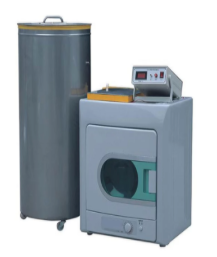
Fabric Friction Charging Charge Tester,JIS L-1094
2026/01/20
Share:

At the core of static friction measurement lies a class of instruments designed to quantify the frictional resistance between surfaces under controlled conditions. These instruments vary in complexity from simple inclinable planes used in educational settings to advanced laboratory machines that follow international standards for material testing.
Tribometers: The General Friction Measurement Instrument
A tribometer is the foundational instrument among devices that measure frictional forces between surfaces. Derived from the field of tribology—the study of friction, wear, and lubrication—a tribometer quantifies frictional interaction by bringing two surfaces into contact and measuring forces as they resist motion. Tribometers have been used since the 18th century to understand friction and wear phenomena in both scientific and industrial contexts.
Tribometers encompass a wide range of specific designs and configurations. In a typical arrangement, a known normal force is applied to press one surface against another. The instrument then records the frictional force needed to initiate movement, which is essential for determining the static friction coefficient. Advanced tribometers can simulate different contact conditions, materials, and motion modes, offering highly repeatable and precise measurements.
Specific Instruments and Methods to Measure Static Friction
While the term tribometer describes a broad category, several specialized machines are used specifically to measure the static friction coefficient. These are often referred to as friction testers, coefficient of friction testing machines, or simply static friction measurement devices.
Inclined Plane Friction Testers
One of the simplest and most intuitive methods for measuring static friction is the inclined plane test. In this setup, a sample material is placed on a flat surface that can be tilted. The operator gradually increases the angle of the plane until the sample just begins to slide. The angle at which sliding initiates directly relates to the static friction coefficient—a relationship that reflects the balance of forces resisting motion. Specialized inclined plane instruments automate this process with motors and sensors, calculating and displaying the friction coefficient once motion starts.
These instruments are especially useful for flat sheet materials like plastic films, paper, and textiles. Automated inclined plane machines often integrate touch-screen control and data logging, making them suitable for quality control and research environments where many samples need to be tested consistently.
Horizontal Coefficient of Friction Testers
Another prevalent approach uses a horizontal plane with a sled or weighted block placed on the surface to be tested. The instrument applies a controlled pull—either by motorized means or via a load cell—to move the sled across the surface. The force required to initiate motion is recorded and divided by the normal force (often the weight of the sled) to calculate the static friction coefficient. This method aligns with widely accepted testing standards such as ASTM D1894 and ISO 8295. particularly in industries such as packaging where plastic films and sheets are common test subjects.
Horizontal friction testers can range from simple laboratory benches to highly precise digital machines. Many modern devices include advanced sensors, digital readouts, and data storage features to create detailed friction profiles for research and quality assurance purposes.
Dynamic and Combined Friction Testers
Some instruments are designed to measure both static and kinetic (dynamic) friction within the same test cycle. These devices apply controlled forces to a test sample and record both the peak force required to break static friction and the steady-state force needed to maintain motion. The resulting data gives engineers a comprehensive understanding of how a material behaves under both conditions.
Such combined testers are especially valuable when materials undergo complex real-world interactions where both starting and sustaining motion are relevant—for example, conveyor belts, tire treads, or flexible packaging feeding through production machinery.
Why Measuring Static Friction Matters
Accurate measurement of static friction is critical across many fields. In manufacturing, material friction characteristics influence how items feed through machines, stack in packaging, or resist slippage during transport. In safety engineering, knowing the static friction of flooring materials helps reduce slip-and-fall hazards, particularly in public spaces where surface slip resistance must meet regulatory thresholds. In research and development, understanding the fundamental friction properties enables the design of surfaces with tailored behaviors, such as low-friction coatings or high-grip materials.
Beyond industrial applications, static friction measurement instruments also play a role in scientific studies of surface interactions. By quantifying the frictional resistance between microscopic or nanoscopic contacts, researchers explore fundamental physics and surface science phenomena, contributing to fields ranging from material science to biomechanics.
The instrument that measures static friction is not a single universal device but rather a family of tools collectively designed to quantify the resistance to motion between surfaces at rest. From the overarching category of tribometers to specialized inclined plane and horizontal sled testers, these instruments provide precise and repeatable data that help engineers, scientists, and quality control professionals understand and control frictional behavior. Whether for industrial quality assurance, safety assessments, or scientific exploration, static friction measurement remains a cornerstone of tribology and material testing.
By integrating controlled force application, accurate sensing of motion onset, and standardized calculation methods, these instruments transform the abstract concept of static friction into actionable data for design, manufacturing, and safety optimization.
Previous: Anti Synthetic blood penetration tester, ASTM F1671
N e x t : Medical Mask Differential Pressure Tester, ASTM F2100
