





Gelbo Flex flexing chamber,EN 13795-2-2004
2026/01/20
Share:

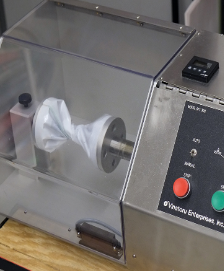
The Purpose of the Gelbo Flex Flexing Chamber
At its core, the Gelbo Flex flexing chamber is engineered to apply complex mechanical stresses—specifically twisting and compression—to a test specimen in a controlled environment. Its primary application is to assess the durability and integrity of flexible materials, including films used in packaging and fibers in non‑woven textiles. The chamber allows researchers to quantify how materials respond when subjected to repeated bending motions that mimic actual handling conditions.
One important use of this apparatus in textile testing is measuring the amount of loose fibers (lint) that are shed by non‑woven materials during flexing cycles. This type of measurement helps materials developers understand how a product will behave in dry conditions and informs quality standards for everything from medical textiles to consumer products.
How the Flexing Process Is Conducted
The Gelbo Flex test procedure places a sample inside a flexing chamber, which is typically a cubic enclosure measuring around 300 mm per side. This chamber houses two mandrels—one fixed, and one attached to a moveable arm. During the test, the sample is clamped between the mandrels and exposed to synchronized twisting and horizontal compression cycles. Air is drawn from the chamber, and any particles dislodged during flexing are counted and classified using an onboard or connected particle counter.
In applications where particle analysis is important, such as textile lint measurement, a laser or optical particle counter counts airborne particles in real time across a defined size range. This data can reveal not only the quantity of particles released but also their size distribution, which has implications for both industrial performance and user safety.
The chamber design often includes removable panels for ease of cleaning and maintenance, along with air intake probes that ensure samples of airborne debris are efficiently funneled to the counting system. In some implementations, HEPA filtration is used to minimize background contamination, improving the accuracy of particle measurements.
Standardized Test Methods and Industry Relevance
The Gelbo Flex test is not only a practical tool but is also widely recognized within global testing standards. In particular, ASTM F392 outlines the flex durability test method for flexible barrier materials such as films and laminates. This standard defines specific procedures and parameters—including the magnitude of twist, the speed of cycles, and sample dimensions—ensuring consistent testing across laboratories and industries.
Typical testing conditions under these standards involve a twisting motion of up to 440° followed by horizontal compression, repeated at a frequency of around 45 cycles per minute. Depending on industry requirements and material characteristics, several conditioning levels can be chosen, ranging from light stress to extended fatigue testing.
What the Test Reveals About Material Performance
Through repeated flexing, materials can develop micro‑defects such as pinholes, cracks, or separation of layers, which are critical indicators of long‑term durability. For example, barrier films used in packaging for food, medical devices, or pharmaceuticals must withstand both manufacturing and real‑world handling stresses without losing their protective functions. Detecting the onset of tiny defects early helps developers refine material formulations or choose better processing methods.
After a flexing cycle, specimens are typically inspected for physical damage. In packaging films, this might involve applying a dye or developer to highlight pinholes or conducting gas or moisture permeation tests to check if barrier properties were compromised. The results directly influence whether a material is considered suitable for a given application or requires reformulation.
Integration with Environmental Monitoring
Advanced versions of the Gelbo Flex flexing chamber incorporate environmental sensors that monitor parameters such as temperature, humidity, and air velocity during the test. Recording this contextual data alongside particle counts or mechanical outcomes provides a more complete picture of material behavior under real use conditions.
This integration is particularly valuable for complex products such as multi‑layer films or high‑barrier laminates, where interlayer interactions can influence overall performance. By correlating environmental conditions with mechanical responses, engineers can better predict how materials will behave in diverse climates and handling scenarios.
Broader Importance
Quality assurance teams in manufacturing and research laboratories use the Gelbo Flex flexing chamber not only to meet regulatory requirements but also to drive product innovation. By identifying weaknesses early in the development cycle, companies can reduce waste, avoid costly field failures, and enhance product reliability. In sectors where safety is paramount—such as medical or aerospace packaging—this kind of testing becomes a cornerstone of material selection and design validation.
Moreover, as industries continue to push for lighter, thinner, and more sustainable materials, the Gelbo Flex test offers a controlled way to compare performance trade‑offs between competing formulations. Continuous improvement in testing methods ultimately supports improved material performance across a wide range of applications.
The Gelbo Flex flexing chamber plays a pivotal role in modern material testing by simulating real‑world mechanical stresses and providing measurable insights into how films, fabrics, and other flexible materials withstand repeated strain. Through a combination of mechanical motion, particle analysis, and adherence to international standards, this testing method enables precise evaluation of durability and integrity. Whether used for evaluating lint release in textiles or determining flex durability in barrier films, the Gelbo Flex system is an indispensable tool for engineers, researchers, and quality specialists striving to ensure material performance, safety, and longevity.
Previous: What does a respirator fit test do?
N e x t : Anti Synthetic blood penetration tester, ASTM F1671
