





Metal Wire Wrap Tester,ISO 4101
2026/01/26
Share:

Basic Concept
The wire wrapping test is a plastic deformation test intended to determine the ability of a metal wire to withstand plastic deformation while being wound around a mandrel of specified diameter. In its basic form, the wire is tightly wrapped into a helical shape around a mandrel at a defined direction, speed, and number of turns. By observing deformation behavior, crack formation, surface damage, or load resistance after wrapping, the ductility and fatigue characteristics of the wire can be evaluated.
According to relevant standards, the wire wrapping test may include unidirectional wrapping, reverse wrapping, or even unwinding and rewinding procedures after the initial wrapping, in order to more comprehensively simulate secondary deformation conditions that may occur in real service environments.
Testing Standards
International Standard ISO 7802
The core standard governing wire wrapping tests is ISO 7802 – Metallic materials — Wire — Wrapping test. This standard specifies in detail the test methods, conditions, operating sequences, and allowable ranges for various test parameters.
The basic requirements defined in ISO 7802 include:
Wrapping the specimen tightly into a helical form around a mandrel of specified diameter, with each turn performed at a standardized speed
Allowing the application of tensile force to the free end of the specimen during wrapping, not exceeding a specified proportion of the nominal tensile strength, to control tensile stress during the test
When reverse wrapping, unwinding, or rewinding procedures are involved, the same steps must be performed slowly and consistently to prevent speed variation or temperature rise from affecting test results
The standard generally applies to metal wires with diameters or thicknesses ranging from 0.1 mm to 10 mm, covering a wide variety of metallic wire products.
In addition, the national standard GB/T 2976 also specifies test methods for bare wire wrapping tests, and its objectives and procedures are largely consistent with those of ISO 7802.
Working Principle
Instrument Structure
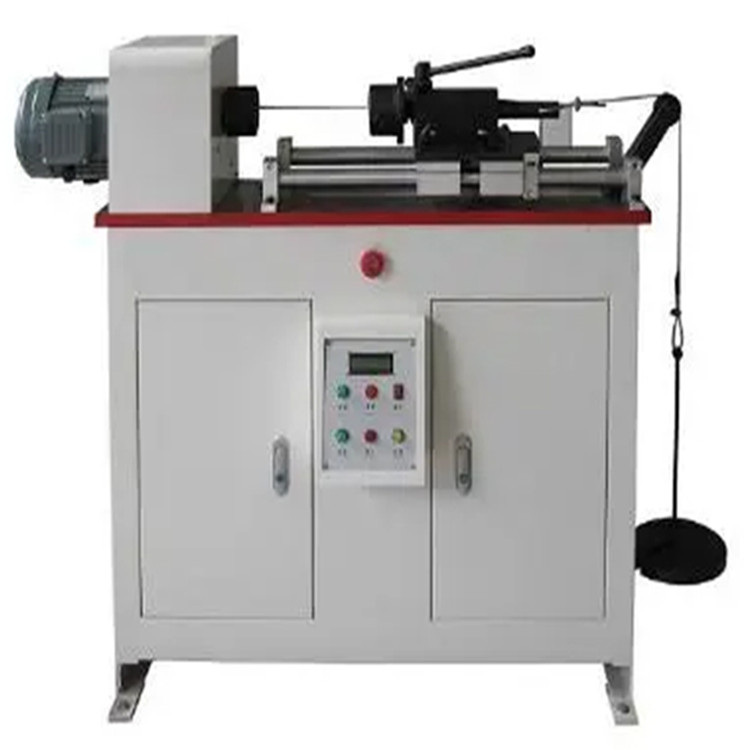
A metal wire wrap tester typically consists of the following key components:
Main frame and transmission system: Provides a stable structure and rotational power for testing
Mandrel fixture: Interchangeable mandrels of different diameters are used according to wire size to perform the wrapping operation
Rotary chuck or drive motor: Drives the mandrel to rotate at a specified speed and direction
Tension control device: Applies controlled tensile force to the free end of the wire to simulate realistic loading conditions
Counting and control system: Controls test sequence, speed, number of turns, and records test data
From a working principle perspective, the tester uses a motor-driven mandrel to rotate and uniformly wrap the wire specimen into a tight helix. This process represents a plastic deformation process, in which the wire is subjected to bending and increasing strain as the number of turns increases. As a result, the test directly reflects the ductility and plastic deformation limits of the material.
Key Test Parameters
During the wrapping test, several critical parameters must be defined:
Wrapping speed: Standards generally require a constant wrapping speed, typically not exceeding one turn per second, to avoid temperature rise affecting material properties
Number of turns: The required number of wrapping turns is determined based on material type and test objectives; some procedures include unwinding and rewinding to simulate more complex service conditions
Tension control: A controlled tensile force may be applied to the free end of the wire during wrapping, limited to a specified proportion of its nominal tensile strength, to realistically simulate deformation under load
Fully equipped wrap testers can automatically control and execute these parameters, significantly improving test repeatability and reliability.
Operating Procedure
Sample Preparation
Before testing, the wire specimen is cut to the length specified by the standard, any visible defects are removed, and the diameter or thickness is verified to be within the applicable range. For coated wires, the integrity of insulation or surface coating must be checked.
Installation and Adjustment
One end of the wire is fixed in the tester clamp, and the mandrel is installed and adjusted to the required diameter. Test parameters such as wrapping speed and number of turns are set via the control system.
Wrapping Execution
The test is initiated, causing the mandrel to rotate while the wire is guided in the specified direction to form a dense, visually observable helical coil around the mandrel. A specified level of tension may be applied during wrapping, as required by the standard.
Observation and Recording
After completion, the specimen is visually inspected for surface cracks, folds, coating delamination, or other defects. The number of wrapping turns and deformation characteristics are recorded to support material performance evaluation.
Evaluation Methods
The primary evaluation criteria of the wire wrapping test include:
Maximum number of wrapping turns: The maximum number of continuous turns the wire can withstand under specified conditions without visible cracking or fracture
Crack or damage location: Observation of surface cracks, splits, or other damage after wrapping
Residual deformation: The degree to which the wire fails to return to its original shape after wrapping
Coating integrity: For coated wires, assessment of coating peeling, cracking, or delamination after the test
These indicators reflect the material’s plastic deformation capacity, ductility, and fatigue resistance, and are useful for comparing different materials and processing conditions, as well as for guiding material selection and design.
Practical Applications
Material Performance Evaluation
In the development of new metal materials, the wrapping test reveals plastic deformation and failure behavior under combined bending and tensile strain, providing theoretical support for material modification and process optimization.
Quality Control and Batch Inspection
Routine wrapping tests during production help ensure batch-to-batch consistency and improve quality control. For example, frequent fracture or surface defects observed during sampling tests of steel wire or copper wire can serve as warning signals for production adjustment.
Coating Adhesion Verification
In addition to basic plasticity evaluation, the wrapping test is widely used to assess the adhesion strength of metallic coatings or insulating layers. For galvanized, copper-plated, or other coated wires, the test effectively reveals whether coatings are prone to cracking or peeling under bending conditions.
Development Trends
With the continuous advancement of materials science and manufacturing technology, wire wrapping test methods and equipment are also evolving. Current development trends include:
Higher automation levels: Integration of advanced control systems and data acquisition devices to improve automation and precision
Digital data analysis: Use of software-based data analysis to more scientifically evaluate continuous material performance
Multi-function integrated testing: Combining wrapping tests with other mechanical tests such as torsion and reverse bending into multi-functional test platforms to improve efficiency
Despite these advancements, challenges remain, particularly in achieving more precise evaluation of high-strength alloy wires and fine coating materials, as well as improving correlation between wrapping test results and real service loading conditions. Further research and standard refinement are still required.
The metal wire wrapping test is an important mechanical testing method for evaluating the plastic deformation behavior of wire materials. Based on international standards, it measures the performance of wires wrapped around a mandrel under defined conditions. The results provide valuable insight into ductility, fatigue characteristics, and coating adhesion, and serve as an essential basis for quality control, material comparison, and product evaluation. With ongoing advances in testing technology, the application of wire wrapping tests will continue to expand across materials engineering, manufacturing, and quality inspection fields.
Previous: What is the reverse bend test of wire?
N e x t : Battery Nail Penetration Tester, IEC 62133
