





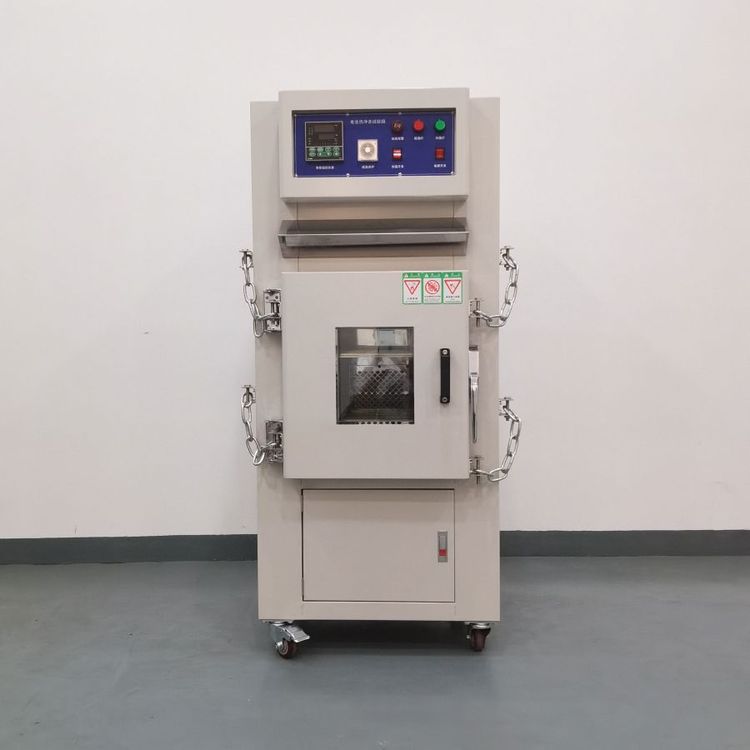
What is an STD Battery short-circuit tester?
2026/01/27
Share:

With the widespread application of lithium-ion batteries and other secondary batteries in consumer electronics, electric vehicles, and energy storage systems, battery safety has become an increasingly critical concern. Among the various safety risks, short circuiting is widely regarded as one of the most dangerous and destructive battery failure modes. The STD Battery Short-Circuit Tester was developed in this context as a key safety testing instrument. It is used to simulate battery behavior under extreme short-circuit conditions, providing reliable data for safety evaluation and compliance with relevant standards.
Battery Short-Circuit Risks and the Significance of Testing
A battery short circuit generally refers to a condition in which the positive and negative terminals are directly connected through an extremely low-resistance path, resulting in a sudden discharge of very high current. Short circuits can be caused by manufacturing defects, insulation failure, accidental contact with external conductors, mechanical damage during transportation, or misuse during operation. Once a short circuit occurs, a large amount of heat is rapidly generated inside the battery, which may lead to electrolyte decomposition, a sharp increase in internal pressure, and, in severe cases, fire, explosion, or cascading safety incidents.
The core function of the STD Battery Short-Circuit Tester is to reproduce these extreme conditions in a controlled, safe, and repeatable laboratory environment. By observing and recording changes in voltage, current, and temperature during the short-circuit process—as well as monitoring for hazardous events such as fire, rupture, or leakage—the tester enables an objective assessment of whether the battery design and manufacturing quality provide sufficient safety margins.
Basic Working Principle
The STD Battery Short-Circuit Tester typically creates an external short-circuit condition by directly connecting the positive and negative terminals of the test battery through an ultra-low internal resistance circuit under specified conditions. During the test, the system continuously monitors key parameters, including:
Short-circuit current behavior
Battery terminal voltage decay
Temperature changes at the battery surface or critical locations
Short-circuit duration and abnormal events
These data provide a clear indication of the battery’s thermal stability, electrochemical reaction intensity, and the effectiveness of internal safety components such as separators and protective devices under short-circuit stress.
Application Scenarios
Among various short-circuit tests, external short-circuit testing is the most fundamental and widely applied. The STD Battery Short-Circuit Tester is primarily used for this purpose, simulating real-world external short circuits caused by incorrect wiring, contact with metallic foreign objects, or terminal failures.
This type of testing is widely applied in:
Safety performance verification of lithium-ion batteries and battery packs
Factory quality control of batteries used in consumer electronics
Safety assessment for battery transportation and storage
Safety validation in the research and development of new battery materials and structures
By applying standardized short-circuit conditions, batteries of different designs or production batches can be compared objectively, providing valuable data to support product improvement.
Relationship with International Standards
Short-circuit testing is not merely an internal quality practice but a mandatory requirement defined in multiple international and national standards. The design and testing logic of the STD Battery Short-Circuit Tester are generally aligned with requirements such as:
Short-circuit test specifications in United Nations regulations for battery transport safety
External short-circuit resistance requirements in portable battery safety standards
Electrical abuse test requirements in industrial and energy storage battery safety evaluations
These standards typically define parameters such as short-circuit loop resistance, ambient temperature, test duration, and acceptance criteria, ensuring that test results are internationally comparable and authoritative.
Key Evaluation Criteria in Short-Circuit Testing
During testing with the STD Battery Short-Circuit Tester, the focus is not solely on whether a short circuit occurs, but on the battery’s overall behavior under short-circuit conditions. Key evaluation aspects include:
Occurrence of fire or explosion
Severe deformation or rupture of the battery casing
Whether the temperature exceeds defined safety thresholds
Presence of sustained combustion or secondary hazards
In some standards, even if the battery completely fails during the short circuit, it may still be classified as a “controlled and acceptable failure” provided that no hazards to personnel or the surrounding environment occur.
Value for Battery Design and Manufacturing
Test results obtained from the STD Battery Short-Circuit Tester provide important guidance for battery design and manufacturing. Based on short-circuit performance data, engineers can:
Optimize electrode materials and structures to reduce heat release during short circuits
Improve separator and electrolyte systems to enhance thermal resistance and flame retardancy
Verify the effectiveness of internal safety protection mechanisms
Evaluate the impact of different process parameters on overall safety performance
For high-energy-density applications such as electric vehicles and energy storage systems, short-circuit testing is an indispensable safety validation step prior to market introduction.
Safety and Test Environment Control
Due to the inherently high-risk nature of short-circuit testing, the STD Battery Short-Circuit Tester is typically equipped with multiple safety protection measures, such as high-temperature-resistant structures, isolated operating areas, and abnormal event protection mechanisms. These measures ensure the safety of test personnel and the laboratory environment, while stable and well-controlled test conditions also improve data repeatability and result reliability.
The STD Battery Short-Circuit Tester is a critical component of the battery safety testing framework. By simulating the most severe and hazardous electrical abuse conditions, it helps the industry identify potential risks at an early stage and drives the development of safer and more reliable battery technologies. As global safety requirements for new energy products continue to rise, the importance of battery short-circuit testing and related equipment will only increase, making it an indispensable core tool in battery research, manufacturing, and certification processes.
Previous: Battery Nail Penetration Tester, IEC 62133
N e x t : Battery combustion tester,IEC 62281:2004
