





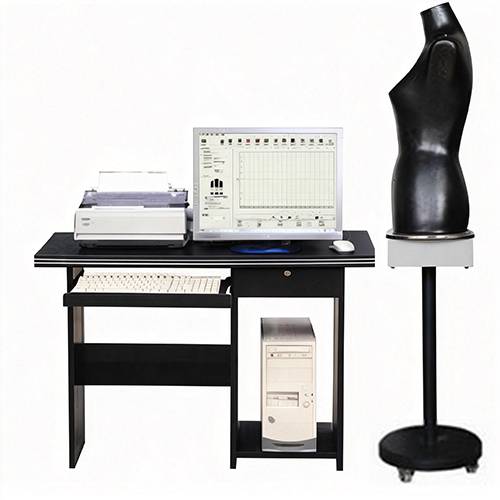
Simulated Human Body Underwear Tester,FZ/T 70015-2022
2026/02/09
Share:

The Importance of Underwear Performance Testing from Practical Needs
Underwear as part of the physiological system
Unlike general clothing, underwear is in close contact with the skin and directly affects heat balance, moisture management, wearing comfort, and surface pressure distribution. During exercise, prolonged office work, sleep, or in extreme environments, underwear performance in heat dissipation, moisture wicking, and pressure distribution significantly influences both subjective comfort and physiological status. Scientific performance evaluation is therefore essential for developing high-comfort underwear.
Limitations of subjective wear tests
Traditional wear tests rely on individual perception, which can vary widely due to physiological differences, mental state, and environmental conditions. To ensure results are scientifically valid and reproducible, instruments are used to simulate human thermal, moisture, and pressure responses under controlled conditions, allowing objective performance evaluation.
The Simulated Human Body Underwear Tester provides a scientific and standardized testing solution for underwear design, material performance evaluation, and comfort measurement.
What is a Simulated Human Body Underwear Tester
This type of tester simulates human heat generation, moisture transfer, thermal exchange, and physiological behavior. It is often based on a thermal manikin or a human-simulating model equipped with sensor systems. Typical systems include:
Heat sources
Temperature sensors
Humidity sensors
Pneumatic pressure sensors
Data acquisition and analysis systems
These systems allow evaluation of underwear material and structural thermal-moisture properties under controlled environmental conditions.
Thermal manikin core concept
A thermal manikin simulates human heat behavior through internal heating elements and temperature control, maintaining a surface temperature similar to human skin. This enables objective measurement of clothing thermal resistance, evaporative resistance, and heat transfer. Manikins are anatomically proportioned and include multiple independently controlled thermal zones to assess different body regions.
Extended functions of underwear testers
Advanced testers can simulate sweat evaporation and moisture transfer, evaluating the garment’s comprehensive thermal and moisture management performance. This approach provides more complete data than single-material tests, such as hot-plate methods.
Working Principles
Thermal simulation
The tester uses internal electric heating to maintain the model surface near human skin temperature (around 35°C). Multiple independently controlled zones allow separate evaluation of different body parts. Measuring the power required to maintain set temperatures allows analysis of heat loss with the garment and determination of thermal insulation performance.
For example, a typical thermal manikin may have zones for the chest, abdomen, back, arms, and legs, each with temperature sensors and independent heating circuits. Control software simulates dynamic heat flow across these zones to measure heat transfer within and through the underwear.
Evaporation simulation
Sweat evaporation is a key physiological heat dissipation process. High-end testers simulate sweating by releasing a controlled amount of moisture on the model surface, measuring changes in garment and environmental humidity. This enables evaluation of moisture management and thermal comfort, more closely reflecting actual wear conditions.
Pressure and fit assessment
Fit also affects comfort and functionality. Some testers include pressure sensors between the model and underwear to evaluate fit and support, ensuring garments are not too tight or loose. This is particularly useful for functional underwear, such as compression or athletic garments.
Standards and Methods
Although "Simulated Human Body Underwear Tester" is not a single standardized term, thermal manikin testing has been widely incorporated into international textile and apparel standards.
Thermal and evaporative resistance standards
Standards such as ISO 15831 (thermal insulation measurement using manikins) and ASTM F2370 (evaporative resistance using manikins) define methods for measuring clothing thermal and moisture resistance. Tests are conducted under controlled environments, and results serve as a basis for comfort analysis.
Experimental condition control
Standardized tests often require controlled chambers with set temperature, humidity, and airflow. Tests may be performed in static or dynamic conditions (e.g., walking simulation). Key parameters include ambient temperature (°C), relative humidity (%), and air velocity (m/s), all strictly set and recorded to ensure scientific validity.
Core Technologies and Data Significance
Thermal resistance analysis
Thermal resistance measures the garment’s ability to retain heat. By measuring the energy required to maintain set skin temperature, the thermal resistance of the worn garment is calculated. Higher values indicate greater heat retention, beneficial in cold conditions but potentially causing overheating in warm conditions. This data is critical for winter or athletic underwear development.
Evaporative resistance analysis
Evaporative resistance indicates how much the garment impedes sweat evaporation. High resistance can trap moisture, leading to discomfort and overheating. This is particularly important for sports and outdoor apparel. The tester quantifies this via simulated sweating and humidity sensors.
Pressure distribution and fit analysis
For compression, shaping, or medical support underwear, pressure distribution data evaluates fit. Excessive localized pressure may impair circulation or cause discomfort, while insufficient pressure reduces functional effectiveness. Sensor-mapped pressure data across the body aids design optimization.
Applications and Case Studies
Apparel design and development
Testing different materials and structural designs under controlled thermal and moisture conditions allows quick evaluation of candidate solutions, increasing R&D efficiency. For high-performance sports underwear, data on thermal and evaporative resistance informs fabric and weave selection for optimal sweat management and comfort.
Comfort evaluation and market positioning
Quantitative comfort data supports product labeling, marketing, and certification. Products can be classified as suitable for cold environments, high evaporation, or other performance criteria to accurately target consumer segments.
Functional product testing
Compression, shaping, or medical underwear relies heavily on fit and pressure data. The tester ensures function is met while maintaining comfort and safety.
High-end materials evaluation
For advanced fibers and smart textiles, thermal, moisture, and pressure data can be incorporated into performance models to verify whether materials meet design intentions. For instance, nano-coated fibers or temperature-regulating fabrics can be tested under simulated human conditions.
Industry Challenges and Future Directions
Enhancing dynamic testing capabilities
Current testers simulate static temperature and sweat behavior, but dynamic scenarios (exercise-induced heat variation, sweat distribution over time) remain challenging. Future development will focus on dynamic physiological simulation and realistic motion modeling.
Integrating intelligent data analysis
AI and machine learning can provide deeper insights into the relationship between underwear performance and human comfort, potentially recommending optimal designs for different usage scenarios.
Virtual simulation combined with real testing
Digital fitting, 3D body scanning, and virtual human models integrated with real manikin tests allow predictive early-stage evaluation, reducing prototype costs and optimizing R&D workflows.
The Simulated Human Body Underwear Tester is a high-precision, user-focused tool that has become a cornerstone of modern underwear development, standardized testing, and comfort evaluation. By scientifically simulating human heat, moisture, and pressure conditions, it provides objective, reproducible data for design and performance analysis, complementing traditional wear tests.
Accurate measurement of thermal resistance, evaporative resistance, and pressure distribution enables designers to optimize materials and structure, improving comfort and functionality. As technology advances, these testing methods will continue evolving, making underwear evaluation more comprehensive, precise, and intelligent.
Previous: What is one way to minimize the risk of chemical permeation into protective clot
N e x t : What is a Walk-in High-Temperature Aging Chamber?
