





High - speed Pellet Impact Testing Machine for Helmet Goggles,EN 166
2026/02/11
Share:

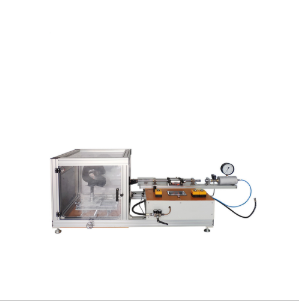
The high-speed particle impact testing machine is a specialized instrument designed to simulate the high-speed impact of steel balls or other standard particles on the surfaces of protective equipment such as helmets and goggles. By precisely controlling particle velocity, impact angle, and testing environment, it enables quantitative assessment of the equipment’s impact resistance. This article systematically explores the core value of high-speed particle impact testing machines in protective equipment testing from multiple perspectives, including technical principles, applicable standards, equipment structure, functional features, and industry practices.
Technical Principles and Testing Objectives
High-Speed Particle Impact Simulation
The core purpose of the high-speed particle impact testing machine is to use particles of standard mass and diameter (commonly steel balls) to strike the surface of the tested sample at a controlled speed, simulating real-world high-speed debris impacts. Typical steel balls have a diameter of approximately 5.5–6 mm and a mass of about 0.86–1 g. Particles are launched using compressed air or gas propulsion systems to reach the preset velocity, enabling assessment of helmets’ and goggles’ impact resistance.
Quantitative Evaluation of Impact Resistance
During testing, the machine launches steel balls at the sample surface at speeds set by the control system (e.g., 45 m/s, 90 m/s, 190 m/s). A high-precision velocity measurement system records the particle speed and impact results. The equipment evaluates impact resistance based on whether the sample fractures, sheds debris, or is penetrated. This quantitative evaluation ensures that protective equipment meets safety standard requirements during design, production, and inspection stages.
Relevant Standards
High-speed particle impact testing machines are subject to clear safety standards in different countries and regions. Various application scenarios—such as motorcycle helmets, industrial goggles, or firefighting helmets—impose specific impact resistance requirements.
International Standards
International standards such as EN 166. EN 168. and ANSI Z87.1 define minimum safety performance and testing methods for eye and face protection under high-speed particle impact. These standards ensure that protective equipment does not shatter when struck by flying debris.
Industry-Specific Standards
Motorcycle helmets, firefighting gear, and specialized protective equipment also have standards such as SNELL SA/K2010. AS1698. and DOT218. These standards impose stricter requirements on helmet and goggle impact velocity, impact location, and material strength. Testing machines must simulate a range of impact intensities to meet these diverse standard requirements.
Equipment Structure and Key Components
High-speed particle impact testing machines consist of several critical components to ensure test repeatability, accuracy, and safety.
Power and Launch System
Machines typically use pneumatic or compressed air systems as the propulsion source, equipped with high-speed valves to ensure particles reach the target velocity. Airflow and pressure specifications are set to maintain stable operation during testing.
High-Precision Velocity Measurement
Modern machines are often equipped with high-precision laser velocity sensors to monitor particle flight speed in real time. Speed readings are displayed clearly on touch screens or monitors, ensuring accurate and reliable test data.
Control and Monitoring System
Touchscreen control interfaces are the mainstream operation method for high-speed particle impact machines. Operators can set testing speeds, monitor impact processes, and read results intuitively. Machines also feature emergency stop systems and safety door limit devices to ensure personnel safety during testing.
Headform and Fixture
Helmets and goggles are mounted on headforms that simulate human heads, typically made of silicone or other materials replicating real head characteristics. The headform angle (0–90°) is adjustable, allowing realistic assessment of impact resistance under actual wearing conditions.
Safety Protection Facilities
To guarantee operational safety, machines are equipped with protective doors, photoelectric limit switches, and shields. Testing cannot start unless safety doors are securely closed, preventing accidents during operation.
Testing Applications and Industry Practices
The application of high-speed particle impact testing machines is broad, extending beyond motorcycles and industrial safety to various specialized fields.
Helmet Performance Testing
Motorcycle, rescue, and military helmets require high-speed particle impact testing to ensure they do not fail or fracture under debris or fragment impacts. Test results determine whether materials and structures meet standard requirements, forming a key part of headform impact assessment.
Goggles and Eye Protection Devices
Eye protection equipment used in industrial processing, laboratory work, and outdoor sports must also withstand high-speed impacts. The machine simulates steel ball impacts on goggles, enabling batch quality evaluation on production lines and ensuring user safety.
Face Shields and Specialized Protection
Firefighting face shields and other facial protection gear may face high-speed debris in practical use. Testing machines evaluate their resistance to high-energy particles, ensuring full compliance with standard performance requirements and minimizing injury risks for wearers.
Technological Development Trends
As testing technology and automation improve, high-speed particle impact testing machines continue to advance in precision, repeatability, and data analysis capabilities.
Intelligent Control and Data Analysis
Modern machines feature complete digital control systems and data management functions, recording real-time test data and generating reports that guide design optimization during the research phase.
Multi-Standard Compatibility
To meet different national and industry standards, equipment increasingly supports multiple standard settings. This allows evaluation of EN, ANSI, SNELL, AS, and other standards on a single platform, facilitating global product certification.
Safety and Automation
Safety interlock systems, automatic inflation systems, and other automated features are becoming standard, making the testing process safer and more reliable while reducing human error.
High-speed particle impact testing machines are essential for evaluating the high-speed impact resistance of helmets, goggles, and other protective equipment. Their technical principles, structural design, and testing methods align closely with safety standards, providing a scientific basis for research, production, and quality control. As safety requirements continue to rise, these testing devices are evolving toward greater automation and intelligence, strengthening the safety and protection of end-users.
Previous: What is a radiant panel test?
N e x t : What is the explosion temperature apparatus?
