





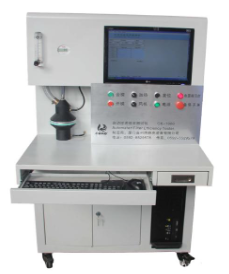
What is Filter Media Tester G500?
2026/02/24
Share:

Background and Significance of Filter Media Testing
Filtration technology is widely applied in industries such as manufacturing, environmental protection, healthcare, and air purification. As the core component of filtration systems, filter media performance directly affects filtration efficiency, service life, and overall application effectiveness. During use, filter media must effectively block target particles, contaminants, or microorganisms while maintaining reasonable gas or liquid flow resistance. Therefore, scientific and standardized testing of filter media is essential in research, production, and quality evaluation.
Filter media performance testing typically involves:
Filtration Efficiency: Measures the ability of the filter media to block particles or substances of specific sizes.
Pressure Drop: Describes the resistance to gas or liquid flow across the media at a defined flow rate.
Dust Holding Capacity: Represents the ability of the filter media to accumulate contaminants under a given load.
Dynamic Performance and Aging Behavior: Evaluates performance changes over extended real-world operating conditions.
These indicators determine not only the performance of the final filter product in practical use but also its ability to comply with international standards such as ISO, EN systems, or specific industry requirements.
The Filter Media Tester G500 is designed to address these complex performance requirements and serves as a critical instrument for comprehensive filter media evaluation in laboratory environments.
Basic Definition of a Filter Media Tester
A Filter Media Tester is laboratory equipment used to evaluate the ability of filter materials to capture specific particles, aerosols, or contaminants under standardized testing conditions, as well as to measure airflow or liquid resistance and other performance characteristics. Such instruments simulate real operating conditions in a controlled and standardized manner, conduct challenge tests on filter materials, and accurately record and quantify results.
The core functions of a filter media tester include:
Providing objective and highly repeatable performance evaluation results;
Supporting material selection and optimization during research and development;
Supplying data for product certification and standard compliance;
Supporting batch testing in production quality control processes.
From a testing scope perspective, it can be applied to filter paper, nonwoven fabrics, membrane materials, felt media, air filtration materials, and liquid filtration materials.
The Filter Media Tester G500 is a representative device within this category, designed to provide comprehensive performance evaluation using standardized testing methodologies.
Core Functions and Testing Principles of the G500
Although specific parameters and configurations may vary among different models, the fundamental working principles of the Filter Media Tester G500 generally include the following core functions:
Filtration Efficiency Testing
Filtration efficiency is one of the primary indicators used to quantify the ability of filter media to block target particles such as dust, aerosols, or fine particulates. The typical testing procedure includes:
Aerosol or Particle Generation: Standard salt solutions (such as sodium chloride), oil mists, or other challenge materials are used to generate aerosols with controlled particle size distributions.
Upstream and Downstream Counting: High-precision particle counters measure particle concentrations before and after the filter sample.
Efficiency Calculation: Filtration efficiency is calculated by comparing upstream and downstream particle concentrations, representing the percentage of particles captured by the media.
This method can be applied to both air and liquid filtration performance evaluation. Test results may include overall filtration efficiency as well as size-specific performance.
Pressure Drop Measurement
When air or liquid passes through filter media, additional resistance is generated, known as pressure drop. Pressure drop affects energy consumption, airflow settings, and application suitability.
During testing, precision pressure sensors record the pressure difference between upstream and downstream at a defined flow rate, allowing evaluation of flow resistance characteristics. These data are useful for optimizing material structure and performance design.
Multi-Particle Size Analysis
Advanced testing systems may support multi-channel or multi-size particle sampling, enabling simultaneous measurement of filtration performance across several particle size ranges (for example, 0.3 µm, 0.5 µm, 1.0 µm). Such size distribution analysis is particularly important for understanding complex filtration behavior and capturing efficiency variations across scales.
Automation and Data Output
Modern filter media testing systems typically feature a high degree of automation, including:
Automatic flow control;
Automatic particle counting and statistical processing;
Automatic test report generation;
Data storage and export functions.
This automation enhances repeatability, simplifies comparison across samples, and reduces human error.
Technical Elements of the G500
To achieve these functions, the equipment generally includes the following technical components:
Aerosol Generation and Control System
This subsystem generates reproducible challenge particles such as oil mist, salt aerosol, or dust. Particle size, concentration, and flow rate can be adjusted to meet standard testing parameters. After generation, charge neutralization devices are often used to balance particle charge and improve measurement accuracy.
High-Precision Particle Counting System
This system captures upstream and downstream particle concentration data, forming the basis for filtration efficiency calculation. Multi-channel or wide-range particle detectors provide more detailed analytical capabilities.
Pressure and Flow Control System
Comprising differential pressure sensors, flow control valves, and air circuit components, this system maintains stable and controllable testing conditions throughout the experiment, ensuring consistency and repeatability.
Sample Fixation and Clamping Mechanism
The tester must securely hold the filter sample to prevent leakage or disturbance during testing. Adjustable clamping systems accommodate different sizes and types of filter media materials.
Testing Standards and Specifications
Filter media performance testing must be conducted in accordance with relevant standards, as different countries and industries define distinct testing conditions. Filter media testers are generally designed to support standards such as:
Air filtration standards (e.g., EN149. EN143);
Particle filtration efficiency standards (e.g., NIOSH, ASTM F2299 or similar protocols);
Liquid filtration standards based on ISO or ASTM guidelines;
Comprehensive evaluation combining efficiency and pressure drop metrics.
These standards specify testing conditions such as flow rate, particle type, test area, and counting methods to ensure consistency across laboratories and equipment. Modern filter media testers are designed with compatibility for such standards in mind.
Typical Application Scenarios
Filter Media Research and Material Screening
During the development of new filter materials, the Filter Media Tester G500 enables comparative evaluation of multiple samples. It supports analysis of how fiber structure, pore design, or coating technologies affect filtration performance.
Product Quality Control
Filter media batches produced during manufacturing require performance verification to ensure compliance with established specifications. The equipment can perform periodic or scheduled testing in laboratory or production environments, supporting consistent quality assurance.
Standard Certification Testing
Research institutions and third-party laboratories use this type of equipment to conduct standardized tests on filter media or filter products and provide certification documentation.
Education and Scientific Research
Universities and research institutes may use such testing systems for experimental teaching and scientific investigations related to air or liquid filtration technologies.
Future Development Trends of the G500 Testing Platform
With ongoing advancements in filtration technology and increasing demand for high-performance materials, future trends in filter media testing equipment include:
Enhanced Multi-Size Particle Analysis
More refined particle size resolution will enable deeper understanding of filtration behavior for extremely fine particles, particularly in applications involving virus filtration and high-performance air filtration materials.
Simulation of Realistic Operating Conditions
Traditional testing methods focus on static conditions, whereas real-world applications involve dynamic and variable environments. Future systems may incorporate dynamic load simulation, humidity variation, and cyclic testing to better replicate practical usage scenarios.
Automation and Intelligent Testing Platforms
By integrating artificial intelligence and advanced automation technologies, future testing systems may optimize testing workflows, intelligently detect anomalies or trends, and provide more insightful analytical guidance for engineers.
The Filter Media Tester G500 is a professional device designed to evaluate filter media performance, focusing on key indicators such as filtration efficiency, pressure drop, and dynamic behavior. It plays an essential role in filter material research and development, manufacturing quality control, standard certification, and academic research. Through standardized testing procedures and precise particle counting and pressure measurement systems, the device provides high-accuracy and repeatable performance data, making it an indispensable experimental platform for filter material development and industrial application.
Previous: What are the 4 types of filtering?
N e x t : General Ventilation And Air Filter Test System
