





What is the kinematic viscosity test of oil?
2026/02/27
Share:

Basic Concept of Oil Viscosity
Before discussing kinematic viscosity testing, it is necessary to understand the meaning of viscosity as a physical property. Viscosity measures the internal friction of a fluid, reflecting the resistance between molecules during flow. For oils, higher viscosity indicates greater internal friction and poorer fluidity, while lower viscosity means the oil flows more easily, although lubrication performance may decrease under certain conditions. Viscosity is one of the most important physical properties of petroleum products, directly affecting lubrication, cooling, sealing, and energy transmission performance.
Dynamic Viscosity and Kinematic Viscosity
In fluid mechanics, viscosity is generally classified into dynamic viscosity and kinematic viscosity. Dynamic viscosity represents the internal shear resistance of a fluid and is related to molecular structure and temperature. Kinematic viscosity takes density into account and is defined as the ratio of dynamic viscosity to density. Therefore, when comparing the flow characteristics of oils with different densities, kinematic viscosity more accurately reflects their flow behavior.
Kinematic viscosity is commonly expressed in mm²/s (square millimeters per second) or cSt (centistokes), which are widely adopted international units. By definition, kinematic viscosity equals dynamic viscosity divided by density, a relationship that is fundamental in standard calculations.
Importance of Kinematic Viscosity Testing
Kinematic viscosity is a core parameter for evaluating oil performance and has several important functions:
Quality Assessment: Measuring whether viscosity meets specified standards helps determine whether the production process is qualified and whether the oil has been contaminated or mechanically degraded.
Application Suitability Evaluation: Equipment operating under different temperature conditions requires lubricants within specific viscosity ranges. Viscosity testing determines whether an oil is suitable for a particular application.
Condition Monitoring: During use, oil viscosity may change due to oxidation, fuel dilution, or water contamination. Periodic testing helps assess oil aging and contamination levels.
Maintenance Planning: In predictive maintenance and equipment monitoring, viscosity variation is an important indicator for detecting insufficient lubrication or oil degradation in advance.
Overall, kinematic viscosity testing is not limited to oil production and quality control; it spans the entire oil lifecycle and directly affects equipment safety and efficiency.
Principles of Kinematic Viscosity Testing
The most commonly used principle for kinematic viscosity testing is the Capillary Viscometer Method, as recommended by standards such as ASTM D445 and ISO 3104.
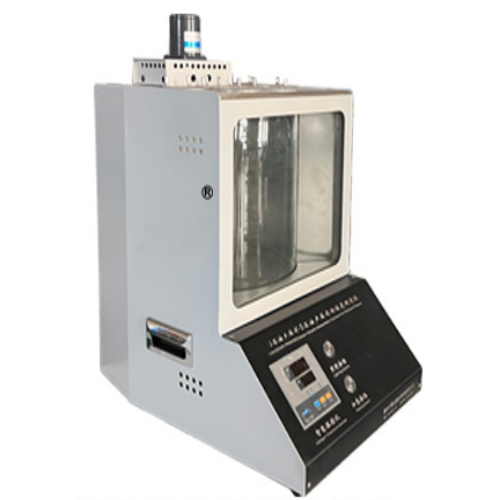
In this method, the oil sample is placed in a glass capillary viscometer immersed in a constant-temperature bath. Since the capillary tube has a fixed internal diameter and standardized geometry, the time required for the oil to flow under gravity reflects its viscosity. The longer the flow time, the greater the resistance to flow and the higher the kinematic viscosity.
Measurement Process of Capillary Viscometers
Before testing, the oil sample is introduced into the glass capillary viscometer. The instrument is then immersed in a precisely controlled constant-temperature bath, typically set at standard temperatures such as 40°C or 100°C. Once thermal equilibrium is achieved, the oil flows through the capillary tube. Timing begins when the oil passes the starting mark and stops when it reaches the end mark. The measured flow time multiplied by the viscometer constant yields the kinematic viscosity value.
Temperature control is crucial because oil viscosity is highly sensitive to temperature changes. As temperature increases, intermolecular friction decreases, resulting in lower viscosity. Therefore, high-precision temperature control is essential to ensure accurate results.
Testing Procedure for Kinematic Viscosity
Although operational details may vary depending on laboratory conditions and instrument types, the essential steps are as follows:
Sample Preparation
Ensure the oil sample is thoroughly mixed, free of air bubbles and suspended impurities, and adjusted to the required test temperature. The sample volume must meet viscometer requirements.
Temperature Stabilization
Place the viscometer containing the sample into the constant-temperature bath and allow sufficient time for thermal stabilization at the specified temperature (e.g., 40°C or 100°C).
Flow Timing
Once equilibrium is reached, allow the oil to flow naturally through the capillary and record the time taken to pass between calibration marks. Multiply the measured time by the viscometer constant to obtain the kinematic viscosity.
Data Processing
Tests are typically conducted in duplicate, and the average value is calculated to improve accuracy. The final viscosity value is obtained by multiplying the average flow time by the instrument constant.
Result Evaluation
Measured values are compared with specification limits to determine whether the oil meets performance requirements. This evaluation is essential for product adjustment, quality control, and maintenance decisions.
Standards and Specifications
Kinematic viscosity testing is regulated by several widely recognized standards.
ASTM D445
ASTM D445 is one of the most widely used standards for determining kinematic viscosity of transparent and opaque liquids. It specifies the capillary method for measuring kinematic viscosity at defined temperatures and allows further calculation of dynamic viscosity.
ISO 3104
ISO 3104 outlines procedures for determining kinematic viscosity of petroleum products and crude oil at specified temperatures. It emphasizes temperature control, capillary calibration, and proper sample preparation.
GB/T 265
In China, GB/T 265 specifies methods for determining kinematic viscosity and calculating dynamic viscosity of petroleum products. It is similar in principle to ASTM D445 and highlights temperature control, instrument usage, and data processing requirements.
These standards ensure global consistency and comparability of viscosity measurement results.
Interpretation and Significance of Test Results
The kinematic viscosity result is more than a numerical value; it provides significant technical insight.
Oil Grade and Suitability
Different oils—such as lubricating oils, hydraulic oils, and engine oils—must meet specified viscosity ranges at defined temperatures. Compliance indicates suitability for intended operating conditions.
Viscosity Variation and Oil Condition
Changes in viscosity during service can indicate contamination, oxidation, or mechanical degradation. Increased viscosity may suggest oxidation or contamination, while decreased viscosity may indicate fuel dilution or shear breakdown.
Temperature Sensitivity and Viscosity Index
The variation of viscosity with temperature is described by the Viscosity Index (VI). A higher VI indicates lower sensitivity to temperature changes and more stable performance. This parameter is critical in lubricant formulation and specification.
Common Misunderstandings and Precautions
Although the testing process appears straightforward, several issues must be considered:
Inaccurate temperature control can significantly distort results, so strict environmental management is required.
Improper sample handling, such as the presence of air bubbles or contamination, can affect accuracy.
Relying on a single temperature measurement is insufficient; multiple temperature data points and additional parameters should be considered for comprehensive evaluation.
Application Fields
Kinematic viscosity testing is widely applied across industries:
Mechanical and Engine Manufacturing: Used for lubricant formulation development, performance evaluation, and quality control.
Oil and Gas Production and Transportation: Used for rheological analysis of crude oil and fuel oils to guide transportation and storage planning.
Industrial Equipment Maintenance: Periodic viscosity testing monitors oil condition and supports predictive maintenance.
Standards and Product Certification: Test results form part of certification requirements to ensure compliance with performance standards.
Development Trends and Future Outlook
With advancements in petrochemical technology and testing instrumentation, kinematic viscosity testing continues to evolve. Automated testing systems, online monitoring equipment, and high-precision digital temperature control technologies are improving efficiency and accuracy. Integration with digital analytics and machine learning is also expanding possibilities for oil performance prediction and intelligent maintenance strategies.
Kinematic viscosity testing is one of the most fundamental and critical aspects of petroleum product analysis. Through standardized methods such as the capillary flow technique, accurate viscosity data can be obtained. These data are essential not only for verifying quality standards but also for equipment maintenance, formulation optimization, and operational safety assurance. Understanding the testing principles, procedures, and engineering significance is vital for technicians, quality inspectors, and engineers. With continuous technological advancement, kinematic viscosity testing will further improve in precision, automation, and data application capabilities.
Previous: What are the different types of leakage tests?
N e x t : Diesel Water Ash Sulfur Mixing Tester,ISO 16332:2018
