





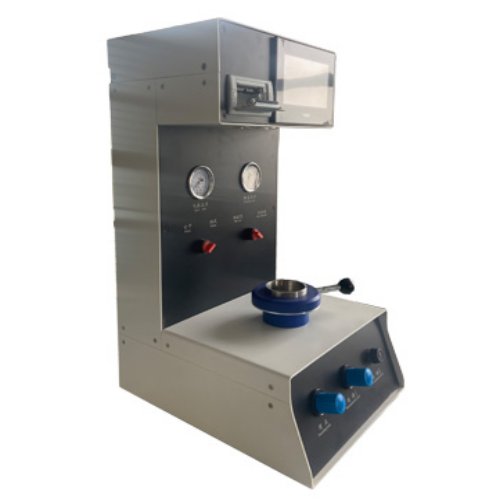
Filter cartridge pore size tester,ISO 2942:2004
2026/02/28
Share:

Importance of Filter Materials and Pore Size
In filtration technology, “pore size” refers to the equivalent diameter or characteristic dimension of the pores within a filter medium. It is a key indicator for determining the size of particles that can be retained, as well as the filtration efficiency and permeability of the filter. The smaller the pore size, the smaller the particles that can be captured; however, smaller pores also increase flow resistance and pressure drop, which in turn affect flow rate and overall system performance.
In high-risk fields such as microbial filtration and sterile pharmaceutical production, accurate measurement of pore size is especially critical, as pore size directly determines the ability to remove bacteria, viruses, and other fine contaminants. Pore size is typically expressed in micrometers (µm). For example, a 0.2 µm filter cartridge is commonly used for sterile filtration applications, while larger pore sizes are used for pre-filtration or coarse particle removal. Because pore size significantly influences both filtration performance and flow rate, it is not merely a theoretical parameter but a fundamental performance and quality control specification.
Basic Principles of Pore Size Testing
Filter cartridge pore size testing involves multiple technical methods. Among them, the bubble point test and capillary flow porometry are the most common and widely standardized approaches.
Bubble Point Method
The bubble point method is based on capillary principles for measuring pore size. Its core concept is as follows:
When the pores of a filter medium are completely wetted with a liquid, a certain pressure is required to displace the liquid and allow gas to pass through, forming bubbles.
This pressure is known as the bubble point pressure and is inversely proportional to the size of the largest pore.
Higher gas pressure corresponds to smaller pore size, whereas lower pressure indicates larger pores.
The bubble point test provides quantitative and highly repeatable results and can be used to determine maximum pore size, mean pore size, and pore size distribution. During testing, gas pressure is gradually increased under controlled conditions, and the change in gas flow between wet and dry states is analyzed to derive pore-related data.
The theoretical basis of the bubble point method is related to the capillary equation, often expressed through the Washburn equation, which relates pore diameter (D) to liquid surface tension (γ), contact angle (θ), and differential pressure (p):
D = (4 γ cosθ) / p
This equation shows that when the surface tension and contact angle of the wetting liquid are known, measuring the bubble point pressure allows calculation of pore size. If continuous pressure scanning is performed, a complete pore size distribution curve can be obtained.
Capillary Flow Porometry
Capillary flow porometry is an advanced pore size measurement technique often considered a modern standard method. In this approach, the sample is saturated with a wetting liquid, and an inert gas is applied with gradually increasing pressure to expel the liquid from pores of different sizes.
The first liquid expelled corresponds to the largest pores. As pressure increases, progressively smaller pores are emptied, enabling the generation of a pore size distribution curve. Capillary flow porometry can simultaneously determine:
Maximum pore size
Minimum pore size
Mean pore size
Pore size distribution
Permeability and flow characteristics
This method is widely adopted in international testing standards and provides comprehensive structural characterization of porous filter materials.
Pore Size Testing Standards and Requirements
To ensure global comparability and repeatability of results, pore size testing must comply with recognized international or industry standards. Common standards include:
ISO 2942. which specifies verification of structural integrity and determination of the initial bubble point for hydraulic filter elements
ISO 4003. which describes bubble test methods for determining pore size of permeable sintered materials
ASTM F316. which outlines bubble point and mean flow pore test methods for membrane filter materials
GB/T 14041.1-2007. which specifies structural integrity verification and initial bubble point determination for hydraulic filter elements
These standards define requirements for the testing environment, selection of wetting liquids, pressurization rate, observation procedures, and instrument calibration. Compliance ensures consistency and comparability of pore size measurements across different laboratories and equipment.
Structure and Functional Modules of Filter Cartridge Pore Size Testers
Modern filter cartridge pore size testers generally include several functional modules:
Sample Loading and Sealing System
The instrument provides various fixtures to accommodate filter cartridges of different diameters and lengths, including flat sheet samples and full cartridge assemblies. The sealing structure ensures no leakage during testing, enabling accurate measurement of pressure and flow changes.
Pressure Control System
High-precision pressure sensors and control valves allow accurate adjustment of test gas pressure over a wide range, covering pore sizes from large to very small. Precise control of the pressurization rate is essential to capture accurate pore size data.
Data Acquisition and Analysis System
Integrated software systems enable:
Real-time display of pressure and flow data
Automatic calculation of maximum and average pore sizes
Generation of pore size distribution curves
Data storage, retrieval, and report printing
Automation and User Interface
Many instruments are equipped with touchscreen interfaces or computer-based control software, allowing automatic test execution, result analysis, and report generation. Automation improves efficiency, repeatability, and operational consistency.
Testing Procedure and Workflow
Although specific instruments may differ, the standard pore size testing procedure typically includes the following steps:
Sample Preparation and Wetting
The filter cartridge must first be completely wetted with a suitable liquid. Common wetting liquids include isopropyl alcohol, mineral oil, or surfactant solutions, selected based on compatibility with the filter material. Complete wetting ensures all pores are filled with liquid.
Installation and Pressurization
The wetted sample is installed in the test fixture. Inert gas pressure is applied gradually, starting from a low value and increasing steadily while monitoring pressure and flow data. Initially, only large pores release liquid; as pressure rises, smaller pores begin to empty.
Recording Bubble Point and Pore Distribution
As pressure increases, the instrument records the corresponding gas flow changes. The pressure at which the first continuous bubble stream appears corresponds to the maximum pore size. The software then calculates pore size distribution and statistical parameters based on stored physical constants and pressure data.
Data Evaluation and Reporting
After testing, the system generates a report including maximum pore size, minimum pore size, average pore size, distribution curves, and related performance indicators. These results support quality control and comparative analysis.
Application Fields and Industries
Filter cartridge pore size testers are widely used in industries requiring high accuracy and controlled filtration performance.
Industrial Filtration
In industrial liquid filtration, oil and gas separation, and chemical processing, pore size uniformity and reliability directly affect product quality and operational safety. Pore size testing is therefore a key step in both design and mass production quality control.
Biotechnology and Pharmaceuticals
In pharmaceutical and bioprocessing applications, sterile filtration is critical. Products such as drug solutions, vaccines, and culture media must pass through filters with precisely controlled pore sizes. Pore size testing ensures compliance with microbial retention standards and reduces contamination risks.
Food and Beverage Industry
During food and beverage production, filters are used to purify liquids. Inaccurate pore sizes or structural defects may result in residual contaminants or microorganisms. Therefore, pore size testing plays a vital role in ensuring food safety and product quality.
Environmental Protection and Water Treatment
Drinking water purification and wastewater treatment rely heavily on high-performance filter cartridges. Pore size testing is used both during product development and in periodic evaluations to ensure compliance with filtration requirements.
Technical Challenges and Error Control
Despite technological maturity, pore size testing still faces several practical challenges.
Wetting Liquid Selection and Surface Tension Accuracy
The surface tension and contact angle of the wetting liquid directly influence calculated pore size. Incompatible or unstable liquids may introduce significant errors.
Relationship Between Bubble Point and Actual Pore Geometry
Since real filter structures are often irregular and non-uniform, bubble point measurements represent an equivalent pore diameter rather than a direct physical measurement. Results must be interpreted in conjunction with structural analysis.
Complexity of Large or Multi-Layer Cartridges
When testing large-area or multilayer filter cartridges, gas flow distribution and pressure response may vary. Sensitivity and resolution can change with sample size, requiring advanced algorithms and instrument design to maintain accuracy.
Future Trends and Development Directions
With advancements in materials science and filtration technology, pore size testers are evolving to meet higher performance demands, including:
Higher resolution detection covering nano- to micrometer ranges
Intelligent analysis supported by machine learning for automated pattern recognition
Integrated multifunction testing combining permeability and porosity measurements
Online and real-time monitoring for in-line production quality control
These developments are transforming pore size testers from laboratory instruments into comprehensive quality assurance systems
The filter cartridge pore size tester is a core testing instrument for ensuring filtration material performance. Based on reliable theoretical principles such as the bubble point test and capillary flow porometry, it enables quantitative measurement of pore size and pore size distribution through precise pressure control and data analysis.
Across industrial filtration, pharmaceutical biotechnology, food safety, and water treatment applications, pore size testing has become an essential component of quality control. As technology continues to advance, improvements in measurement accuracy, automation, and intelligent analysis will further enhance the role of pore size testing instruments in supporting filtration research and industrial quality management. Whether in research laboratories or production facilities, filter cartridge pore size testers will continue to play an increasingly critical role in filtration performance assurance systems.
Previous: How to calculate flow rate through a filter?
N e x t : Hydraulic Pump Contamination Resistance Tester,JB/T 7043-2006
