





What is an automatic coating thickness measuring instrument?
2026/03/10
Share:

Features
Automatic coating thickness measuring instruments are generally designed for ease of operation, with current mainstream models emphasizing human-machine interaction and portability. Key features include:
One-Button Start and Automatic Calibration:
Most devices support automatic detection on power-up and one-button calibration.
Some models can automatically identify substrate type (magnetic or non-magnetic).
Intuitive Interface and Single-Hand Operation:
Commonly configured with three buttons (+, Menu, −) and a large LCD screen.
Supports unit switching, data viewing, statistics, and can be operated with one hand.
Smart Alerts and Error Protection:
Equipped with beeps, screen error alerts, and auto-shutdown functions to reduce misuse.
Simple Setup:
Standard calibration modes use preset calibration blocks (0. 50. 100. 250. 500 μm), allowing quick use by beginners.
Advanced users can perform multi-point calibration for specialized requirements.
Operational Ease by Model:
Entry-Level / Portable Devices (e.g., iwin T100. QNIX series): Extremely easy to operate, suitable for on-site inspections.
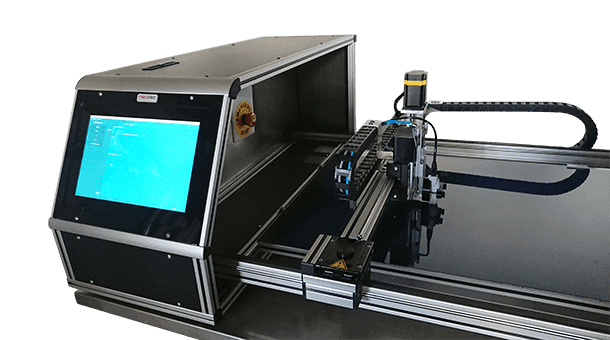
Industrial / Automated Systems (e.g., Haida large-scale equipment): Require professional training, higher operational complexity, usually for lab or production-line integration.
In summary, handheld automatic coating thickness gauges are easy to operate, particularly for non-specialists in industrial environments.
Operating Principle
The core measurement principles are:
Magnetic Induction Principle:
Measures non-magnetic coatings (e.g., paint, plastic, anodized films) on magnetic substrates (steel, iron).
The probe generates a magnetic field, and coating thickness changes the magnetic flux.
Eddy Current Principle:
Measures non-conductive coatings on non-ferrous metal substrates (aluminum, copper).
High-frequency electromagnetic fields induce eddy currents in the substrate; reflected impedance correlates with coating thickness.
Dual-Mode Automatic Identification:
High-end devices automatically detect substrate type and switch measurement mode (magnetic induction or eddy current) without manual setting.
Optical Interference Principle:
For transparent or semi-transparent thin films, calculates thickness from reflected interference fringes.
Mechanical Contact:
Uses high-precision displacement sensors (e.g., inductive probes) to directly measure the distance between coating surface and substrate, suitable for dry films.
Operation Process
Using a common handheld device (e.g., PULANI CT2013FN):
Power-On Self-Test:
Press and release the probe; display shows “222” with a beep, then “---” indicating self-test complete.
Ensure the probe is away from metal objects during startup.
Unit Switching:
In standby mode, press “+” to toggle between μm and mil.
Calibration (Essential):
Standard Calibration: Long press “MENU” to enter calibration mode; use calibration foils (50 μm, 100 μm, etc.) for multi-point calibration.
Multi-Point Calibration: Define multiple points for non-standard thicknesses to improve accuracy.
Coating Measurement:
Place the probe perpendicular to the surface, press until a short beep sounds.
Thickness is displayed on the LCD within 1–2 seconds.
Data Viewing and Storage:
Measurements are automatically stored (20–2500 sets depending on model).
Press “MENU” to review historical data.
Shutdown:
Auto-shutdown after 30 s inactivity or long-press button (model-dependent).
Precautions:
Clean the surface before measurement; remove oil, oxides, or particles.
Use specialized probes (e.g., V-groove) for curved or small parts.
Calibrate on the same substrate material to avoid errors.
Core Functions and Benefits
Primary Functions:
Ensure coating quality meets design or industry standards.
Enhance production consistency by providing real-time thickness feedback for process control.
Reduce rework and waste by detecting coatings that are too thin (corrosion risk) or too thick (high cost, poor adhesion).
Support data traceability and compliance, with storage, statistics, and transmission features meeting ISO, GB, and other quality system requirements.
Key Advantages:
High Accuracy: Typical ±(2 μm + 3%H), measurement range 0–1700 μm (some up to 0–67.8 mils).
Automatic Substrate Recognition: Distinguishes magnetic (steel, iron) and non-magnetic (aluminum, copper, stainless steel) substrates, selecting appropriate measurement principle.
Ease of Operation: Single-hand use, with beeps and indicator lights; zero-point, standard foil, and multi-point calibration; some models support Bluetooth, USB, PC software, and mobile apps.
Wide Application: Automotive coatings (paint, electroplating), appliances, pipes, metal surfaces, labs, factory QC, on-site inspections.
Strong Environmental Adaptability: Operating temperature 0–40 °C (some -10–50 °C), humidity ≤85% RH.
Maintenance Guidelines
Core Component Protection:
Probe: Wipe with dust-free cloth after each use; use minimal anhydrous alcohol for stubborn residues; avoid hard or abrasive materials.
Avoid contact with sharp objects to prevent housing deformation or internal damage.
Store in protective sleeve when not in use.
Magnetic/eddy current probes: keep away from strong magnets; store eddy current probes in dry environments (≤60% RH).
Main Unit and Calibration Tools:
Wipe main unit with soft cloth; keep vents clean.
Protect calibration foils from damage or contamination; clean regularly.
Professional calibration every 3–6 months based on usage and environment.
Storage and Operating Environment:
Dry, clean, shaded; avoid extreme temperatures (<0 °C or >40 °C).
Prevent moisture and vibration; use stable surface during measurement.
Remove probe carefully along axis, avoid twisting.
Preventive Maintenance:
Inspect probe cables monthly; replace if damaged or exposed.
Avoid unauthorized disassembly; contact manufacturer or qualified technicians.
Use original parts to ensure stability and reliability.
The Automatic Coating Thickness Measuring Instrument is not only an essential quality control tool but also key for enhancing international recognition of Chinese manufacturing, reducing trade risks, and increasing overseas customer satisfaction.
Previous: Which kind of suit is required for protection against acid and alkali?
N e x t : What is Garment Electromagnetic Radiation Shielding Performance Testing System?
