





What is a Filter Dynamic Cycling Tester?
2026/04/11
Share:

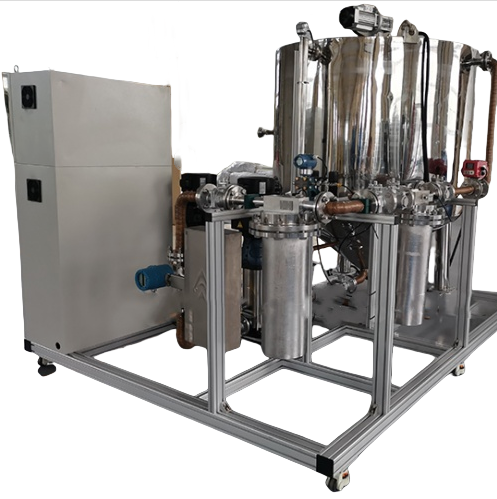
What is the purpose of a Filter Dynamic Cycling Tester?
The Filter Dynamic Cycling Tester is a specialized device designed to simulate the repeated filtration and cleaning cycles of filter media under real-world operating conditions. Its primary purpose is to evaluate the performance of filter materials under dynamic and cyclic operating conditions.
Key applications include:
Assessing filter media performance during continuous filtration and cleaning cycles, including filtration efficiency, pressure drop variation, durability, and cleaning effectiveness.
Supporting the development of new filter materials by providing data for optimizing material structure and enhancing filtration performance.
Conducting product quality control to ensure filter media meet relevant standards during production.
Verifying the adaptability of filter media under different operating conditions, providing scientific guidance for practical applications.
What functions does a filter dynamic circulation tester perform?
The Filter Dynamic Cycling Tester is a specialized device designed to simulate the repeated filtration, dust accumulation, and cleaning cycles of filters under real-world operating conditions. It is widely used for evaluating the performance of filter media, such as baghouse filter materials, automotive cabin filters, and industrial air filter cartridges. Its main functions include:
Dynamic Filtration Performance Testing: Simulates continuous filtration and cleaning cycles under realistic conditions, evaluating performance changes of filter media during aging and steady-state operation.
Cleaning Cycle and Residual Resistance Measurement: Automatically records cleaning time, cleaning frequency, initial and average residual pressure drop, reflecting the cleaning efficiency and resistance characteristics of the filter media.
Dust Removal Efficiency and Penetration Analysis: Measures dust concentration upstream and downstream of the filter media to calculate static and dynamic filtration efficiency and penetration rates.
Dust Holding Capacity Evaluation: Measures the mass of dust passing through and remaining on the filter media to assess its dust capture capability.
Synchronized Multi-Parameter Acquisition: Monitors key parameters in real time, including pressure drop curves, outlet dust concentration, filter media mass changes, airflow rate, temperature, and humidity.
Customizable Test Procedures: Supports user-defined or programmable test steps (e.g., number of aging cycles, pulse frequency, dust concentration) to accommodate various standards and application scenarios.
Self-Calibration and Data Security: Equipped with automatic error correction and operational permission management to ensure data accuracy and security.
Compliance with International Standards: Most devices comply with authoritative standards such as VDI 3926. GB/T 6719. ISO 11057. ASTM D6830. and JIS Z8909-1. ensuring comparability and reliability of results.
Which industries is the Filter Dynamic Cycling Tester suitable for?
The Filter Dynamic Cycling Tester is suitable for a wide range of industries, including:
Industrial Manufacturing and Quality Control: Used for high-efficiency, repeatable QA/QC testing of HEPA/ULPA filters, HVAC systems, automotive cabin filters, and compressor intake filters, supporting high-throughput production environments.
Respiratory Protection and Personal Protective Equipment (PPE): Specifically designed to test particulate protection masks (such as N95. P100) for filtration efficiency and pressure drop characteristics, in compliance with international standards like NIOSH and EN 143.
Filter Media Research and Production: Applicable for performance evaluation of new filter materials such as nonwoven fabrics, melt-blown fabrics, and bag-type filter media. Supports dynamic loading and cleaning cycle tests to simulate real-world usage conditions.
Environmental Protection and Air Purification: Used to assess dust filtration efficiency, resistance changes, and regeneration performance of filter media in industrial dust removal equipment and air purifiers, in accordance with standards such as VDI 3926 and GB/T 6719.
Pharmaceutical and Cleanroom Production: While not directly for liquid filtration, its associated integrity testing and particulate control capabilities can indirectly support air filtration verification in sterile environments.
How is the Filter Dynamic Cycling Tester used?
The operation of the Filter Dynamic Cycling Tester can be summarized in the following workflow:
1. Preparation
Sample Preparation:
Cut the filter media to standard dimensions (e.g., 15 cm diameter circular samples).
Install the sample in the test fixture with the rough surface facing up, ensuring it is flat and wrinkle-free.
Instrument Check:
Inspect the aerosol tank solution for turbidity or insufficient volume. If necessary, clean with water and fill to approximately half the volume.
Remove foreign objects from the test fixture and wipe silicone pads with alcohol to keep them dry and clean.
Ensure the device is placed on a stable, level surface (levelness ≤ 0.2/1000) away from vibrations, corrosive substances, and strong electromagnetic interference.
Environmental Preparation:
Maintain stable temperature and humidity in the test environment, complying with relevant standards (e.g., ISO or GB/T standards).
2. System Setup and Calibration
Power and Connections:
Connect to AC 220V power and check that hoses and wiring are secure.
Software Setup:
Log in to the test system, select language, and set sample ID, material type, and testing method (e.g., oil aerosol, salt aerosol).
Choose a pre-set program or define custom parameters according to the applicable standard (e.g., ISO 11057:2011. GB/T 6719-2009).
Sensor Calibration:
Use the differential pressure sensor’s zeroing function for baseline calibration.
If necessary, calibrate the particle counter using standard microparticles (e.g., ISO 11171 certified polystyrene spheres).
3. Test Operation
System Start:
Turn on the power, preheat or cool the system to the set temperature, and allow stabilization for about 30 minutes.
Aerosol Generation:
Use the dust generator to produce an airflow containing particles (e.g., ISO 12103-1 A2 fine dust), simulating dirty air or contaminated fluid.
Filtration and Monitoring:
Airflow passes through the filter media while a photometer or laser particle counter monitors upstream and downstream concentrations in real time to calculate filtration efficiency.
Differential pressure sensors record the pressure drop across the media.
Cycling and Cleaning:
The system automatically performs multiple “filtration-pulse cleaning” cycles (e.g., back-pulse every 5 seconds).
When the pressure drop reaches the preset value (e.g., 1000 Pa), a compressed air pulse triggers back-blowing for cleaning.
Parameter Monitoring:
Monitor flow rate, differential pressure, cycle frequency, particle concentration, and other key data in real time. Adjust the test flow if necessary.
4. Test Completion and Cleanup
Automatic Shutdown:
The test ends automatically after reaching the preset time, number of cycles, or stable resistance.
Data Recording:
Software automatically saves results (filtration efficiency, residual resistance, dust removal rate, etc.) and allows export for analysis.
Instrument Cleaning:
Clean the aerosol tank, fixtures, and other components to prevent residue from affecting subsequent tests.
Power Off and Maintenance:
Turn off the device and perform routine maintenance.
5. Key Notes
Different filter types (e.g., automotive air filters, oil filters, infusion filter cartridges) correspond to different test standards (e.g., ISO 11155-2:2009. GB/T 6719-2009. ISO 11057:2011).
Environmental Stability: Avoid temperature and humidity fluctuations during testing to ensure result accuracy.
Regular Maintenance: Periodically calibrate sensors, replace consumables, and maintain device accuracy.
Why is the filter dynamic circulation tester so important?
The importance of the Filter Dynamic Cycling Tester lies in its ability to realistically simulate the dynamic operating conditions of filters in actual use, providing a comprehensive evaluation of their performance, durability, and reliability. Its key roles include:
Simulating Real-World Operating Conditions:
The tester can replicate complex conditions such as pressure pulses in fuel systems, fluctuating temperatures, and variable flow rates, closely mimicking real vehicle operation rather than static or idealized laboratory conditions.
Evaluating Long-Term Durability:
By applying tens of thousands to hundreds of thousands of cyclic loads (e.g., hydraulic pulses, thermal cycles), the tester can detect potential structural failures, declines in filtration efficiency, or sealing leaks over the filter’s service life.
Verifying Multi-Dimensional Performance:
The device simultaneously monitors key indicators such as pressure drop, filtration efficiency, dust-holding capacity, and sealing integrity, providing full lifecycle performance data to ensure filters meet safety and emission standards at all stages.
Supporting Standards Compliance and R&D:
Dynamic cycling testing is a mandatory requirement in numerous international standards (e.g., ISO 19438. SAE J2288) and domestic standards (e.g., QC/T 918), offering reliable data for product certification, quality control, and new technology development.
Preventing Systemic Failures:
Filter failure can lead to engine wear, injector blockage, or HVAC contamination. Dynamic testing identifies potential issues in advance, safeguarding overall vehicle reliability and user health.
In summary, the Filter Dynamic Cycling Tester is a core quality assurance tool in automotive component manufacturing and quality control. It ensures product performance and reliability, while also driving the industry toward higher reliability and longer service life. By accurately simulating dynamic cyclic processes under real-world conditions, the device comprehensively evaluates filter durability, filtration efficiency, and overall performance, providing solid experimental data and analytical support for continuous product optimization and technological advancement.We sincerely invite you to visit our official website to access more detailed product descriptions, technical specifications, and application cases, and to explore how this advanced equipment can elevate your R&D and production processes.
Previous: What is an Infrared and Microwave Sensing Test Dummy?
N e x t : What is a Pump and Valve Contamination Tolerance Tester?
