





What is a Safety Harness Test Rubber Dummy?
2026/04/20
Share:

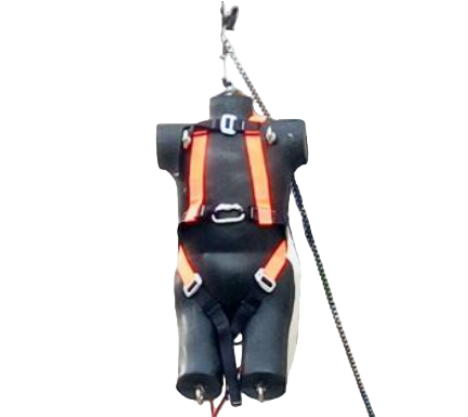
Applications of the Safety Harness Test Rubber Dummy
The Safety Harness Test Rubber Dummy is a key testing device specifically designed to evaluate and verify the performance of safety harness systems. Its core function is to precisely simulate the force distribution and dynamic response of a human body under safety harness restraint, enabling comprehensive assessment of the harness’s protective effectiveness and reliability under various operating conditions and environments.
The primary applications and test scenarios of this dummy system include:
1. Dynamic Load Testing:
This test simulates vehicle collisions, emergency braking, or other sudden deceleration scenarios.
By measuring the instantaneous restraining force and energy absorption of the harness on the dummy, it evaluates the harness’s immediate protective performance under impact loads.
2. Overall Static Load Testing:
This test assesses the durability of the harness and its connecting components under sustained tensile loads.
It evaluates strap tensile strength, buckle locking reliability, and the structural integrity of vehicle attachment points, ensuring long-term operational reliability without failure.
3. Overall Slide Test:
This test evaluates whether the harness experiences unexpected movement, loosening, or slippage under load.
It ensures that in real-world applications, the harness reliably secures the user, preventing secondary injuries due to restraint failure.
Applicable International Standards for the Safety Harness Test Rubber Dummy
The Safety Harness Test Rubber Dummy is primarily used to verify the performance of safety harness systems under dynamic and static loads. Its applicable standards are based on national and regional testing requirements for personal fall protection equipment or automotive seat belts.
1. China National Standard GB/T 6096-2009
This standard specifies the technical parameters for safety harness test rubber dummies, including:
Outer rubber thickness ≥ 40 mm
Surface Shore hardness > 90
Total mass: 100 kg ± 2 kg
Overall dimensions conforming to Appendix A, Figure A.1 of GB/T 6096-2009
The dummy is suitable for dynamic load, static load, and slide tests of safety harnesses.
2. China National Standard GB 6095-2021 (equivalent to GB 6095-2009)
This standard defines the basic requirements for safety harnesses, including:
Static load resistance ≥ 15 kN
Dynamic impact force ≤ 6 kN
The rubber dummy serves as the test carrier to meet the testing conditions under this standard system.
3. EN 361:2002 (European Standard)
Applicable to full-body safety harnesses.
Specifies requirements for material strength, stitching quality, and corrosion resistance of metal components.
The rubber dummy can be used for dynamic testing of harnesses in accordance with this standard.
4. ANSI Z359.11-2014 (American Standard)
Applicable to fall protection systems.
Requires safety harnesses to withstand impact forces of at least 15 kN (approximately 1500 kg).
The rubber dummy can be used to simulate test conditions to meet this standard.
5. FIA Standards (Fédération Internationale de l’Automobile)
Primarily applicable to racing harnesses.
The appendices regarding test dummies or simulated human load testing provide reference value.
Suitable for safety harness certification in motorsports applications.
Working Principle of the Safety Harness Test Rubber Dummy
The Safety Harness Test Rubber Dummy is a specialized device used for evaluating the performance of safety harness systems. Its core working principle lies in simulating the human body’s response under impact or load conditions, thereby assessing the restraining effectiveness of the harness.
1. Structural Simulation of Human Mass and Center of Gravity:
The dummy has a total mass of 100 kg ± 2 kg, and its overall dimensions comply with Appendix A of GB/T 6096-2009.
The internal material distribution is designed to adjust the center of gravity, realistically simulating the human body’s dynamics during a collision.
2. High-Hardness Rubber Outer Layer:
The surface is covered with a 40 mm thick rubber layer with a Shore hardness above 90.
This layer can withstand impact forces while providing damping characteristics similar to human soft tissue.
3. Application in Static and Dynamic Safety Harness Testing:
In a laboratory setting, the dummy is secured within the harness system.
It undergoes simulations such as fall tests, emergency braking, or sled impact tests, as well as static tensile testing.
Parameters such as harness elongation, locking response, and load distribution across straps are observed to verify compliance with safety standards.
4. Passive Test Dummy (No Active Sensors):
Unlike anthropomorphic crash test dummies equipped with sensors, the rubber dummy is typically sensor-free.
It is primarily used for qualitative or semi-quantitative evaluation, focusing on structural compatibility and basic restraining performance.
Operating Procedures for Safety Harness Test Rubber Dummy
I. Pre-Test Preparation
Dummy Status Confirmation:
Ensure the rubber dummy has a mass of 100 kg ± 2 kg, with a 40 mm thick rubber outer layer, Shore hardness >90. and dimensions conforming to Appendix A, Figure A.1 of GB/T 6096-2009.
Safety Harness Wearing:
Correctly fit the test harness (e.g., fall arrest harness) on the dummy, ensuring all buckles and connectors are securely fastened.
Connection to Lifting Device:
Connect the lifting hook of the test frame’s upper hoist to the dummy’s “1” lifting ring.
Pass a flat lifting strap through the “1” ring to ensure a secure connection.
II. Dynamic Load Test (Drop Test)
Dummy Lift:
Raise the dummy to the specified height, typically simulating the initial drop position.
Release for Drop:
Allow the dummy to fall freely, triggering the harness to deploy and absorb impact energy.
Data Collection:
Record parameters such as forces at the lifting hook and dummy displacement using sensors.
Safety Distance:
Once the dummy leaves the ground or force readings appear, operators must immediately withdraw to a safe distance of at least 3 meters.
III. Static Load Test
Harness-Specific Fixing Methods:
Fall Arrest Harness: Use U-shaped shackles and steel cables to secure dummy’s “4” lifting ring to the central ring of the test frame base.
Lanyard/Restraint Harness: Connect dummy’s “5” and “6” lifting rings to the corresponding base rings via U-shaped shackles.
Area-Limiting Harness: Connect dummy’s “2.” “3.” and “7” lifting rings to the corresponding base rings with U-shaped shackles.
Load Application:
Apply the specified static load (typically 22 kN) and maintain for 1 minute, observing whether the harness slips, fractures, or exhibits structural failure.
IV. Post-Test Handling
Waiting Time:
After testing, wait for 1 minute before entering the test frame to handle the dummy or equipment.
Storage Requirements:
Store the rubber dummy indoors in a dry environment, avoiding direct sunlight, high temperatures, or chemical exposure.
Maintenance Procedures for Safety Harness Test Rubber Dummy
The maintenance of a safety harness test rubber dummy mainly follows two sources: general maintenance guidelines for personal protective equipment and test devices, and specific standards or operational instructions related to the dummy and its rubber components.
Regular Visual Inspection
Check for cracks, bulges, wear, deformation, or surface aging, with particular attention to connection points and high-stress areas.
Cleaning and Care
Wipe the dummy with a soft cloth and mild cleaning agent.
Avoid using strong solvents or corrosive chemicals to prevent degradation of the rubber material.
Proper Storage
Avoid direct sunlight and high-temperature environments (recommended storage temperature below 35°C).
Keep in a dry environment, maintaining relative humidity below 50%.
Store away from oils, chemicals, and ozone sources (e.g., motors, high-voltage equipment).
Avoid Mechanical Damage
Handle the dummy carefully to prevent dropping, compression, or scratches from sharp objects.
Record Usage and Maintenance
Maintain a logbook documenting each use, cleaning, inspections, and any anomalies, which aids in traceability and lifespan assessment.
Importance of Safety Harness Test Rubber Dummy
The Safety Harness Test Rubber Dummy is crucial because it plays an irreplaceable role in verifying the performance of safety harness systems, directly affecting personnel safety in high-altitude work, industrial protection, and other critical scenarios. Its key importance can be summarized as follows:
Standardized Testing Assurance
The dummy is manufactured strictly according to GB/T 6096-2009 and GB/T 6096-2020 national standards, ensuring that safety harness performance data under dynamic load, static load, and fall tests are comparable and compliant.
Simulation of Real Human Response
The dummy’s weight is set at 100 kg ± 2 kg or 136 kg ± 2 kg, with a surface Shore hardness > 90 HD and a 40 mm thick rubber layer.
Internal material configuration adjusts the center of gravity, realistically simulating the biomechanical behavior of the human body under fall or load conditions.
Elimination of Metal Interference
Except for the suspension rings, the dummy is made entirely of rubber to prevent metal components from affecting the harness’s friction, sliding, or locking performance, ensuring that test results accurately reflect real-world conditions.
Supports Multiple Safety Scenario Tests
It is suitable not only for general safety harness testing but also for area-restricted systems, railing work systems, fall arrest systems, and rescue performance evaluation, covering diverse industrial safety risk scenarios.
Promotes Product Iteration and Regulatory Improvement
By providing stable and repeatable test data, it helps enterprises optimize safety harness design and provides technical support for the formulation of stricter national safety standards, such as GB 6095-2021.
Practical Application Value
Saving Lives: Research shows that the widespread adoption and improved performance of safety harnesses have saved tens of thousands of lives worldwide. The rubber dummy serves as a technical foundation for validating these results.
Reducing Corporate Risk: Compliance testing allows companies to avoid workplace injuries, legal liabilities, and insurance claims caused by harness failure.
Facilitating International Recognition: Compliance with internationally accepted testing standards promotes the export of domestic safety products and facilitates integration into the global market.
In conclusion, the Safety Harness Test Rubber Dummy demonstrates significant advantages in enhancing efficiency, optimizing user experience, and fostering innovation. Its impact is broad and profound, benefiting individuals, organizations, and industry development. Therefore, it warrants continuous attention and in-depth exploration to fully leverage its potential value. We welcome active discussion, inquiries, and direct contact through the provided channels. Through such engagement, users can conveniently and comprehensively access technical details, application scenarios, latest updates, and support services, and we are committed to providing thorough assistance and guidance.
Previous: What is a Hydraulic Oil Precision Filter Tester?
N e x t : FAQs About Aircraft Seat Cushion Fuel Burn Test System
