





What is a Fire-Resistant Cable Burning Test Apparatus?
2026/04/27
Share:

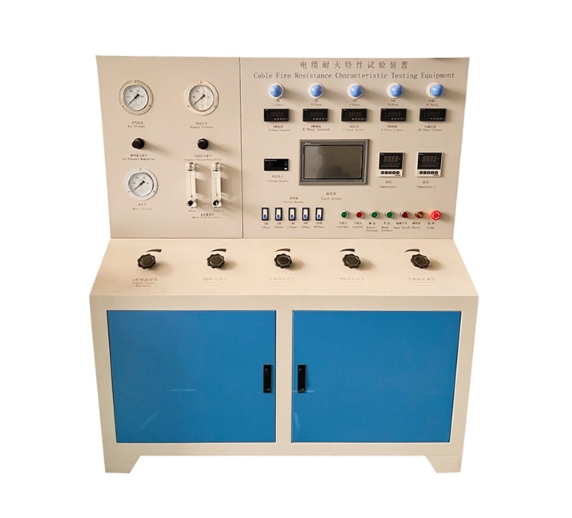
Functions and Applications of the Fire-Resistant Cable Burning Test Apparatus
The Fire-Resistant Cable Burning Test Apparatus is specifically designed to evaluate the ability of fire-resistant cables to maintain circuit integrity and power supply under flame exposure. Unlike conventional flammability tests, its core purpose is not to assess how easily a material burns, but to verify whether a cable can continue conducting electricity during a fire, ensuring the reliable operation of critical systems.
Main Functions
Simulation of Real Fire Conditions:
The system uses standard ignition sources such as propane burners or Bunsen burners to apply high-temperature flames (not less than 750°C) to vertically mounted single cables or cable bundles, realistically replicating fire scenarios.
Circuit Integrity Testing:
During combustion, the apparatus continuously monitors the electrical continuity of the cable to determine whether it can maintain power transmission for a specified duration (e.g., 90 minutes).
Automatic Control and Safety Protection:
Precisely regulates gas and air flow to maintain stable flame temperature
Equipped with automatic ignition, flame failure protection, and gas shut-off systems
Many systems include nitrogen or water spray extinguishing devices for rapid fire suppression after testing
Smoke and Fume Treatment:
Incorporates water curtains and filtration systems to treat combustion smoke, ensuring compliance with environmental protection requirements.
Data Acquisition and Automation:
Uses PLC or computer-based control systems to manage test parameters and automatically record key data such as afterflame time and combustion behavior.
Main Applications
Vertical Flame Propagation Testing (Single or Bundled Cables):
In accordance with standards such as GB/T, the system simulates cable fire behavior and measures key indicators including flame spread and afterflame duration.
Circuit Integrity Evaluation Under Fire Conditions:
Advanced configurations can simulate flame environments above 750°C, verifying whether cables can maintain electrical continuity during fires—critical for fire protection and emergency systems.
Bundled Cable Flame Spread Testing:
Using dedicated test chambers compliant with GB/T standards, the system evaluates the flame spread resistance of densely installed cable bundles.
Quality Control and R&D Applications:
Widely used in the production testing and research of wires and cables, low-voltage electrical equipment, household appliances, mining cables, and aerospace wiring, ensuring compliance with safety standards and improving product reliability.
Overall, this apparatus is an essential tool for ensuring that fire-resistant cables perform reliably under extreme conditions, making it indispensable in safety-critical industries.
Applicable Industries of the Fire-Resistant Cable Burning Test Apparatus
The Fire-Resistant Cable Burning Test Apparatus is primarily used to evaluate the flame-retardant performance and vertical flame propagation characteristics of wires, cables, optical fibers, and related materials under fire conditions. Based on current standards and industry practices, it is widely applied in the following sectors:
Wire and Cable Manufacturing:
Used to test the fire resistance and flame-retardant performance of power cables, communication optical cables, and control cables, ensuring compliance with GB/T series standards.
Electronics and Electrical Industry:
Ensures that internal wiring of electronic devices meets safety requirements defined by standards such as UL and IEC.
Construction and Building Materials:
Applied in vertical and horizontal flame tests for building cables and insulation materials, helping meet fire protection codes and safety regulations.
Automotive Industry:
Used to evaluate the safety performance of automotive wiring harnesses and high-voltage cables under high-temperature or fire scenarios.
Rail Transit and Aerospace:
Assesses the flame-retardant properties and smoke toxicity performance of specialized cables used in enclosed and high-risk environments.
Overall, this equipment plays a critical role in ensuring fire safety and regulatory compliance across multiple high-risk and safety-sensitive industries.
Technical Features of the Fire-Resistance Cable Burning Test Apparatus
The Fire-Resistance Cable Burning Test Apparatus is specifically designed to evaluate the fire resistance of cables—particularly their ability to maintain circuit integrity (continuous power supply) during combustion. Its key technical features are summarized as follows:
Core Technical Features
Fire-Resistant Layer Simulation and Verification:
The apparatus is typically used with cable specimens wrapped in mica tape. Mica maintains excellent insulation properties even at temperatures above 1000°C, ensuring that the circuit remains uninterrupted under flame exposure.
Compliance with International and National Standards:
The equipment is designed in accordance with recognized standards, including:
GB/T standards (e.g., vertical flame test for single insulated wires)
IEC series standards (corresponding fire test methods)
Automation and High-Precision Measurement:
Controlled via PLC with touchscreen or computer software
Enables precise programming of test cycles (e.g., “15 seconds flame / 15 seconds off,” repeated 5 times)
Supports automatic ignition, flame height adjustment, and automatic recording of afterflame and afterglow time (accuracy up to 0.1 seconds)
Standardized Flame Application System:
Uses Bunsen burners or ribbon-type propane burners
Flame parameters strictly controlled according to standards:
Inner flame: 50–60 mm
Outer flame: 170–190 mm
Adjustable burner position:
Distance from specimen surface: 75 ± 5 mm
Distance from chamber base: 600 ± 5 mm
Environmental and Safety Control:
Equipped with an airflow control system (5000 ± 500 L/min) to simulate realistic combustion conditions
Integrated smoke exhaust and purification system (e.g., water curtain filtration, fume collection) for environmental compliance
Includes safety features such as automatic flame failure protection, and optional nitrogen or water spray fire suppression systems
Versatility for Different Specimen Types:
Suitable for testing single wires (typically 600 ± 25 mm in length)
Supports bundled cable testing, with specimens mounted on a standard steel ladder configuration
Overall, the system combines standardized flame exposure, precise control, and robust safety features, making it an essential tool for evaluating the fire resistance and operational reliability of cables in critical applications.
Operating Procedure of the Fire-Resistance Cable Burning Test Apparatus
The operation of the Fire-Resistance Cable Burning Test Apparatus is generally carried out in accordance with international and national standards such as IEC and GB/T, which are used to evaluate smoke density and combustion characteristics of cables or optical fibers under specified conditions.
1. Sample Preparation
Cut cable specimens according to standard requirements (typically 600 mm ± 5 mm in length).
Record specimen specifications, including outer diameter, material type, and insulation thickness.
2. Equipment Calibration and Setup
Ensure the apparatus complies with standards such as IEC 61034-1 / GB/T 17651-1. including:
Enclosed or semi-enclosed combustion chamber
Precisely controlled heat source (e.g., electric heater or Bunsen burner)
Smoke density measurement system (laser light source and photodetector)
Exhaust and ventilation control system
Calibrate key parameters such as temperature, light intensity, and airflow velocity.
3. Ignition and Combustion
Fix the specimen in a horizontal or vertical position depending on the applicable standard.
Activate the heat source and apply the specified heat flux (typically 30 kW/m² or as required by the standard).
Record ignition time, flame spread behavior, and the presence of dripping or melting.
4. Smoke Density Measurement
During combustion, continuously monitor smoke concentration using a photodetector system.
Record light transmittance over time and calculate:
Minimum light transmittance
Average smoke density
5. Combustion Duration and Extinguishing Observation
For tests based on IEC / GB/T standards, record:
Whether the flame self-extinguishes after removing the heat source
Whether the burning duration exceeds specified limits (e.g., ≤ 60 seconds)
6. Data Recording and Evaluation
Document all observed phenomena, including flame propagation, dripping behavior, and smoke generation.
Determine whether the specimen passes the fire-resistance or flame-retardancy test based on standard criteria.
This standardized procedure ensures reliable and repeatable evaluation of cable performance under fire conditions, providing critical data for safety certification and product development.
Importance of the Fire-Resistance Cable Burning Test Apparatus
The Fire-Resistance Cable Burning Test Apparatus plays a vital role in the scientific evaluation of the safety performance of wires and cables. Its significance extends to ensuring public safety, supporting regulatory compliance, and enhancing product competitiveness. The core value is reflected in the following aspects:
1. Safeguarding Life and Property
Verification of Flame-Retardant and Fire-Resistant Performance:
By simulating real fire conditions, the apparatus evaluates whether cables can maintain circuit integrity for a specified period and delay flame propagation, thereby providing critical time for evacuation and firefighting operations.
Prevention of Electrical Fires:
A significant proportion of building fires originate from electrical faults. Burning tests help identify high-risk cables at the source, effectively reducing the likelihood of fire incidents.
2. Ensuring Compliance and Market Access
Meeting Mandatory National Standards:
Compliance with standards such as GB/T series is required before cables can be released to the market, making this testing a fundamental prerequisite.
Supporting International Certification:
The apparatus is compatible with global standards such as UL, IEC, and CSA, helping manufacturers meet international regulatory requirements and expand into overseas markets.
3. Supporting Safety in Construction and Infrastructure
Application in High-Rise Buildings and Public Facilities:
In environments where the “chimney effect” is prominent—such as high-rise buildings, subways, and hospitals—fire-resistant cables can effectively limit vertical flame spread.
Ensuring Power Supply for Critical Systems:
Fire-resistant cables can maintain electrical functionality during fires, ensuring the operation of essential systems such as fire alarms, emergency lighting, and evacuation systems.
4. Promoting Product Quality Improvement and Technological Innovation
Guidance for R&D and Quality Control:
Test data supports optimization of material formulations (e.g., flame retardants) and structural design (insulation and sheathing), improving product reliability.
Driving Industry Upgrading:
High-standard testing encourages the adoption of safer technologies, promoting the development of advanced materials such as low-smoke zero-halogen (LSZH) compounds.
5. Providing Authoritative and Traceable Test Results
Standardized Equipment Ensures Reliable Data:
Equipment compliant with GB/T, IEC, and other standards—featuring precise temperature control, flame calibration, and certified measurement systems—ensures the credibility and repeatability of results.
Complementary Testing Methods:
Single-cable tests evaluate basic flame-retardant performance
Bundled cable tests simulate real installation density, offering a more comprehensive assessment of fire behavior in practical applications
In summary, the Fire-Resistance Cable Burning Test Apparatus is not only a fundamental requirement for product compliance and market entry, but also a critical technical tool for building safe and reliable infrastructure in modern society. It plays an indispensable role in enhancing overall fire safety and risk prevention capabilities.We sincerely welcome your inquiries. Please feel free to contact us via message or direct communication so that we can provide detailed technical manuals, high-definition demonstration videos, or customized solutions tailored to your specific needs, helping you fully understand the equipment’s performance, technical advantages, and practical applications.
Previous: What is an Air Intake Filter Test System?
N e x t : What is a Cleanable Filter Media Test System?
