





How are HEPA filters tested?
2026/04/29
Share:

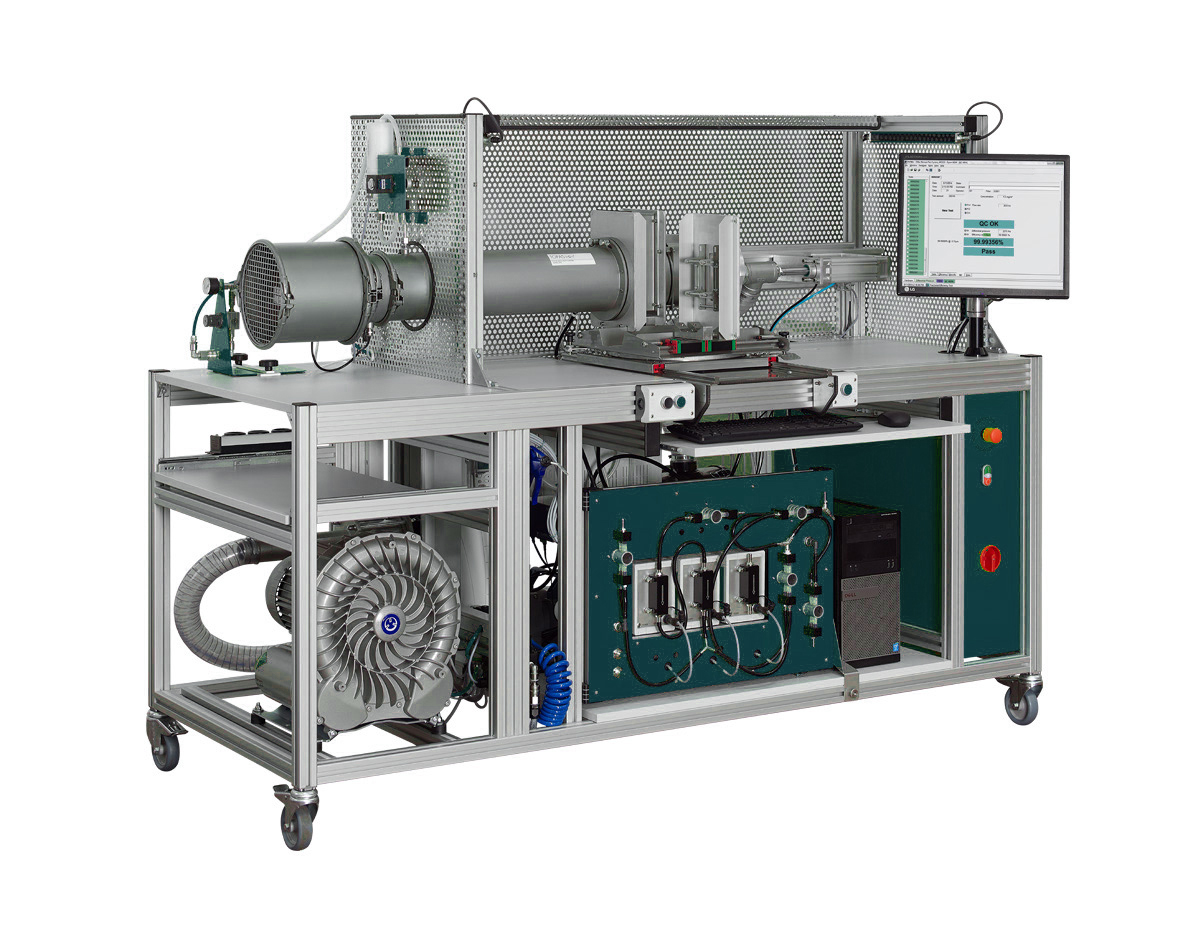
Functions and Applications of the HEPA Filter Element Quality Control Test System
The HEPA Filter Element Quality Control Test System is a specialized device designed to perform standardized performance testing on HEPA (High-Efficiency Particulate Air) filter elements. Its core function is to verify whether the filter meets key indicators specified by international or industry standards, such as filtration efficiency, integrity (leakage), and airflow resistance.
Main Functions
Filtration Efficiency Testing: Measures the capture efficiency of HEPA filters for particles of various sizes, especially the Most Penetrating Particle Size (MPPS), typically around 0.1–0.3 μm. According to ISO 29463. an H13-grade HEPA filter should achieve a filtration efficiency of ≥99.97% for 0.3 μm particles.
Local and Overall Leak Detection: Detects localized leakage using scanning methods (e.g., photometer-based scanning) and calculates the overall penetration rate to ensure there is no bypass airflow.
Pressure Drop (Resistance) Measurement: Measures the pressure differential across the filter under specified airflow conditions to evaluate airflow resistance and prevent excessive resistance that could reduce system efficiency.
Automated Testing and Report Generation: Typically controlled by a computer system, enabling automated test procedures and generating reports compliant with standards such as ISO.
Multi-Aerosol Compatibility: Supports testing with various standard aerosols, including NaCl (salt aerosol) and DEHS/PAO (oil aerosol), covering a wide range of application scenarios.
Main Applications
Factory Quality Control: Used by HEPA filter manufacturers to verify batch consistency during production, ensuring compliance with H10–H14 (ISO/EN) classification requirements.
R&D and New Product Validation: Assists in performance comparison and optimization during the development of new high-efficiency filter materials.
Third-Party Certification and Compliance Testing: Provides authoritative test data for certifications such as “medical-grade” or “infant-safe,” and ensures compliance with Chinese national standards such as GB/T.
Industry Application Assurance: Widely used in healthcare (e.g., operating rooms, isolation wards), aviation (aircraft cabin filtration), cleanrooms, and high-end home appliances (e.g., Dyson air purifiers) to ensure air safety.
Applicable Industries for the HEPA Filter Element Quality Control Test System
The HEPA Filter Element Quality Control Test System is primarily used to ensure that HEPA filter elements meet critical performance requirements in real-world applications, including filtration efficiency, sealing performance, and overall integrity. This type of testing system is widely utilized in industries with extremely high demands for air quality, cleanliness, and safety.
Semiconductor Manufacturing: Chip production must be carried out in ultra-clean environments. HEPA filters are used to remove micron- and submicron-level particles, ensuring high production yield.
Biopharmaceuticals: Includes the production of pharmaceuticals, vaccines, and biological products, all of which must comply with GMP standards. HEPA testing is a key component in maintaining sterile environments.
Food and Beverage: Particularly in processes such as aseptic filling and active ingredient processing, where prevention of microbial and particulate contamination is essential.
Optical and Electronics Manufacturing: Applications such as LCD panel production and precision instrument manufacturing require strict control over airborne particulate levels.
Aerospace: Assembly of high-reliability components must be conducted in cleanrooms, relying on HEPA filtration systems to maintain required cleanliness levels.
Medical and Laboratory Environments: Includes operating rooms, biosafety laboratories, and hospital ventilation systems, where HEPA filters must effectively capture viruses, bacteria, and other microorganisms.
Nuclear and Chemical Industries: Used for treating exhaust gases containing radioactive or toxic particles. HEPA filters must undergo rigorous integrity testing to ensure personnel safety.
Technical Features of the HEPA Filter Element Quality Control Test System
The HEPA Filter Element Quality Control Test System is a critical piece of equipment used to verify the performance of HEPA (High-Efficiency Particulate Air) filter elements. Its technical features are centered on high precision, automation, standardization, and multi-parameter integrated measurement.
Core Technical Features
High-Precision Aerosol Generation and Concentration Control
The system can generate stable aerosols with controllable particle size distribution, such as NaCl (salt aerosol) and DEHS/PAO (oil-based aerosol). The concentration range typically covers salt aerosols (12–20 mg/m³) and oil aerosols (20–200 mg/m³), meeting the requirements of various testing standards.
Multi-Particle Size Detection Capability
Equipped with high-sensitivity particle counters or photometers, the system can detect multiple particle size ranges such as 0.3 μm, 0.5 μm, and 1.0 μm. Some advanced systems support full-range particle size analysis from 0.02 to 100 μm.
Automated Filtration Efficiency and Resistance Measurement
Filtration efficiency is calculated based on the concentration difference between upstream and downstream (ranging from 0.001% to 99.9995%), while pressure drop (typically 0–2000 Pa or higher) is monitored in real time to evaluate airflow resistance and energy consumption.
Standard-Compliant Scanning Leak Detection
Supports local and overall efficiency testing in accordance with ISO standards. Scanning leak detection is performed using photometers or particle counting methods, with a typical leak threshold of 0.01% to ensure filter integrity and sealing performance.
Controlled Environmental Conditions and Automated Data Acquisition
Testing is conducted under controlled temperature and humidity conditions (e.g., 25±5°C, 30±10% RH) and constant airflow (e.g., 85±4 L/min or 100–1200 m³/h). A microprocessor or PLC system automatically records data and generates standardized test reports.
Modular Adaptability and Wide Applicability
The system can accommodate filters of various sizes (e.g., from 300×300 mm to 610×1200 mm) through interchangeable adapters. It is suitable for testing HEPA/ULPA filters, automotive filters, cleanroom filters, and more.
Safety and Leak-Proof Design
Features such as closed airflow channels, isokinetic sampling, and negative pressure control are implemented to prevent aerosol leakage during testing, ensuring safe operation.
Operating Procedure of the HEPA Filter Element Quality Control Test System
The following provides a detailed explanation of the core operational steps:
Aerosol Introduction (Upstream Challenge)
A specific type of aerosol—such as PAO, DOP, or NaCl—must be introduced on the upstream side of the HEPA filter element. It is essential to ensure a uniform concentration distribution in the upstream area to simulate real filtration conditions.
For HVAC (Heating, Ventilation, and Air Conditioning) systems, it is recommended to introduce the aerosol from the negative pressure side of the fan. If introduced through ductwork, the injection point should be at least 10 times the duct diameter away from the HEPA filter, and duct bends should be minimized to maintain stable aerosol flow. The upstream aerosol concentration is typically controlled within 10–20 μg/mL (i.e., 10.000–20.000 μg/m³), which complies with the recommended conditions of ISO.
Detection Equipment Preparation
An aerosol photometer or particle counter is used to perform downstream scanning of the filter.
Before operation, the detection equipment must be initialized, and the alarm threshold should be set according to relevant standards (typically based on a 0.01% leakage rate).
The upstream sampling tube should be connected to monitor and confirm that the aerosol concentration has reached a stable level, ensuring reliable test conditions.
Scanning Leak Detection Procedure
Remove the downstream diffuser of the HEPA filter to fully expose the entire filter surface and its surrounding sealing structures (including the filter media, frame, and plenum connections), allowing for comprehensive scanning.
The scanning process should follow these parameters:
Maintain a distance of approximately 3 cm between the sampling probe and the filter surface;
Keep the scanning speed at no more than 5 cm/s;
Use a linear back-and-forth scanning pattern, with adjacent scan lines overlapping by approximately 50% (about 1 cm overlap).
If the instrument triggers an alarm (indicating a leakage rate exceeding 0.01%), the probe should be held in place immediately to accurately locate the leakage point.
Leakage Determination and Recording
If the measured leakage rate exceeds 0.01% (or up to 0.1% for filters with efficiency lower than 99.95%, depending on applicable standards), the filter is deemed non-compliant.
It is necessary to record in detail the exact location of the leakage point, the corresponding aerosol concentration data, and any corrective actions taken. This ensures traceability of the testing process and provides support for subsequent quality analysis and improvement.
Importance of the HEPA Filter Element Quality Control Test System
The importance of the HEPA Filter Element Quality Control Test System is mainly reflected in the following aspects:
Ensuring Compliance with Filtration Efficiency Standards:
HEPA filters (especially H13 grade and above) are required to achieve a filtration efficiency of ≥99.97% for 0.3 μm particles. The testing system accurately verifies actual filtration performance using standard aerosols (such as NaCl and PAO) in combination with particle counters, preventing falsely labeled or substandard products from entering the market.
Safeguarding User Health and Safety:
In applications such as healthcare, infant care, and allergy protection, HEPA filters are used to capture harmful particles including viruses, pollen, and dust mites. Any leakage or insufficient efficiency can directly threaten respiratory health. The testing system can identify sealing defects and structural flaws, reducing the risk of secondary contamination.
Supporting Industry Standards and Certification:
In accordance with domestic and international standards such as GB/T, EN, and ISO, the testing system provides authoritative performance data for HEPA filters and is a necessary condition for obtaining certifications such as “medical-grade” and “infant-safe.”
Enhancing Product Reliability and Competitiveness:
Through multi-dimensional testing—such as pressure drop, airflow resistance, and temperature tolerance—the system ensures stable filter performance under real operating conditions. Third-party test reports (e.g., those provided by professional certification bodies) can strengthen consumer confidence and support compliant market entry.
Driving Technological Advancement and Market Standardization:
High-precision testing systems (such as dual condensation particle counters and automated control platforms) encourage manufacturers to improve production processes, while also eliminating low-quality products and promoting high-quality industry development.
In summary, the HEPA Filter Element Quality Control Test System is not only an indispensable core quality inspection tool in the manufacturing process, but also a vital technical foundation for safeguarding public health and maintaining market order. Through precise testing and evaluation, it ensures the high performance and reliability of filter products, playing a crucial role in fields such as air purification, medical protection, and industrial clean environments.We sincerely invite partners and potential users to contact us or leave a message for more detailed technical information, operation demonstration videos, or customized solutions. This will help you gain a comprehensive understanding of the system’s advanced features and advantages, and jointly promote the improvement of industry quality standards and the expansion of its applications.
Previous: What is the Blanket Flammability Test Machine?
N e x t : What is the Fire-Resistance Cable Burning Test Apparatus?
