





What is the Fire-Resistance Cable Burning Test Apparatus?
2026/04/29
Share:

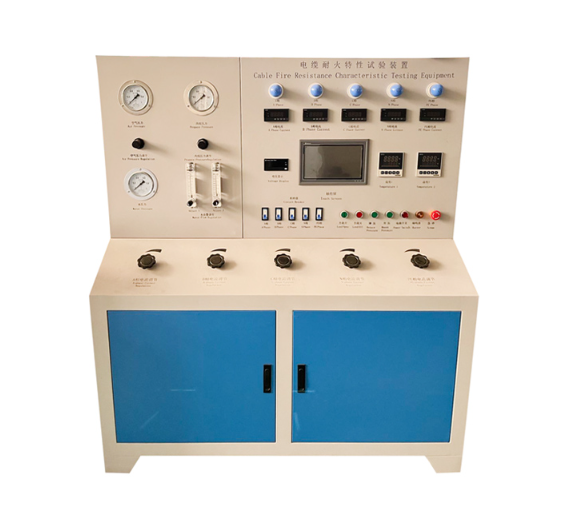
Functions and Applications of the Fire-Resistance Cable Burning Test Apparatus
The Fire-Resistance Cable Burning Test Apparatus is a specialized testing system used to evaluate the flame retardancy, flame spread resistance, and circuit integrity of electrical cables under fire conditions. Its core function is to determine whether cables can continue to operate electrically when exposed to extreme environments such as high-temperature flames, mechanical impact, or water spray, ensuring reliability in emergency fire situations.
Main Functions
Vertical Flame Spread Testing of Cables
Evaluates the vertical flame propagation behavior of vertically installed bundled wires, cables, or optical cables under specified flame conditions.
Combustibility Testing of Single Cables
Assesses the flammability of individual insulated wires and cables to determine their fire resistance characteristics.
Circuit Integrity Verification (Fire Resistance Test)
Verifies the ability of fire-resistant cables to maintain electrical continuity under high-temperature flames (typically ≥750°C), ensuring uninterrupted circuit operation during fire exposure.
Automated Control and Safety Functions
Equipped with automatic ignition, flame monitoring, precise gas/air flow control, and safety protection systems such as automatic gas shutoff upon flame failure and nitrogen fire suppression.
Multi-Test Mode Capability
Supports various standardized test configurations, including bundled cable tests, single cable tests, and horizontal/vertical flame propagation tests.
Environmental Protection Systems
Some models include smoke purification systems (e.g., water curtain filtration) to ensure compliant and environmentally safe exhaust emissions during combustion testing.
Main Applications
Quality Control and Product Certification
Used by cable manufacturers and inspection agencies for factory acceptance testing and type testing to verify compliance with fire resistance and flame retardancy standards.
Research and Material Development
Supports the development and performance validation of new flame-retardant materials and cable structural designs.
Standard Compliance Testing
Ensures compliance with standards such as GB/T 18380 series (IEC 60332 equivalent) and GB/T 19216 series (IEC 60331 equivalent), which are widely used in cable fire performance evaluation.
Selection for High-Risk Environments
Provides critical reference data for cable selection in environments with strict fire safety requirements, such as subways, tunnels, high-rise buildings, chemical plants, and power stations.
Environmental Compliance Support
Helps ensure that combustion emissions meet environmental protection requirements through integrated exhaust and filtration systems.
The Fire-Resistance Cable Burning Test Apparatus is widely used across industries such as power generation, telecommunications, construction, aviation, and rail transit, where the fire safety performance of cables and electrical systems is critical to overall operational safety.
Applicable Industries of the Fire-Resistance Cable Burning Test Apparatus
The Fire-Resistance Cable Burning Test Apparatus is primarily used to evaluate the flame retardancy and fire resistance properties of cables, optical cables, and related materials under fire conditions. It is widely applied across industries where electrical safety and fire performance are critical.
Construction and Building Materials Industry
Used to test building cables, fire-stopping materials, decorative materials, and insulation products to ensure compliance with standards such as GB 8624 and GB/T 9978. supporting fire safety inspection and acceptance requirements.
Power and Energy Industry
Applied to power cables and control cables used in power plants, substations, and transmission/distribution systems to ensure they can maintain circuit integrity for a certain period during fire conditions.
Transportation Industry
Covers cable systems in subways, railways, ships, and aviation. These applications require bundled flame tests, smoke density evaluation, and toxicity assessment to ensure safety in enclosed environments.
Electronics, Electrical Appliances, and IT Industry
Used to test the flame retardancy of wires, household appliances, power tools, and IT equipment cables, ensuring compliance with standards such as UL 94 (V-0. 5VB) and UL 1581.
New Energy Industry
Applied to photovoltaic, wind power, and energy storage system cables (DC/AC cables), ensuring safety compliance through specialized fire resistance and flame retardancy testing.
Petrochemical and Heavy Industry
Used for special cables operating in high-temperature, corrosive, and flammable or explosive environments, verifying their fire resistance stability under extreme conditions.
Overall, the Fire-Resistance Cable Burning Test Apparatus plays a critical role in ensuring electrical safety, regulatory compliance, and system reliability across multiple high-risk industrial sectors.
Technical Features of the Fire-Resistance Cable Burning Test Apparatus
The Fire-Resistance Cable Burning Test Apparatus is a key testing system used to evaluate the ability of electrical cables to maintain circuit integrity and flame resistance under fire exposure. Its technical characteristics are reflected in compliance with international standards, advanced hardware design, precise environmental control, and intelligent automation.
1. Core Functions and Standard Compliance
Testing Purpose
Simulates real fire conditions to verify whether cables can maintain continuous electrical operation within a specified time (circuit integrity), while also evaluating flame retardancy, smoke toxicity, and related safety performance.
Key Standards Covered
Chinese Standards: GB/T 18380.31–36-2008 (bundled cable flame tests), GB/T 19666. GB 31247 (fire resistance and flame retardant classifications A/B1/B2/B3)
International Standards: IEC 60332-3 (vertical flame spread), IEC 60754 (halogen gas emission), IEC 61034 (smoke density)
European & North American Standards: UL 1685 / UL 1666. NFPA 262 (CMP rating), CPR EN 50399 (CE certification for building cables)
2. Key Hardware and Control System Features
Combustion Chamber Design
Typical dimensions: 1000 mm × 2000 mm × 4000 mm (W × D × H)
Constructed from 304 stainless steel, ensuring high temperature resistance and corrosion protection
Equipped with nitrogen extinguishing or water spray systems for rapid flame suppression after testing
Ignition System
Uses band-type propane gas burner
Burner position accuracy:
75 ± 5 mm from specimen front surface
600 ± 5 mm from chamber bottom
Equipped with Venturi mixer, automatic ignition, and flame detection system to ensure stable and repeatable flame conditions
Environmental Control System
Airflow: 5000 ± 500 L/min, controlled by variable-speed blower
Temperature monitoring: digital display (0–400°C range) for real-time chamber temperature tracking
Wind speed monitoring: 0.05–5 m/s range to ensure stable test conditions without airflow interference
Safety Protection System
Automatic gas-air control sequence with automatic shutdown during flame failure
Optional smoke purification system (e.g., multi-layer water curtain filtration) to treat exhaust emissions before release
3. Intelligent Control and System Flexibility
Computerized Control System
Enables centralized operation including parameter setting, data acquisition, automatic recording, and report generation.
Multi-Test Mode Compatibility
Supports multiple test configurations such as:
Vertical flame test
Horizontal flame test
VW-1 test
Smoke density test
Toxicity and corrosivity evaluation
Specimen Mounting System
Standard stainless steel ladder width: 500 mm, optional 800 mm, suitable for different cable bundle sizes and installation requirements.
The Fire-Resistance Cable Burning Test Apparatus integrates high-precision combustion control, standardized testing compliance, intelligent automation, and strong safety protection systems. It is an essential instrument for ensuring the fire safety performance of cables used in construction, energy, transportation, and industrial applications.
Operating Procedure of the Fire-Resistance Cable Burning Test Apparatus
1. Pre-Test Preparation
Specimen Preparation
Cable specimens are typically required to be longer than 1200 mm or 1500 mm, depending on the applicable standard.
Environmental Requirements
The equipment must be installed in a well-ventilated indoor environment free from flammable or explosive gases.
Temperature: 5°C – 30°C
Atmospheric pressure: 86 – 106 kPa
Gas and Power Connection
Fuel gas: High-purity propane (≥98%) supplied by the user
Auxiliary gas: Compressed air (pressure ≥ 1 MPa)
Power supply: AC 380V ±10%, 50 Hz
2. Flame Calibration and System Inspection
Use a K-type thermocouple (temperature resistance ≥1100°C) to calibrate flame temperature, ensuring compliance with required levels (e.g., 750°C or 830°C depending on the standard).
Verify gas and air flow accuracy:
Propane flow rate: ≤ 30 L/min
Air flow rate: ≤ 250 L/min
Ensure the burner nozzle is clean and unobstructed, and confirm stable flame output.
3. Specimen Installation
Fix the cable onto the specimen holder (such as a circular support frame or steel ladder frame).
For impact-fire tests, install the mechanical impact device if required.
In continuous monitoring tests, each conductor is typically loaded with approximately 0.25 A current, and indicator lights are used to monitor circuit continuity.
4. Test Operation
Close the combustion chamber door and start the exhaust system to maintain slight negative pressure.
Set flame application time (commonly 20 minutes or as specified by the standard).
Activate the automatic ignition system and apply flame to the specimen.
If performing combined fire + impact testing, mechanical impact shall be applied during flame exposure according to the standard.
5. Monitoring and Recording
Observe through the viewing window for flame spread, dripping behavior, and ignition of cotton indicators.
Record whether the electrical circuit remains continuous (no short circuit or open circuit).
Ensure the exhaust system does not disturb flame stability during testing.
6. Test Completion
The flame is automatically extinguished and the carriage returns to its original position.
Continue observing:
Afterflame time
Afterglow time
Char length
Activate high-power exhaust to remove combustion gases from the chamber.
7. Result Evaluation
Fire resistance qualified: Circuit remains continuous within the specified time without short/open circuit.
Fire + impact qualified: Circuit integrity is maintained under mechanical impact conditions.
Fire + water spray qualified: Circuit continues to operate normally after water exposure.
8. Safety Precautions
Operation must be conducted in a sealed test room (≥4 m³) or dedicated combustion chamber (e.g., 3 m × 3 m × 3 m).
Check gas connections for leakage before each test.
Operators must wear appropriate protective equipment to avoid exposure to high temperature and harmful combustion gases.
Importance of the Fire-Resistance Cable Burning Test Apparatus
The Fire-Resistance Cable Burning Test Apparatus plays a vital role in evaluating the fire performance of electrical cables under realistic fire conditions. Its importance can be summarized in the following key aspects:
1. Ensuring Life and Property Safety
By simulating real fire scenarios, the apparatus evaluates critical parameters such as flame spread behavior, heat release rate, smoke generation, and toxic gas emissions.
These evaluations help prevent the rapid spread of electrical fires and provide valuable time for evacuation and firefighting, thereby significantly enhancing personal safety and reducing property losses.
2. Ensuring Product Compliance and Market Access
Both domestic and international mandatory standards—such as GB/T 18380 series, GB 31247-2014. IEC 60332. and UL 1581—require cables to pass combustion performance testing before being placed on the market.
This equipment is essential for verifying compliance with fire safety classifications such as B1 grade, fire resistance ratings, and low-smoke halogen-free requirements, making it a critical gateway for product certification and market entry.
3. Supporting Fire Safety Design in Buildings and Public Infrastructure
In high-rise buildings, subways, data centers, hospitals, airports, and other densely populated or critical facilities, the use of cables tested by this apparatus significantly improves overall fire safety performance.
It helps prevent the “chimney effect” and vertical flame propagation within building cable systems, reducing the risk of large-scale fire spread.
4. Driving Material Innovation and Technological Development
Test data generated by the system provides scientific support for the development of advanced fire-resistant cables, including low-smoke halogen-free cables, nano-flame-retardant materials, and mineral-insulated cables.
This contributes to continuous technological upgrades and the advancement of industry safety standards.
5. Meeting Regulatory Inspection and Quality Control Requirements
Fire resistance testing is an essential requirement for fire safety inspections, engineering acceptance, and production quality control.
The apparatus provides authoritative test reports that support the entire lifecycle of cable products—from R&D and manufacturing to engineering application.
Typical Application Scenarios
Single Vertical Flame Test: Evaluates flame retardancy of individual power, control, and elevator cables.
Bundled Cable Flame Test: Simulates flame spread in densely installed cable systems such as building wiring and data centers.
Circuit Integrity Fire Test: Verifies whether cables can maintain electrical function under temperatures above 750°C, used in fire alarm and emergency power systems.
In summary, the Fire-Resistance Cable Burning Test Apparatus serves not only as a critical “gatekeeper” for safety compliance, but also as an essential foundation for improving public safety and driving technological progress in the cable industry.We sincerely welcome your inquiries regarding technical specifications, testing standards, operating procedures, or any related questions. Please feel free to leave a message or contact us directly. We will provide detailed product documentation, demonstration videos, and customized solutions to help you fully understand the equipment’s capabilities and advantages.
Previous: How are HEPA filters tested?
N e x t : What is Ross Flexing Fatigue Tester?
