





What is a Wire Swing Bending Tester?
2026/05/09
Share:

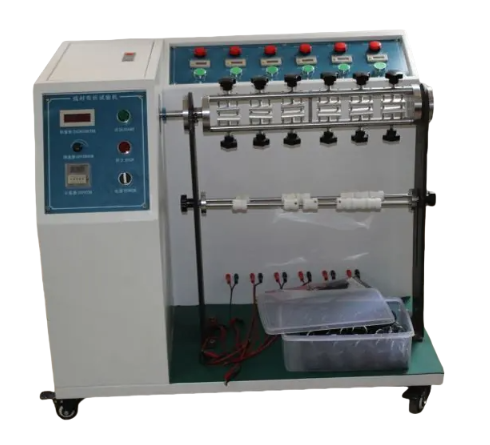
Functions and Applications of Wire Swing Bending Testers
A Wire Swing Bending Tester is a professional testing device used to evaluate the durability, bending resistance, and electrical reliability of wires under repeated bending and oscillating conditions. It is widely applied in quality control and product development across multiple industries.
Core Functions
Simulation of Real-World Usage Conditions
The tester secures the wire using fixtures and applies a specified load while performing left-right swing motion at defined angles, speeds, and cycles. This effectively simulates the bending stress experienced by wires during daily use.
Automatic Counting and Stop Function
The system allows presetting of bending cycles, typically ranging from 0 to 999.999 cycles (with some advanced models supporting up to 99.999.999 cycles).
The machine automatically stops and records the total number of cycles when:
The wire breaks
The electrical continuity fails
The wire cannot carry the preset load current
Multi-Station Simultaneous Testing
Most models are equipped with 6 independent test stations, allowing multiple wire samples to be tested simultaneously without interference. Each station operates independently with separate cycle counting.
Adjustable Test Parameters
Bending angle: 10°–180° (some models support 0°–360° or ±90°)
Test speed: 10–60 cycles/min (advanced models up to 1–100 cycles/min)
Load weights: 50g, 100g, 200g, 300g, 500g (typically 6 sets each), with optional Newton (N) units
Load-Enabled Testing (Advanced Models)
Some high-end systems support AC/DC electrical loading:
AC current: 0–30A
DC current: 0–5A
Failure is determined not only by physical breakage but also by electrical failure under load, providing a more realistic simulation of operational conditions.
Intelligent Control Functions
Power-off memory function
Automatic zero reset
Automatic return mechanism after test completion
Main Applications
Product Compliance Testing
The equipment is used to verify compliance with international and national standards such as UL, IEC, GB, CCC, VDE, and SAA, ensuring that wire products meet required durability and safety regulations.
Applicable Wire Types
The tester is suitable for a wide range of products, including:
Power cables
DC cables
USB data cables
Earphone wires
Flexible printed circuits (FPC)
Automotive wire harnesses
Charging cables
The Wire Swing Bending Tester plays a critical role in evaluating the mechanical fatigue and electrical reliability of wire products. With its high automation, multi-station design, and advanced load testing capabilities, it provides essential support for product development, quality assurance, and international certification.
Industries Applicable to Wire Swing Bending Testers
A Wire Swing Bending Tester is a specialized device used to evaluate the fatigue resistance, insulation integrity, and conductor reliability of cables, plug leads, and data wires under repeated bending or oscillating conditions. It is widely used across multiple industries, as outlined below:
Electronics and Electrical Manufacturing
This is one of the largest application areas. The equipment is used to test bending life of products such as:
Mobile phone charging cables
USB data cables
Earphone wires
Power cords
It helps manufacturers meet strict quality and certification requirements, such as Apple MFi certification standards.
Automotive Industry
The tester is used to verify the durability of automotive wiring systems, including:
Door harnesses
Engine compartment wiring
In-vehicle charging cables
It ensures reliable electrical performance under vibration, high temperature, and complex driving conditions.
Aerospace Industry
Wire Swing Bending Testers are used for fatigue life testing of high-reliability aerospace cables, ensuring stable electrical connections under extreme environmental conditions such as vibration, temperature fluctuation, and mechanical stress.
Home Appliance Industry
The equipment is widely used to test wires in frequently moving parts of household appliances, such as:
Refrigerator door cables
Washing machine power cords
It ensures long-term durability under repeated mechanical movement.
Industrial Automation and Robotics
It is used to evaluate the bending resistance of cables used in:
Robot joints
Industrial control systems
Motion-driven cable assemblies
This ensures stable operation in continuous dynamic motion environments.
Medical Device Industry
The tester is applied to verify the reliability of cables used in medical equipment, ensuring compliance with strict medical safety and performance standards.
Quality Inspection and Research Institutions
The equipment is also widely used by third-party testing laboratories and academic institutions for:
Cable material performance analysis
Compliance testing with international standards
Research on fatigue and failure mechanisms
The Wire Swing Bending Tester plays an important role in ensuring the mechanical durability and electrical reliability of wire and cable products across various high-demand industries. It provides essential technical support for product development, quality assurance, and international certification.
Technical Features of Wire Swing Bending Testers
A Wire Swing Bending Tester is a specialized instrument used to evaluate the fatigue resistance and electrical reliability of wires and cables under repeated bending conditions. Its key technical features are as follows:
Core Technical Features
Multi-Station Independent Testing
The machine is typically equipped with 6 independent test stations, allowing simultaneous testing of multiple samples. Each station operates independently with separate cycle counting and no interference, significantly improving testing efficiency.
Wide Adjustable Test Parameters
Bending angle range: typically 10°–180°, with some models supporting full rotation (0°–360° or ±90°)
Test speed: 10–60 cycles/min (some high-end models support 1–100 cycles/min)
This wide adjustment range allows compatibility with various standards such as UL, GB, and IEC.
High-Precision Automatic Control System
The equipment adopts a PLC + touchscreen + AC servo motor control system, ensuring precise motion control, parameter setting, and logical operation.
Equipped with a 7-inch color touchscreen or LCD display
Supports Chinese/English interface
Provides user-friendly human–machine interaction
Intelligent Stop and Power-Off Memory Function
Automatically stops when wire breakage, short circuit, or electrical failure occurs under load current
Locks and records the current cycle count at failure
Power-off memory function allows continuation of unfinished tests after power recovery
Standardized Loading System
Equipped with multiple hook-type weights (commonly 50g, 100g, 200g, 300g, 500g, typically 6 sets each)
Supports stacking to simulate real-world mechanical stress conditions
Some advanced models support electrical load testing:
AC current: 0–30A
DC current: 0–5A
Failure is determined not only by physical breakage but also by inability to carry the preset current.
High-Precision Counting and Data Recording
Each station is equipped with an independent
Operating Procedure of Wire Swing Bending Tester
The Wire Swing Bending Tester is used to evaluate the fatigue resistance of wires and cables under repeated bending motion. The correct operation procedure is as follows:
Pre-Operation Preparation
Check that the equipment is placed on a stable surface and properly grounded. Ensure the power supply connection is secure.
Clean the fixtures and swing arms to make sure there is no obstruction or debris.
Prepare the test samples, corresponding weights (load weights), and required fixtures.
If the machine is equipped with pneumatic clamps, turn on the air supply and confirm that the air pressure is within the normal range.
Sample Installation
Fix the upper end of the wire to the swing fixture, ensuring it is securely clamped without flattening the wire.
Pass the lower end of the wire through the fixed guide and connect it to the weight hook.
Hang the specified load weight according to test requirements (e.g., 100 g / 200 g / 300 g).
Adjust the wire tension to ensure it is naturally vertical, without twisting or knotting.
For multi-station machines, each station must be installed and checked independently.
Parameter Setting (Touchscreen / Digital Panel)
Turn on the power and start the system.
Set the following parameters:
Swing angle: typically ±90° (total 180°)
Swing speed: adjustable from 10 to 60 cycles per minute
Test cycles: preset values such as 10.000 or 50.000 cycles
Enable the automatic stop function for wire break detection (this must be turned on).
Reset all counters to zero before testing.
Test Start Operation
Double-check that all samples, weights, and fixtures are properly installed.
Press the START button to begin the swing motion.
The machine will automatically count cycles and display the current count in real time.
During operation, observe for abnormalities such as unusual noise, wire entanglement, or fixture loosening.
Test Completion Criteria
The test will automatically stop under either of the following conditions:
Wire breakage is detected, triggering electrical continuity failure
The preset number of cycles is reached
After the test stops:
Record the number of cycles at failure or completion
Inspect the sample for damage such as insulation cracking, conductor breakage, or detachment
If further testing is required, reset the counter and reinstall new samples
Shutdown and Maintenance
Remove all weights and test samples after completion.
Turn off the power supply and unplug the device.
Clean the fixtures and workbench to keep them dry and dust-free.
Regularly lubricate swing shafts and moving parts.
Cover the equipment with a dust cover if it will not be used for a long period.
Important Safety Precautions
Do not clamp the wire too tightly or too loosely to avoid damage or slippage.
Ensure all weights remain vertical and do not collide with the machine body.
Do not place hands inside the swing area during operation to prevent injury.
Immediately stop the machine if abnormal noise or jamming occurs.
Do not arbitrarily change test standards such as weight or swing angle, as different wire types require specific testing conditions.
Proper operation of the Wire Swing Bending Tester ensures accurate fatigue life evaluation of wires and cables while maintaining equipment safety and long-term stability.
Importance of Wire Swing Bending Testers
A Wire Swing Bending Tester plays a critical role in modern industrial quality control and product reliability verification. Its importance is reflected in multiple dimensions, including product safety, compliance standards, R&D innovation, and industrial applications.
Ensuring Product Safety and Regulatory Compliance
The primary function of this equipment is to simulate real-world conditions where wires and cables are repeatedly bent and oscillated, in order to evaluate fatigue resistance and electrical connection reliability.
Testing procedures are aligned with internationally recognized standards such as UL817. IEC 60884. GB 2099.1. and the dedicated electric vehicle charging cable standard GB/T 33594-2017.
This means that products such as household appliance power cords, data cables, and automotive wiring harnesses must pass such testing before entering the market. The tester therefore serves as a critical safeguard against risks such as short circuits, power failure, and even fire hazards caused by wire fatigue or breakage.
Key Role in Improving Product Quality and Reliability
In manufacturing and quality inspection processes, the tester typically adopts a multi-station (commonly 6 stations) parallel testing design, significantly improving efficiency.
It allows precise control of key parameters, including:
Bending angle: 10°–180° (some models support full 360° rotation)
Swing speed: 10–60 cycles/min
Load weights: 50g to 500g or higher configurations
By automatically counting cycles and stopping when wire failure or preset limits are reached, the device provides accurate fatigue life data.
This data is essential for manufacturers to optimize:
Conductor structure (e.g., stranding method)
Insulation and sheath materials
Termination and connection processes
Ultimately, it supports continuous improvement in product durability and consistency.
Supporting R&D Innovation and Supply Chain Management
During product development, the tester is used to compare the durability of different materials and structural designs, accelerating product iteration and validation.
In supply chain management, it serves as an objective tool to evaluate supplier consistency and ensure incoming materials meet design specifications.
Its application has expanded beyond traditional consumer electronics and home appliances into high-reliability industries such as:
Automotive systems
Aerospace engineering
New energy vehicles (NEVs)
For example, EV charging cables require specific test conditions (e.g., ±90° swing angle and defined loading conditions such as 50N–100N weights) to ensure durability under frequent plugging, bending, and long-term use.
Driving Standardization and Intelligent Manufacturing
The evolution of wire swing bending testers reflects the industry’s shift toward standardization and smart manufacturing.
Modern systems typically feature:
PLC control systems
Touchscreen interfaces
Servo motor drive systems
Programmable test parameters
Automatic stop and power-off memory
Data logging and traceability functions
These improvements make testing more accurate, efficient, and traceable.
Their wide compatibility with global standards also contributes to unifying product quality benchmarks in international trade.
In summary, the Wire Swing Bending Tester is not only a “gatekeeper” ensuring product compliance and safety, but also a fundamental tool driving product reliability improvement, supporting advanced manufacturing, and enabling industrial innovation.Its widespread use and continuous technological advancement provide a strong foundation for the safe operation of key industries such as electronics, automotive, aerospace, and new energy systems.We sincerely welcome your inquiries or messages so that we can provide more detailed product information and technical support.
Previous: What is a Safety Footwear Compression Puncture Tester?
N e x t : What is a Nonwovens Liquid Loss Tester?
