





What is a Wire-to-Wire Vibration Abrasion Tester?
2026/05/12
Share:

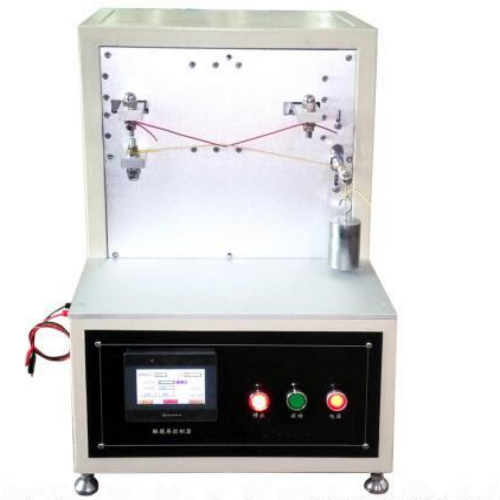
Functions and Applications of the Wire-to-Wire Vibration Abrasion Tester
Understanding the functions and applications of this equipment is not merely about recognizing a single device; it provides direct insight into its value in engineering design, quality control, and product reliability assessment.
Functions
Simulates dynamic abrasion of cable environments:
Through a combined motion of vibration and friction, the tester replicates the mechanical stresses experienced by cables in real-world applications, such as internal wiring in equipment or connection points in moving components.
Evaluates abrasion resistance performance:
Standard abrasive media (such as steel mesh) are used to perform reciprocating friction on cable surfaces. The number of cycles is recorded until insulation damage occurs or the conductor becomes exposed.
Complies with industry testing standards:
The equipment is designed to meet relevant cable abrasion resistance testing standards, such as NEMA-C 9.5 and other similar specifications.
Applications
Cable and wire manufacturing industry:
Used to verify the abrasion resistance of wire insulation and sheathing materials, ensuring product reliability in environments with frequent bending or vibration.
Automotive and industrial equipment sector:
Used to test the durability of wire harnesses in high-vibration areas such as engine compartments and robotic joints.
Quality control and R&D:
Serves as a basis for factory inspection and material selection, helping improve product lifespan, safety, and overall performance.
Industries Applicable to the Wire-to-Wire Vibration Abrasion Tester
The main industries where this equipment is widely used include:
Automotive manufacturing:
Used to test the abrasion resistance of wire harnesses, corrugated conduits, and adhesive tapes in high-vibration areas such as engine compartments and door systems.
Aerospace industry:
Evaluates the long-term reliability of aerospace cables and connectors under high-vibration operating environments.
Rail transit:
Tests the durability of cable insulation and sheathing materials used inside trains under continuous operational vibration.
Industrial machinery and robotics:
Used for reciprocating friction and torsional wear testing of industrial cables and robotic wiring subjected to repeated bending, dragging, and movement.
Mining equipment:
Assesses the wear resistance and tear resistance of rubber-sheathed mining cables in harsh underground environments with high impact and friction.
Military and defense equipment:
Ensures the abrasion and scratch resistance of cable protection systems under extreme conditions, guaranteeing operational reliability in field environments.
Technical Features of the Wire-to-Wire Vibration Abrasion Tester
The Wire-to-Wire Vibration Abrasion Tester is a dedicated instrument designed to evaluate the abrasion resistance of wire insulation—particularly automotive wires—under wire-to-wire vibration and friction conditions. Its key technical features are as follows:
Core Technical Features
Accurate simulation of real operating conditions:
Horizontal vibration is used to replicate the friction between wire harnesses caused by vibration and displacement during vehicle operation, faithfully reproducing real-world wear processes.
High-precision vibration control:
The vibration frequency is maintained at a stable 10 Hz, with an amplitude of 6.35 ± 0.25 mm. The vibration direction is horizontal, ensuring high repeatability and consistency of test results.
Automatic failure detection:
When insulation wear progresses to the point where the conductor is exposed and electrical continuity failure occurs, the system automatically stops, allowing precise determination of the abrasion resistance limit.
Programmable test cycles:
The device supports adjustable cycle settings from 1 to 9.999 cycles, meeting various standard requirements and R&D testing needs.
Standardized load application:
Equipped with weights of 10 N, 12.5 N, 15 N, and 20 N, allowing the application of specified loads in accordance with standards such as VW and GS specifications.
Specialized fixture and positioning design:
Both ends of the fixed wire are mounted on the vibration table with a spacing of 280 mm. One end of the moving wire is fixed, while the other passes through a guide shaft (diameter > sample diameter × 14), ensuring the friction point is located at the midpoint of the specimen (±10%). The distance between the vibration table and fixed table is 45 mm, guaranteeing accurate and consistent friction positioning.
Operating Procedure of the Wire-to-Wire Vibration Abrasion Tester
1. Sample Preparation Stage
First, the wire samples must be cut to the specified length in accordance with relevant testing standards such as ASTM or ISO. The samples are then properly fixed onto the test fixtures, ensuring that the two wires maintain strict parallel contact within the critical test area. During this process, a precise pre-tension or static load must be applied via the fixture system in accordance with standard requirements, so as to simulate the actual contact stress conditions encountered in real-world applications and establish a proper foundation for subsequent vibration abrasion testing.
2. Equipment Calibration and Initialization
Before testing begins, the equipment must undergo systematic calibration. The vibration table drive system should first be checked to ensure it is properly zeroed. In addition, integrated sensors such as accelerometers or load force sensors must be confirmed to be within a valid calibration cycle to ensure accurate and reliable readings. Based on the selected test standard (ASTM, ISO, or specific industry specifications), key vibration parameters are then preset in the control system, including target frequency, displacement amplitude, or more complex power spectral density (PSD) profiles, ensuring full compliance with standard requirements.
3. Detailed Test Parameter Configuration
At this stage, several key parameters are precisely configured in the control software:
Frequency range: Depending on the material properties of the tested wire (e.g., metal or polymer composites) and application scenarios, values are typically set within 10 Hz to 1000 Hz. Either fixed frequency or sweep mode can be selected.
Vibration type: The appropriate test mode is selected according to standards, such as broadband random vibration for complex environmental stress simulation, or sinusoidal sweep vibration for resonance identification.
Test duration: A defined continuous operation time is set based on testing objectives and standard requirements, commonly 30 minutes, 1 hour, or longer.
Environmental conditions: If required by the test standard, a temperature and humidity chamber must be activated in advance to stabilize the environment within specified ranges.
4. Test Loading and Start-Up Execution
After all settings are completed, the vibration system is started and the amplitude is gradually increased in a controlled and smooth manner to the preset target value, preventing initial shock to both the sample and equipment. At the same time, the wear monitoring subsystem is activated, such as cycle counters or online monitoring systems based on resistance change or real-time mass loss measurement, to begin initial data acquisition.
5. Real-Time Monitoring During Operation
During the test, the system operation must be continuously monitored. Early signs of wear at the contact interface should be observed and recorded, such as abnormal friction noise or fluctuations in vibration displacement signals. If equipped with high-speed cameras or high-resolution optical sensors, they should be activated simultaneously to dynamically capture and record the evolution of wear morphology at the contact interface, providing visual evidence of the abrasion process.
6. Test Completion and Performance Evaluation
Once the preset test duration is reached, the system is safely shut down and the tested wire samples are carefully removed. The samples are then analyzed using optical microscopes, electron microscopes, surface roughness testers, or precision balances (for gravimetric methods) to quantitatively evaluate wear characteristics such as wear depth, wear volume, or mass loss. Finally, the results are compared in detail with reference standard samples or the original condition of the specimen to comprehensively determine whether the abrasion resistance performance meets the required technical specifications or qualification criteria.
Importance of the Wire-to-Wire Vibration Abrasion Tester
The importance of the Wire-to-Wire Vibration Abrasion Tester lies in its provision of a critical and irreplaceable quantitative method for evaluating the durability and reliability of wire harnesses, connectors, and related electrical and electronic components under simulated harsh operating conditions. Its significance can be summarized in the following aspects:
1. Ensuring long-term reliability under dynamic mechanical stress
Electrical and electronic products are frequently exposed to continuous vibration and friction during transportation and actual operation. The Wire-to-Wire Vibration Abrasion Tester accurately simulates long-term micro-motion friction (fretting wear) between cables or between cables and contact surfaces caused by vibration. This type of wear is a primary cause of insulation damage, signal degradation, and even short-circuit failures. Through this testing, mechanical weaknesses can be identified and improved during the design stage, significantly enhancing product lifespan and operational stability in real-world conditions.
2. Meeting high durability requirements across demanding industries
In industries such as automotive, aerospace, industrial equipment, and high-end consumer electronics, the reliability of wire harnesses and connectors directly affects system safety and performance. The tester reproduces controlled vibration frequencies and amplitudes combined with reciprocating friction, providing a standardized method to evaluate the abrasion resistance of wire insulation and connector interfaces. This ensures that manufacturers can meet or exceed industry standards (such as those in the automotive sector) and achieve necessary market certification and customer acceptance.
3. Optimizing material selection and product design while controlling quality costs
The tester enables comparative evaluation of different insulation materials, coating systems, cable braid structures, and connector designs in terms of wear resistance. The resulting data provides direct guidance for material selection and structural optimization during R&D, helping achieve an optimal balance between cost and performance. In production, it also serves as a quality control tool to filter out non-compliant batches, reducing after-sales repair costs and minimizing brand reputation risks caused by early-life failures.
4. Simulating real failure modes to support failure analysis and prevention
Unlike single-mode vibration or friction tests, the core value of the Wire-to-Wire Vibration Abrasion Tester lies in its combined stress simulation capability. It can realistically induce typical failure modes observed in real applications, such as insulation wear-through, conductor fatigue fracture, and increased contact resistance. Through post-test failure analysis, engineers can gain deeper insight into failure mechanisms and implement targeted improvements in product design, assembly processes, or protective measures, enabling proactive quality assurance.
In summary, the Wire-to-Wire Vibration Abrasion Tester is an essential tool in the wire harness and connector industry for ensuring mechanical durability, meeting industry standards, and supporting efficient R&D and quality control. Its test results serve as a key indicator for evaluating long-term reliability under complex dynamic environments.We sincerely welcome your inquiries or direct contact, and we will be pleased to provide more detailed product information.
Previous: What is a notching machine used for?
N e x t : What are the core advantages of Sock Stretch Tester?
