





What is HD2 Pneumatic Foam Fatigue Tester?
2026/05/13
Share:

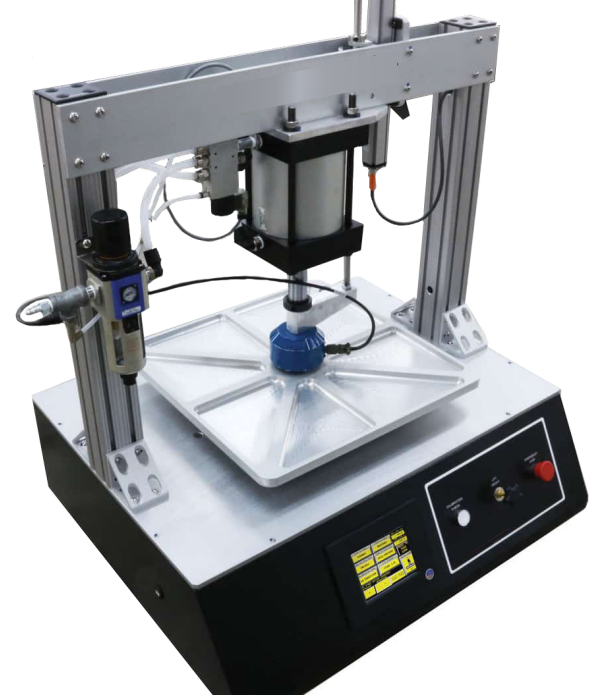
Technical Features of the HD2 Pneumatic Foam Fatigue Tester
Technical Features
Drive System:
Uses pneumatic or servo motor drive to achieve reciprocating compression motion.
Test Frequency:
Typically adjustable from 0–110 cycles/min, with a standard requirement of (70 ± 5) cycles/min.
Compression Head Specification:
Common diameter is φ250 mm ±1 mm, with a rounded edge radius of 25 mm ±1 mm.
Loading Capacity:
Maximum load options commonly include 1000 N, 2 kN, and 5 kN.
Specimen Size:
Typically a rectangular foam sample measuring 500 mm × 500 mm × 50 mm ±2 mm.
Control System:
Equipped with a PLC touch-screen controller supporting bilingual (Chinese/English) operation, allowing parameter settings such as compression cycles, frequency, and displacement.
Data Acquisition:
Real-time display of peak force values with accuracy up to Class 0.5. and a six-digit counter for recording cycle counts.
Safety and Automation:
Features automatic shutdown, power-off protection, and fault alarm functions.
Functions and Applications of the HD2 Pneumatic Foam Fatigue Tester
The HD2 Pneumatic Foam Fatigue Tester is a dedicated device designed to evaluate the fatigue performance of foam materials (such as sponges and polyurethane foams) under repeated loading conditions. Its core functions and applications are as follows:
Functions
Simulates repeated compression and rebound processes in real-world use, assessing the durability of foam materials;
Utilizes a pneumatic drive system, where a cylinder drives the testing head to perform reciprocating vertical motion, simulating dynamic loading conditions in applications such as buttons, seat cushions, and packaging;
Allows setting of test cycles, speed, stroke, and load, and supports independent multi-station control;
Equipped with load sensors and displacement measurement systems to record force values and deformation data in real time;
Features an automatic shut-off function, stopping the test when the preset number of cycles is reached or when specimen failure occurs;
Supports high-speed testing, with test speeds ranging from 10 to 120 cycles per minute and a typical stroke of 10 mm.
Applications
Foam material quality control: used for fatigue life evaluation of products such as sponges, mattresses, automotive seats, and packaging foams;
Product R&D and certification: enables dynamic performance testing of foam materials in compliance with international standards such as ASTM and ISO;
Industrial reliability validation: applicable to durability testing of foam components in automotive, furniture, home appliance, and sports protection industries;
Multi-station batch testing: allows simultaneous testing of multiple samples to improve testing efficiency.
Industries of Application for the HD2 Pneumatic Foam Fatigue Tester
The HD2 Pneumatic Foam Fatigue Tester is primarily focused on evaluating the durability of soft foam materials. It determines material service life and performance stability by measuring indicators such as residual deformation rate and hardness degradation.
Applicable Industries
Automotive Manufacturing Industry:
Used to test the compression fatigue performance of foam materials in automotive interiors such as seats, headrests, and armrests, ensuring long-term comfort and safety in use.
Furniture Industry:
Evaluates the durability and resilience of foam materials used in sofas, mattresses, and other upholstered furniture products.
Packaging Industry:
Tests the protective performance and structural stability of cushioning foams under repeated impact or stacking pressure.
Sports Goods and Toy Manufacturing:
Used for fatigue reliability verification of foam materials in products such as sports protective gear, exercise mats, and children’s toys.
Material R&D and Quality Inspection Institutions:
Supports new material development, formulation optimization, and compliance testing in accordance with international and national standards such as ISO and GB/T.
Operating Procedure of the HD2 Pneumatic Foam Fatigue Tester
1. Pre-Operation Preparation
Specimen preparation:
Cut foam specimens according to relevant standards (e.g., GB/T or ISO), ensuring accurate dimensions, flat surfaces, and no burrs or impurities. Condition the samples in a standard environment (e.g., 23 ± 2°C, 50 ± 5% RH) for at least 24 hours.
Equipment inspection:
Check whether the power supply and air supply connections are secure and intact;
Verify that the impact head, support platform, and safety door are functioning properly;
Ensure the emergency stop button and safety protection systems are operational.
2. Main Operating Steps
Power-on and parameter setting:
Turn on the equipment and allow it to complete self-check;
Set test parameters according to the relevant standard, such as frequency, stroke, and number of cycles (e.g., frequency 1–5 Hz, displacement 10–50 mm).
Specimen placement and fixation:
Place the specimen at the center of the test platform;
Secure it properly using fixtures or vacuum adsorption to prevent displacement or deformation.
Test start and monitoring:
Close the safety door and start the machine;
Monitor the running status in real time via the display screen or observation window, and press the emergency stop immediately if any abnormal condition occurs.
Test completion and data processing:
After automatic stop, remove and label the specimen;
Save data such as force–displacement curves and fatigue life in time, and generate a test report.
3. Precautions
Safety compliance:
Strictly follow the principle of “door closed before operation, door opened only after stop.”
Parameter accuracy:
Set parameters in accordance with relevant national or international standards; avoid using non-standard values.
Regular maintenance:
Clean the equipment regularly, lubricate moving parts, and check sensor accuracy to ensure stable performance.
Importance of the HD2 Pneumatic Foam Fatigue Tester
The importance of the HD2 Pneumatic Foam Fatigue Tester lies in its role as a critical instrument for evaluating the long-term durability and performance reliability of porous elastic materials such as sponges and foams. Its significance is mainly reflected in material quality control, product R&D optimization, compliance with standards, and safety and economic assurance.
1. Ensuring Product Quality and Performance Consistency
The fatigue performance of foam materials is directly related to the service life and user experience of end products. In applications such as furniture, automotive seats, mattresses, and packaging materials, foam components are subjected to long-term cyclic compressive loads.
Service life prediction:
By simulating repeated compression conditions encountered in real-world use, the HD2 tester quantitatively evaluates the degradation of material properties (such as hardness and resilience) under cyclic loading, enabling scientific prediction of product lifespan and durability.
Performance stability assurance:
The test helps identify batches with poor fatigue resistance, preventing premature softening, collapse, or permanent deformation that could lead to functional failure, thereby ensuring consistency and reliability of finished products.
2. Optimizing Product Development and Process Improvement
In material science and product design, the equipment serves as an essential R&D tool.
Material formulation screening:
By comparing fatigue test data of foams produced with different formulations, densities, and processes, researchers can obtain objective performance comparisons, optimize material formulations, and develop more durable and comfortable materials.
Process parameter guidance:
Test results provide feedback for production, helping adjust foaming processes, curing conditions, and other parameters to improve mechanical performance. The ability to simulate different waveforms and loading conditions enables more realistic replication of complex working environments.
3. Meeting Industry Standards and Regulatory Requirements
Many industries impose strict standards for the durability of foam-based products.
Compliance verification:
Using standardized fatigue testing methods (such as national standard A, B, or C methods) is essential for demonstrating compliance with national, international, or industry standards in fields such as furniture, automotive interiors, and medical devices.
Quality management system support:
Integrating fatigue testing into routine quality control is a key part of establishing a robust quality assurance system, supporting market inspections and customer audits, and enhancing brand reputation.
4. Preventing Failures and Improving Safety & Economic Benefits
Fatigue testing of foam materials delivers significant safety and economic value.
Risk prevention:
For foam used in critical applications such as medical support pads, sports protective gear, and vehicle seating, premature fatigue failure may lead to safety hazards or functional loss. Pre-testing effectively mitigates these risks.
Cost reduction:
Comprehensive fatigue testing reduces long-term costs associated with after-sales repairs, returns, and warranty claims. It also helps avoid over-engineering, optimizing material usage and maximizing cost efficiency.
5. Technical Features Supporting Its Importance
The significance of the HD2 tester is also reinforced by its advanced technical capabilities:
Precise simulation and control:
Closed-loop control systems (such as PID control) and high-precision sensors ensure accurate application and maintenance of cyclic load and displacement, guaranteeing data accuracy and repeatability.
Automation and efficiency:
Automatic operation, real-time data acquisition, curve analysis, and report generation significantly improve testing efficiency and objectivity.
Multi-function integration:
Advanced models may include environmental simulation systems, enabling fatigue testing under varying temperature and humidity conditions, further expanding application scope.
In summary, the HD2 Pneumatic Foam Fatigue Tester serves as a crucial bridge between fundamental material properties and real-world product reliability. Through scientific and quantitative testing, it provides indispensable technical support for material quality control, product innovation, standards compliance, and risk-cost management.We sincerely welcome your inquiries or messages so that we can provide you with more detailed product information.
Previous: What are the core advantages of Sock Stretch Tester?
N e x t : Why is the Anti-glare Panel Falling Weight Tester important?
