





What is the Leather Shoe Hook Core Longitudinal Bending Stiffness Tester?
2026/05/18
Share:

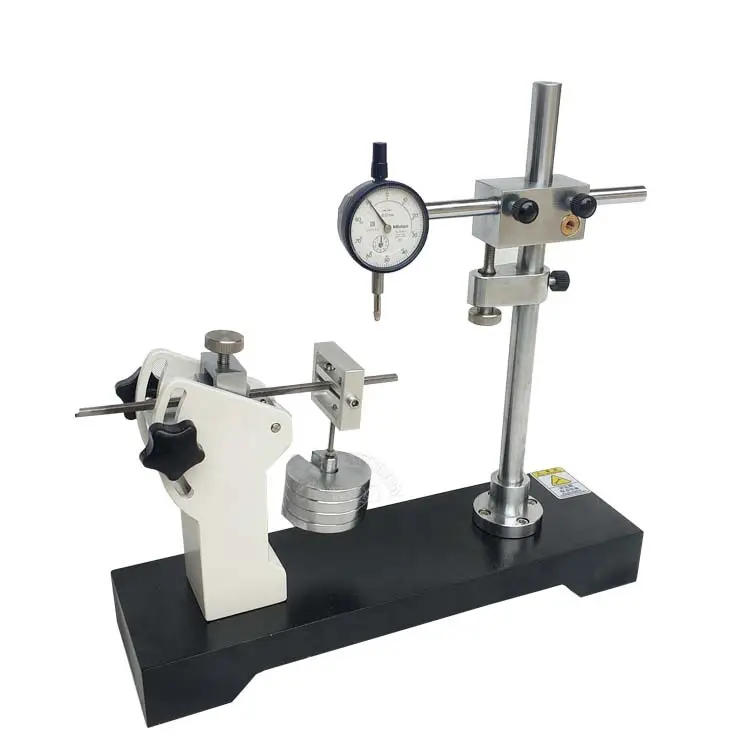
Functions and Applications of Leather Shoe Shank Longitudinal Bending Stiffness Tester
The Leather Shoe Shank Longitudinal Bending Stiffness Tester is a specialized instrument designed to test the longitudinal bending stiffness of the steel shank inside leather shoes. Its core function is to evaluate the bending deformation of the shank under applied force, thereby calculating its bending stiffness and ensuring that the structural support performance of footwear products meets relevant standards.
Main Functions
Measurement of Longitudinal Bending Stiffness
By fixing the rear end of the shank and applying a load to the front end, the tester measures the resulting deflection and calculates the stiffness value accordingly.
Replaceable Fixtures
Equipped with interchangeable fixtures to accommodate shanks of different shapes and sizes, improving testing flexibility and application range.
High-Precision Positioning
Adopts a limiting mechanism to prevent beam movement or shaking during testing, ensuring higher repeatability and accuracy.
Compliance with Multiple National Standards
Designed and manufactured in accordance with various national and industry testing standards.
Typical Applications
Quality Control
Widely used by footwear manufacturers for quality inspection of shank raw materials and finished shoes.
Research and Development Verification
Assists in shank selection and structural optimization during the development of new shoe models.
Third-Party Testing
Provides compliant and traceable testing data for certification bodies and inspection agencies.
Compliance with International Standards
Meets the requirements of international standards such as ISO and BS.
Industries Applicable to the Leather Shoe Shank Longitudinal Bending Stiffness Tester
The Leather Shoe Shank Longitudinal Bending Stiffness Tester is a specialized instrument used to measure the longitudinal bending stiffness of the steel shank in leather shoes. It is widely used in the following industries:
Footwear Manufacturing Industry
Used to evaluate the structural stiffness and support performance of leather shoes, ensuring that finished products meet quality and performance standards.
Leather Material Research and Quality Inspection
Applicable for testing the mechanical properties of shoe leather materials and related composite materials, helping manufacturers improve product durability and comfort.
Third-Party Testing and Certification Institutions
Provides professional testing services for footwear and leather products in accordance with international or national standards.
Universities and Research Institutes
Widely used in teaching, laboratory testing, and scientific research in fields such as material science, footwear engineering, light industry, and textile engineering.
The tester is equipped with replaceable front and rear fixtures to accommodate different shank shapes and sizes. In addition, its limiting mechanism enhances testing precision and repeatability, making it highly suitable for high-accuracy longitudinal stiffness evaluation of footwear components.
Working Principle of the Leather Shoe Shank Longitudinal Bending Stiffness Tester
The working principle of the Leather Shoe Shank Longitudinal Bending Stiffness Tester is based on the bending deformation theory in material mechanics. By applying a known load and measuring the resulting deformation, the bending stiffness of the shoe shank can be calculated.
Core Working Procedure
Rear-End Fixing
The heel end of the leather shoe shank is firmly clamped onto the fixture to ensure stable positioning during the test.
Front-End Loading
A standard weight load, typically 200 g ±1 g, is applied to the front end of the shank.
Bending Deformation
Under the applied load, the shank undergoes elastic bending deformation.
Deflection Measurement
A high-precision displacement sensor or deflection gauge is used to measure the bending deflection at the front end. Common measuring ranges are 0–10 mm or 0–20 mm, with a minimum scale value of 0.01 mm.
Stiffness Calculation
Under a simplified mechanical model, the bending stiffness can be expressed by the formula:
K=\frac{F L^3}{48EI}
In practical applications, the stiffness is more commonly calculated directly from the ratio of load to deflection:
K=\frac{F}{\delta}
Where:
K = bending stiffness
F = applied load
δ = measured deflection
L = effective length of the shank
E = elastic modulus of the material
I = moment of inertia of the section
Through this testing principle, the instrument can accurately evaluate the support performance and structural stability of leather shoe shanks.
Operating Procedure of the Leather Shoe Shank Longitudinal Bending Stiffness Tester
The leather shoe shank stiffness test follows a rigorous and standardized operating procedure to ensure accurate and reliable test results.
First, professional testing equipment must be prepared, typically a Leather Shoe Shank Longitudinal Bending Stiffness Tester. This instrument is capable of precisely applying force and measuring various data generated during the loading process.
Before the test begins, the operator carefully selects representative leather shoe shank samples to ensure the validity of the testing results.
Next, the shank is mounted onto the testing machine according to the specified method, simulating its actual stress condition inside the shoe. The tester then applies a gradually increasing force to the shank at a specified loading rate and direction. During the entire process, high-precision sensors continuously monitor critical parameters such as deformation and applied force.
Key Control Points During Testing
Several important factors must be strictly controlled throughout the testing process:
Environmental Conditions
The test should generally be conducted under standard temperature and humidity conditions to eliminate the influence of environmental factors on the material properties of the shank and ensure testing accuracy.
Loading Speed Control
The force application rate must strictly comply with relevant testing standards. Excessively fast or slow loading may result in inaccurate test data.
Accurate Sample Installation
The installation position and angle of the shank sample must be precisely aligned. Even slight deviations can alter the stress condition of the shank and affect the final test results.
Evaluation of Test Results
The evaluation of leather shoe shank stiffness is also based on clearly defined standards.
Different types and applications of leather shoes require different shank stiffness values. Relevant industry standards specify acceptable stiffness ranges for various categories of footwear. Only when the measured stiffness value falls within the specified range can the shank be considered qualified, ensuring that the footwear product meets quality requirements in terms of structural support performance.
For example:
Formal Leather Shoes
The shank stiffness must meet a minimum value to provide stable foot support during prolonged standing and walking, while also remaining below a maximum limit to maintain flexibility and comfort.
Casual Leather Shoes
Due to differences in wearing scenarios and movement characteristics, the required stiffness range for casual shoe shanks may differ from that of formal footwear.
Through standardized testing procedures and strict result evaluation, the Leather Shoe Shank Longitudinal Bending Stiffness Tester plays an important role in ensuring footwear comfort, durability, and structural stability.
Importance of the Leather Shoe Shank Longitudinal Bending Stiffness Tester
The Leather Shoe Shank Longitudinal Bending Stiffness Tester plays a vital role in footwear manufacturing and quality control. Its importance is mainly reflected in the following aspects:
1. Ensuring Footwear Structural Safety and Wearing Comfort
The shank is a supporting component located between the outsole and insole of a shoe, usually made of metal or composite materials. Its primary function is to maintain the longitudinal stiffness of the sole and prevent excessive bending of the foot.
This tester simulates the longitudinal bending force experienced by the shank during walking and evaluates its resistance to deformation. If the shank stiffness is too low, it may lead to sole collapse, insufficient arch support, and foot fatigue or injury. On the other hand, excessive stiffness may restrict natural foot movement and reduce wearing comfort.
2. Compliance with National and Industry Standards
China’s national standard GB/T 3903.34-2019 Footwear — Test Methods for Shanks — Longitudinal Stiffness clearly specifies the testing methods and technical requirements for shoe shank longitudinal stiffness. This tester serves as the core equipment for implementing the standard.
Compliance with such standards helps manufacturers successfully pass quality inspections and export certifications, including requirements related to CE, ASTM, and other international regulations, thereby improving market access capability.
3. Improving Product Quality and Brand Competitiveness
By accurately quantifying shank performance, manufacturers can optimize material selection and structural design while reducing after-sales problems caused by shank failure, such as sole deformation or delamination.
In the highly competitive footwear market, stable and reliable shank stiffness has become an important selling point for high-end functional footwear, including safety shoes, sports shoes, and formal leather shoes.
4. Supporting Research, Development, and Process Improvement
Testing data provides valuable support for the development of new materials, such as lightweight alloys and carbon fiber shanks, promoting product innovation and technological advancement.
The tester also offers excellent repeatability, making it suitable for batch comparison, durability prediction, and production process optimization, thereby supporting refined manufacturing management.
5. Enhancing Consumer Safety
A fractured or failed shank may cause ankle injuries or slipping accidents during walking. This testing instrument helps identify unqualified products at the source, significantly reducing potential safety risks for consumers.
In summary, the Leather Shoe Shank Longitudinal Bending Stiffness Tester is not only an essential quality control instrument for ensuring product quality and consistency, but also an important bridge connecting material science, engineering design, and practical footwear applications. It accurately links the intrinsic properties of raw materials, the optimization of product structures, and the real wearing experience of end users, playing an indispensable role throughout the entire chain of research, production, and consumer use.We understand that every technical detail may influence your decisions and product performance. Therefore, we sincerely welcome industry professionals, business partners, and interested friends to contact us for more comprehensive technical information, application cases, and customized testing solutions. Together, we can explore how precise testing technology can drive product innovation and quality improvement in the footwear industry.
Previous: How to use Rubber Rebound Elasticity Tester?
N e x t : What is the liquid batch dosing system?
