





What is the liquid batch dosing system?
2026/05/19
Share:

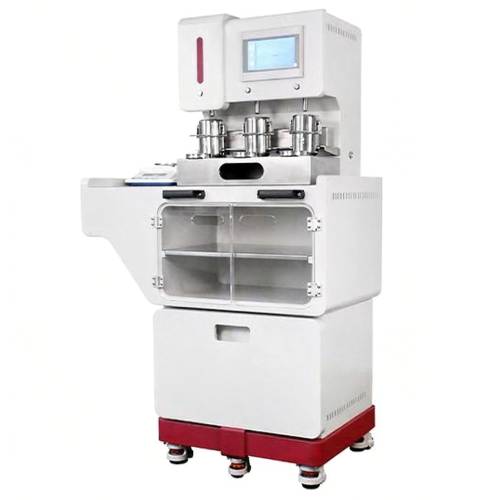
Functions and Applications of the Automatic Liquid Dosing System for Textile Color Fastness
The Automatic Liquid Dosing System for Textile Color Fastness is a supporting device specifically designed to improve the accuracy, safety, and efficiency of color fastness testing. It is widely used in textile testing for wash fastness, dry-cleaning fastness, and shrinkage-related fastness tests. Its core functions and applications are as follows:
Main Functions
1. Precise Dosing and Intelligent Solution Preparation
The system uses a high-precision electronic balance to weigh samples and automatically calculates the required amounts of detergent, water, and other auxiliary agents based on the preset liquor ratio, with an error controlled within 1 mL.
According to different testing standards (such as GB/T, ISO, and AATCC) and fiber types (e.g., cotton, wool, and synthetic fibers), the system can automatically adjust parameters such as liquid temperature and concentration. This helps prevent damage to protein-based fibers at high temperatures and simulates more rigorous washing conditions.
2. Automated Liquid Dosing and Process Control
The system uses mechanical arms, solenoid valves, and other components to automatically extract and inject liquids (such as tetrachloroethylene used in dry-cleaning tests), eliminating the need for manual intervention and reducing operators’ exposure to organic solvents.
Based on a PLC (Programmable Logic Controller), the system enables fully automated operation of dosing, solution preparation, mixing, transport, and drainage processes, supporting unattended operation.
3. Data Acquisition and Feedback Adjustment
The system continuously monitors parameters such as temperature, concentration, and flow rate in real time. If any deviation from preset values is detected, it automatically adjusts heating or replenishes liquid to ensure stability.
It can also automatically generate and store test reports, supporting historical data retrieval and comparison, providing a reliable basis for process optimization.
4. Remote Monitoring and Intelligent Connectivity
Some advanced models (such as SmartFill) support Wi-Fi connectivity with mobile applications (such as SmarTexLab), enabling parameter setting, real-time status monitoring, and consumable reminders via mobile devices.
Main Applications
1. Improved Testing Reliability
By precisely controlling variables such as liquor ratio, temperature, and steel ball quantity, the system significantly improves the repeatability and accuracy of wash fastness testing.
2. Increased Laboratory Efficiency
Each test can save approximately 10 minutes of preparation time. Based on 200 samples per day, the system can reduce labor costs by nearly 30% annually.
3. Full-Chain Quality Control Support
It is widely used in third-party testing laboratories, apparel brands, fiber manufacturers, and dyeing and finishing enterprises, ensuring that products comply with both domestic and international quality standards.
Technical Features of the Automatic Liquid Dosing System for Textile Color Fastness
As a key device for improving the accuracy, safety, and efficiency of textile quality inspection, the Automatic Liquid Dosing System for Textile Color Fastness is mainly characterized by four aspects: precise dosing technology, full-process automation control, real-time data feedback and adjustment, and high-level safety and environmental performance. The system is widely used in wash fastness, dry-cleaning fastness, and shrinkage-related fastness tests, and strictly complies with major international and domestic testing standards such as GB/T series, ISO, AATCC, and JIS.
1. Precise Dosing and Intelligent Solution Preparation Technology
The core advantage of the automatic dosing system lies in its high-precision liquid control capability, which fundamentally eliminates errors caused by manual operation.
High-precision weighing and calculation algorithm
The system is equipped with a high-precision electronic balance to accurately weigh textile specimens. Combined with preset liquor ratios, the built-in computer control system uses intelligent algorithms to automatically calculate the required amounts of detergent, water, and other auxiliary agents.
In wash fastness testing, the liquid dosing error can be controlled within 1 mL, significantly improving test consistency.
Material-adaptive parameter adjustment
The system has intelligent adaptability for different fiber types. For protein fibers such as wool and silk, it automatically maintains a lower temperature to prevent thermal damage; for synthetic fibers, higher temperatures can be set to simulate more severe washing conditions.
In addition, the built-in stirring device ensures full dissolution of detergents and other chemicals, guaranteeing solution uniformity.
High-stability dosing accuracy
In dry-cleaning fastness testing, the automatic dosing unit uses precision pumps and PTFE-lined pipelines to control the dosage of organic solvents such as tetrachloroethylene within ±1% of the standard value (e.g., 200 mL ± 2 mL).
Compared with manual dosing, which is easily affected by human factors, the automated system ensures higher accuracy and stability through fully controlled liquid intake and flow rate.
2. Full-process Automation and Process Control Technology
Based on a PLC (Programmable Logic Controller) and a large touchscreen interface, the system enables fully unattended operation from sample handling to wastewater discharge.
Automated mechanical execution system
The system uses robotic arms, solenoid valves, and precision pipetting units to automatically transport and add liquids.
In dry-cleaning tests, solvents are automatically extracted from storage tanks and injected into test vessels. In washing tests, the system completes weighing, dosing, mixing, stirring, and drainage in sequence. This greatly improves efficiency and reduces labor demand.
Standardized program control
Operators only need to select the required testing standard (such as GB/T or ISO series) and parameters on the touchscreen interface. The system then automatically executes the entire process based on preset programs.
Some high-end models support dual-cylinder independent control, enabling simultaneous testing under different temperatures or conditions, significantly increasing laboratory throughput.
Multi-station parallel processing capability
Advanced systems often feature multi-station configurations (e.g., 12 stations in a 3×4 layout), allowing simultaneous dosing for multiple test cups. This meets high-volume testing demands and accelerates sample throughput.
3. Data Acquisition and Closed-loop Feedback Control Technology
To ensure maximum testing accuracy, the system integrates advanced sensor networks and data analysis modules to form a closed-loop control system.
Real-time parameter monitoring
Built-in sensors continuously monitor key parameters such as temperature, concentration, and flow rate, transmitting data to the central control system.
When deviations are detected, the system automatically initiates corrective actions. For example, heating is activated when temperature drops below the set value, or solvent/solute is replenished when concentration is inconsistent.
PID temperature control and safety protection
The heating system adopts PID temperature control combined with solid-state relays, ensuring no mechanical contact, long service life, and high precision (±0.3°C).
The system is also equipped with multiple safety functions, including dry-burn protection, water shortage protection, overflow alarms, and automatic completion alerts, ensuring stable long-term operation.
Data traceability and analysis
The system stores and analyzes historical test data and generates detailed reports. Users can query fastness performance across different batches of textiles, providing strong support for process optimization.
With the development of IoT technology, future systems are expected to achieve stronger self-learning capabilities and interconnect with other testing equipment to build a fully automated quality inspection production line.
4. Occupational Health and Environmental Friendliness
The system provides significant advantages in protecting operator health and reducing environmental pollution, especially in tests involving hazardous solvents.
Reduced exposure to hazardous substances
Dry-cleaning fastness tests typically use tetrachloroethylene (perchloroethylene), which can be irritating and anesthetic to the human body.
The automatic dosing system uses a closed pipeline delivery method, significantly reducing direct exposure to organic solvents and minimizing inhalation and skin contact risks, in compliance with occupational health and safety requirements.
Reduced volatilization and environmental pollution
Manual dosing often leads to solvent volatilization, causing laboratory air contamination.
The automated system enables fast and sealed dosing operations, effectively reducing volatile emissions and improving the laboratory working environment, reflecting the principles of green testing.
In summary, the Automatic Liquid Dosing System for Textile Color Fastness integrates precision mechanical engineering, intelligent algorithms, automated control, and sensor technology to achieve standardization, automation, and intelligence in color fastness testing.It not only ensures the accuracy and repeatability of test data but also significantly improves laboratory safety and operational efficiency.
Operation procedure of automatic liquid dispensing system for color fastness testing of textiles
The Automatic Liquid Dosing System for Textile Color Fastness is primarily used in dry-cleaning color fastness testing, replacing manual addition of organic solvents (such as tetrachloroethylene). It improves dosing accuracy, ensures operator safety, and reduces environmental pollution.
Operating Procedures
1. Equipment Preparation
Ensure that the automatic dosing system is properly connected to the power supply and is in normal working condition.
Check whether the solvent pipelines (typically PTFE-lined tubes) are intact and leak-free, and ensure that the pump system is clean and dry.
2. Solvent Loading
Pour the required solvent (e.g., tetrachloroethylene) into the dedicated solvent container or storage tank.
Insert one end of the suction tube into the solvent container, and connect the other end to the inlet port of the automatic dosing unit.
3. Parameter Setting
Set the following parameters via the control interface (usually a large touchscreen panel):
Dosing volume: Typically 200 mL per cycle, adjustable according to standards such as GB/T 5711–2023
Dosing speed: Set according to solvent viscosity and safety requirements to prevent splashing or excessive volatilization
Target vessel: Select the corresponding dry-cleaning test cup position (some systems support multi-station layouts, e.g., 3×4 = 12 stations)
4. Start Dosing Operation
After confirming all settings are correct, press the “Start Dosing” or “Execute” button.
The system will automatically extract the solvent and accurately dispense it into the designated container. The dosing accuracy can reach 200 ± 2 mL (±1%).
5. Completion and Subsequent Steps
Once dosing is completed, the system will issue an audible alert or display a “Completed” status on the screen.
The operator only needs to cover the dry-cleaning test cup and place the sample-solvent assembly into the dry-cleaning fastness testing machine for further testing.
Precautions
Safety Protection
Operators should wear protective gloves and goggles during operation, and perform the process in a well-ventilated area or fume hood.
Regular Calibration
It is recommended to periodically calibrate the dosing accuracy using standard measuring instruments to ensure long-term stability and reliability.
Solvent Compatibility
Ensure that the system materials are compatible with the solvents used. For example, tetrachloroethylene may corrode certain rubbers and plastics, so PTFE or resistant materials should be used.
Importance of the Automatic Liquid Dosing System for Textile Color Fastness
With the textile industry shifting toward high-quality development and standardization, and global testing standards becoming increasingly stringent, the accuracy, safety, and efficiency of color fastness testing have become key concerns in the industry. As a critical device for improving laboratory automation, the Automatic Liquid Dosing System for Textile Color Fastness plays an important role in four aspects: ensuring data accuracy, improving operational safety, optimizing testing efficiency, and promoting standardized quality inspection processes.
1. Ensuring Accuracy and Consistency of Test Data
Color fastness is a critical quality indicator of textiles, directly determining color stability and final product quality.
Traditional manual dosing and solution preparation are easily affected by human factors, leading to errors in liquor ratio, concentration deviation, and inconsistent temperature control, which ultimately reduce the comparability of test results. The automatic dosing system ensures high data accuracy through the following mechanisms:
Precise dosing and intelligent solution preparation
The system uses a high-precision electronic balance to weigh samples and, combined with preset liquor ratios, automatically calculates the required amounts of detergent, water, and other auxiliary agents through intelligent algorithms. The dosing error can be controlled within 1 mL, effectively eliminating random errors caused by manual operation.
Material-adaptive parameter control
The system can automatically adjust solution temperature and concentration based on different fiber types (e.g., wool and silk vs. synthetic fibers). For sensitive fibers, lower temperatures are applied to avoid damage, while higher temperatures can be used for synthetic fibers to simulate more severe washing conditions.
The built-in stirring system ensures complete dissolution and uniform distribution of all components, guaranteeing solution consistency from the source.
Real-time feedback and closed-loop control
Equipped with sensors and a PLC (Programmable Logic Controller), the system continuously monitors key parameters such as temperature, concentration, and flow rate.
When deviations are detected (e.g., insufficient temperature or concentration), the system automatically initiates corrective actions such as heating or replenishing solute/solvent, ensuring stable process conditions throughout the test.
2. Improving Operational Safety in Laboratories
Color fastness testing involves various chemical reagents, and some procedures—such as dry-cleaning fastness tests—require organic solvents like tetrachloroethylene, which may pose health risks.
Reduced exposure to hazardous chemicals
During dry-cleaning fastness testing, the system uses mechanical arms and solenoid valves to automatically extract and inject solvents from sealed storage tanks without manual intervention. This significantly reduces direct operator exposure to toxic and hazardous chemicals, minimizing occupational health risks.
Standardized procedures reduce operational errors
PLC-based process control converts complex operations such as dosing, mixing, and stirring into standardized automated procedures.
Operators only need to select the corresponding testing standard and parameters via a touchscreen interface, and the system executes the entire process automatically, significantly reducing the risk of safety incidents caused by human error or improper operation.
3. Significantly Improving Testing Efficiency and Laboratory Throughput
With increasing testing demands and large sample volumes, automation greatly enhances laboratory productivity.
Fully unattended operation
The system can automatically complete sample weighing, solution preparation, dosing, stirring, and drainage, enabling fully unattended operation.
This not only frees technicians to focus on data analysis and higher-value tasks but also enables continuous 24/7 operation capability.
Fast response and parallel processing capability
Intelligent temperature control algorithms and automated dosing units significantly reduce preparation time. Advanced systems such as WashTrue support one-touch touchscreen operation, automatic completion alerts, and low-noise long-duration operation, making them suitable for large-scale batch testing.
4. Promoting Standardization and Data-Driven Quality Management
The automatic dosing system is not only an execution tool but also an important component of laboratory digital management, providing data support for process optimization and quality traceability.
Data acquisition and traceability analysis
The system features strong data storage and analysis capabilities and can generate detailed test reports while recording historical testing data.
By comparing color fastness results across different batches of textiles, companies can identify issues in dyeing processes, optimize dye selection, and improve finishing procedures, thereby enhancing overall product quality.
Adaptability to emerging testing requirements
With evolving apparel standards and updated evaluation requirements for staining in textile testing standards, the system can flexibly adapt to new testing procedures and parameters through software upgrades, ensuring compliance with the latest regulations and market demands.
The application of the Automatic Liquid Dosing System for Textile Color Fastness represents a transformation in textile quality inspection—from experience-driven methods to data-driven and automation-driven systems.By integrating precision dosing, safety protection, efficient execution, and data management, it effectively solves the limitations of traditional manual operations and provides a reliable quality control solution for textile enterprises.With the further integration of artificial intelligence and IoT technologies, this system will play an even more central role in future automated textile testing production lines, driving the industry toward full-process intelligent upgrading.We sincerely welcome your inquiries or messages, and we are happy to provide more detailed product information and technical support.
Previous: What is the Leather Shoe Hook Core Longitudinal Bending Stiffness Tester?
N e x t : How to use the Air Flow Velocity Distribution Test System?
