





What is an Automatic pH Tester?
2026/05/20
Share:

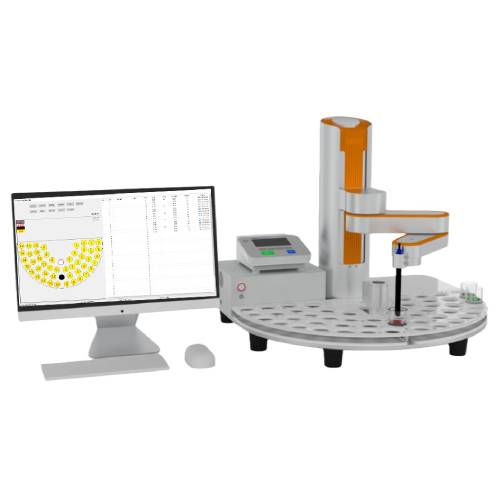
Principle of a Fully Automatic pH Tester
The textile and leather fully automatic pH tester is based on the potentiometric measurement method. Its core principle is the use of a pH indicator electrode and a reference electrode to form an electrochemical circuit. By detecting the activity of hydrogen ions in the extraction solution, the system converts the electrochemical signal into a corresponding pH value.
When the combined pH electrode is immersed in the extraction solution, hydrogen ions in the solution interact with the sensitive membrane of the electrode through ion exchange, generating a membrane potential. This potential varies with the hydrogen ion concentration in the solution and follows the Nernst Equation:
E = E° + (2.303RT/F) × log[H⁺]
where E is the electrode potential, E° is the standard potential, R is the gas constant, T is the absolute temperature, and F is the Faraday constant. The pH value has a linear relationship with the measured potential. The instrument converts the electrical signal into a pH reading through high-precision analog-to-digital conversion.
To ensure measurement accuracy, the instrument is equipped with a built-in temperature sensor to achieve automatic temperature compensation (ATC). Since the electrode slope changes with temperature, automatic compensation eliminates the influence of temperature variations on the potential, ensuring consistent and reliable results under different conditions.
On this basis, the fully automatic system further realizes complete process automation, including automatic reagent dispensing, constant-temperature shaking extraction, automatic lid opening, automatic sampling, automatic calibration, automatic measurement, automatic cleaning, and automatic data calculation and output. The entire process requires no manual intervention, effectively eliminating pipetting errors, timing deviations, reading errors, and operational contamination, thereby ensuring more stable, reliable, and traceable test results.
Applications of the Instrument in the Textile and Leather Industry
For textiles and leather products that come into direct contact with the skin—such as infant products, underwear, home textiles, leather garments, and footwear—the pH value must be controlled within a weakly acidic to neutral range. The fully automatic pH tester can accurately determine whether acidic or alkaline residues exceed allowable limits, helping to prevent skin irritation, itching, redness, and allergic reactions caused by abnormal pH levels. It is therefore an essential tool for safeguarding consumer health.
In textile dyeing and finishing processes, washing, softening, neutralization, as well as in leather tanning, retanning, washing, and fatliquoring processes, pH is a critical process control parameter. By monitoring the pH of extraction solutions from semi-finished products in real time, manufacturers can adjust process conditions promptly, reduce chemical residues, improve product pass rates, and lower rework costs.
Raw materials such as fabrics, yarns, leather substrates, and chemical auxiliaries must undergo pH screening before entering production. The fully automatic tester enables rapid batch testing, preventing non-conforming materials from entering the production line and ensuring quality control at the source.
Inspection institutions, research institutes, and customs laboratories rely on this instrument for high-throughput sample testing. With its high efficiency, stability, and automation, it has become an essential piece of laboratory equipment.
The development of new eco-friendly dyes, formaldehyde-free tanning agents, bio-enzyme washing processes, and water-saving finishing technologies all require reliable pH data support. The instrument provides accurate and scientific testing data for new materials, processes, and product development.
Based on potentiometric measurement principles and combined with automation control, constant-temperature extraction, automatic calibration, and data management technologies, the textile and leather fully automatic pH tester achieves efficient, precise, and standardized pH testing. It is not only a key device for ensuring product safety and regulatory compliance, but also an important tool for improving quality control, optimizing processes, reducing risks, and enhancing market competitiveness.
Technical Features of the Fully Automatic pH Tester
Main Features
Compared with traditional manual testing methods (manual sampling, manual extraction, and manual pH meter measurement), the core advantages of the fully automatic pH tester include:
High degree of automation: The entire process—from sample pre-treatment to data output—requires no manual intervention. This significantly reduces human errors such as inaccurate pipetting and inconsistent extraction time, while improving repeatability (typically RSD ≤ 1%).
Wide sample compatibility: The system supports various textile forms (fabrics, yarns, garments) and leather types (shoe upper leather, upholstery leather). By adjusting extraction parameters such as liquid-to-solid ratio, shaking frequency, and extraction time, it can meet diverse testing requirements.
Strict compliance with standards: Extraction conditions (temperature, time, liquid-to-solid ratio) and testing environment (e.g., temperature control accuracy of ±0.1°C) strictly follow international and national standards, ensuring authoritative and comparable results.
Intelligent data management: Equipped with dedicated software, the system supports sample information input (ID, material, batch, etc.), preset test parameters, automatic calibration using standard buffer solutions, and full data traceability, meeting laboratory paperless and standardized management requirements.
High-throughput testing capability: The instrument can process multiple samples simultaneously (typically 6–24 positions per batch), reducing testing time by more than 50% compared with manual methods. It is ideal for large-scale quality inspection in factories and third-party laboratories.
Operating Procedure of a Fully Automatic pH Tester
A pH testing instrument is a commonly used laboratory device widely applied in chemical, biological, pharmaceutical, textile, and related fields. It is mainly used to measure the acidity or alkalinity of a solution and provide accurate pH values. The following describes the operating steps and testing workflow of a pH instrument, helping users better understand and operate the equipment.
The operating procedure of a pH tester is as follows:
Step 1: Instrument Preparation
Place the fully automatic pH tester on a stable working surface and connect the power supply. Ensure that the instrument is in proper working condition. After powering on, allow the system to warm up and stabilize according to the equipment requirements.
Step 2: Electrode Preparation
Remove the pH electrode and check whether it is clean and undamaged. If the electrode is dirty or contaminated, clean or replace it if necessary. Use a cleaning solution with cotton swabs or lint-free wipes to gently clean the electrode surface, then rinse thoroughly with deionized water. Avoid touching the electrode membrane directly with hands to prevent performance interference.
Step 3: Instrument Calibration
Pour standard buffer calibration solutions into clean containers, ensuring the liquid level does not exceed the minimum immersion mark of the electrode. Immerse the electrode into the buffer solution and wait until the reading stabilizes. Adjust or confirm the automatic calibration function so that the displayed pH value matches the known value of the buffer solution. Calibration should be performed using appropriate buffer solutions according to the instrument manual.
Step 4: Sample Testing
After calibration, remove the electrode from the buffer solution and rinse it thoroughly with cleaning solution and deionized water. Immerse the electrode into the test solution, ensuring it is fully submerged without touching the container bottom or walls. Wait for the reading to stabilize, then record the pH value displayed by the instrument.
Step 5: Result Recording and Analysis
Record the measured pH value in the laboratory data sheet or system software. Based on testing requirements, further analysis can be conducted, such as evaluating acidity/alkalinity trends or supporting related process calculations.
Step 6: Cleaning and Maintenance
After testing, clean the electrode promptly. Soak it in a cleaning solution to remove any residues attached to the surface, then rinse thoroughly with deionized water. Gently dry the electrode with lint-free tissue and store it properly to prevent contamination or damage. Regular maintenance ensures stable performance and extends electrode service life.
In summary, the operating process of a pH tester includes instrument preparation, electrode preparation, calibration, sample measurement, result recording, and cleaning/maintenance. Proper operation ensures accurate and reliable pH measurements, providing strong support for scientific research and laboratory testing. Regular calibration and careful electrode maintenance are essential to ensure instrument stability and extend service life, ultimately improving testing efficiency and result reliability.
Importance of a Fully Automatic pH Tester
The importance of a fully automatic pH tester lies in its ability to deliver high-precision, high-efficiency, continuous, and standardized pH measurements. It plays a critical supporting role in industrial process control, environmental monitoring, scientific research compliance, and product quality assurance.
Ensuring measurement accuracy and repeatability
The fully automatic system ensures highly stable and reliable results through high-precision electrodes, automatic temperature compensation, and standardized calibration procedures (using buffer solutions). It effectively eliminates human errors such as improper electrode cleaning, inaccurate calibration, or inconsistent reading timing. As a result, measurement accuracy can typically be controlled within ±0.01–0.02 pH, which is essential for demanding fields such as pharmaceuticals, food fermentation, and ultrapure water treatment.
Improving testing throughput and efficiency
In laboratories and quality inspection centers handling large sample volumes—such as pharmaceutical screening, environmental monitoring, or water quality surveys—the system can perform batch or continuous measurements. It is capable of processing dozens to hundreds of samples per hour, significantly outperforming manual testing and greatly reducing turnaround time while freeing personnel for data analysis tasks.
Enabling continuous real-time process monitoring and closed-loop control
In chemical production, wastewater treatment, boiler feedwater systems, or bioreactors, fully automatic pH testers (often integrated with transmitters and control systems) enable 24/7 online monitoring. When pH values deviate from preset thresholds, the system can trigger alarms or automatically adjust acid/alkali dosing, preventing process instability, equipment corrosion, or regulatory non-compliance. This supports compliance with standards such as HACCP and ISO.
Enhancing data integrity and traceability
The system automatically records timestamps, pH values, calibration logs, and alarm events, and can export data to LIMS or SCADA systems. This ensures full electronic record compliance, eliminates manual transcription errors, and significantly improves audit readiness and traceability.
Reducing long-term operational risk and cost
Although the initial investment is higher, the system reduces overall cost of ownership by minimizing reagent waste, preventing batch losses caused by pH deviations (e.g., failed fermentation batches in pharmaceuticals or brewing), extending electrode life through automatic cleaning, and reducing labor intervention. In hazardous or clean environments such as semiconductor cleaning or sterile pharmaceutical production, it also reduces operator exposure risk.
Supporting intelligent and digital transformation
Modern fully automatic pH instruments integrate predictive maintenance (e.g., electrode aging analysis), multi-parameter measurement (pH, conductivity, temperature), and cloud connectivity. They serve as key sensing nodes in smart factories and networked water quality systems, forming the foundation for a “perception–analysis–decision–execution” closed-loop digital ecosystem.
In summary, the fully automatic pH tester for textile and leather extraction solutions significantly improves the efficiency, accuracy, and standardization of pH testing through automation. It is a core quality control and safety inspection instrument in the textile and leather industries. We sincerely welcome you to leave a message or contact us directly for more detailed product information.
Previous: What is an Automotive Wire Puncture Tester?
N e x t : What is the purpose of the Hail Impact Test Machine?
