





What is molten metal splash and what causes it?
2026/05/26
Share:

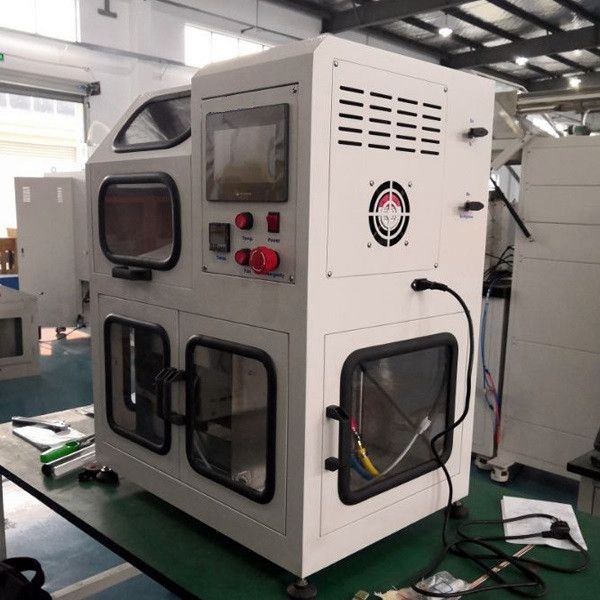
Functions and Applications of the Molten Metal Splash Impact Tester
The Molten Metal Splash Impact Tester is a specialized testing device used to evaluate the resistance of protective materials—such as protective clothing, safety helmets, gloves, and similar products—to thermal attack and impact caused by splashes of molten metals, including molten aluminum, copper, iron, or cryolite. The equipment is designed in accordance with standards such as ISO, EN, and EN ISO.
Function
By using an electrically heated crucible to quantitatively pour molten metal of a specified mass and temperature (typically between 1400–1600°C), usually aluminum or its alloys, the tester simulates splash impact conditions encountered in industrial processes such as welding, casting, and metallurgy.
The system evaluates the degree of damage to the tested material by measuring:
temperature rise on the reverse side of the material,
carbonization area,
burn-through,
delamination,
and other forms of thermal damage,
thereby quantitatively assessing its thermal protective performance.
Applications
The equipment is mainly used for the research and development, quality control, and compliance certification of personal protective equipment (PPE) and flame-retardant materials. It helps ensure that such products can effectively reduce burn risks in high-temperature working environments such as steel plants, aluminum processing facilities, and welding workshops.
It should be noted that this equipment is not intended for mechanical impact testing of metallic materials. Such testing belongs to the category of pendulum impact testers or drop-weight impact testing machines.
Industries Applicable to the Molten Metal Splash Impact Tester
The Molten Metal Splash Impact Tester is mainly applicable to the following industries:
Metallurgy and Foundry Industry
Used to evaluate the protective performance of personal protective equipment against splashes of molten iron, molten steel, molten aluminum, and other molten metals, thereby ensuring the safety of personnel working in high-temperature environments.
Metal Processing and Welding Industry
Used to test whether welding protective clothing, gloves, face shields, and related equipment comply with standards such as AQ, GB/T, and ISO.
Personal Protective Equipment (PPE) Manufacturing
Applied in the research, development, and quality inspection of heat-resistant clothing, safety helmets, flame-retardant gloves, face shields, and other PPE products to assess their resistance to molten metal splashes.
Aerospace and Advanced Materials Industry
Used to study the resistance of materials to molten metal impact in high-temperature processes such as thermal spraying and casting simulation.
Firefighting and Emergency Rescue Equipment
Used to test the resistance of firefighters’ protective clothing to molten metal splashes in metal fire scenarios, such as Class D fires.
Certification and Testing Organizations
Used by third-party laboratories and certification bodies to conduct compliance testing of protective equipment in accordance with standards such as ISO, EN, and GB/T.
Technical Features of the Molten Metal Splash Impact Tester
The Molten Metal Splash Impact Tester is a core piece of quality testing equipment for textile and leather products. Its technical performance directly determines the accuracy and authority of test results. This article provides an in-depth analysis of the five core technical features of the equipment and explores how technological innovation enables it to meet the stringent testing requirements of the textile and leather industry.
1. High-Precision Molten Metal Control Technology for Accurate Simulation of Textile and Leather Testing Conditions
The core of this technology lies in the stable generation of molten metal splashes that comply with standard requirements, thereby meeting the testing demands of textile and leather materials with varying thicknesses and heat resistance characteristics.
The equipment adopts a stepper motor-driven precision metal wire feeding system, with a feeding speed error of ≤ ±1%, allowing flexible adjustment of the metal wire supply according to testing requirements. Combined with an oxy-acetylene proportional closed-loop control module, it precisely controls flame temperature and intensity, achieving a wide temperature adjustment range of 700–1800°C. This ensures that different media, such as molten aluminum and molten iron, can consistently reach the molten state specified by relevant standards.
At the same time, through an airflow-assisted regulation device, the particle size and impact kinetic energy of molten splashes can be accurately controlled, perfectly meeting the splash parameter requirements for different protection levels of fabrics specified in FZ/T 64083-2021 Protective Fabrics Against Molten Metal Splash.
2. Intelligent Multi-Standard Compatibility Technology Covering Full Textile and Leather Testing Scenarios
To address the differences among testing standards for various textile and leather products, the equipment is equipped with a built-in parameter database covering FZ/T 64083-2021. as well as internationally recognized standards such as BS EN ISO 9185:2025 and EN ISO 11612.
The system supports one-click switching between testing modes, eliminating the need for repeated manual parameter adjustments. Whether conducting molten aluminum splash testing for textile protective fabrics or high-temperature splash resistance testing for leather-based protective materials, the equipment can provide precise adaptation.
It is also compatible with multiple testing media, including molten aluminum and low-carbon steel, meeting the specialized testing requirements of textile and leather sub-industries such as footwear materials, industrial protective clothing, and household protective fabrics, while complying with the latest requirements of AQ 6111—2023 Safety Management Specification for Personal Protective Equipment.
3. Precision Guidance and Calibration Technology Ensuring Authoritative Test Results
Since textile and leather specimens are generally lightweight and thin materials, testing accuracy directly affects quality evaluation results.
The equipment adopts a laser alignment calibration system capable of real-time monitoring of splash landing point deviations. When the deviation exceeds ±2 mm, the system automatically issues an adjustment alert to ensure that molten splashes uniformly impact the designated area of the textile or leather specimen.
The guiding hood is manufactured using an integrated high-temperature-resistant PTFE molding process, which not only withstands the impact of high-temperature molten metal but also prevents splash adhesion and blockage, ensuring continuous testing operation.
This dual-precision protection design effectively solves the problem of test result deviations caused by inaccurate landing points in conventional equipment, making the testing data of textile and leather materials more reliable and valuable.
4. Full-Process Safety Protection Technology for Textile and Leather Laboratories
Testing involving high-temperature molten metals presents multiple safety hazards. To address this, the equipment incorporates comprehensive safety protection measures to establish a secure testing environment for textile and leather laboratories.
The system is equipped with a fully enclosed anti-splash protective chamber, effectively preventing molten splashes from escaping and avoiding injuries to operators or damage to surrounding textile samples.
A high-temperature residue isolation and collection device featuring an inclined heat-resistant collection tray rapidly gathers residues to prevent secondary burn injuries.
In addition, the equipment integrates an intelligent smoke exhaust system to promptly remove hazardous fumes generated during testing.
At the same time, a gas leakage intelligent monitoring module is installed. Once leakage is detected, the gas supply is automatically shut off within 0.5 seconds. Together with the flame stability monitoring and warning function, the system provides comprehensive protection for textile and leather laboratory environments.
5. Intelligent Operation and Data Management Technology for Improved Testing Efficiency
To meet the batch testing requirements of textile and leather enterprises, the equipment adopts an industrial-grade PLC control system combined with a 7-inch high-definition touchscreen interface.
The operation interface is simple and intuitive, supporting Chinese-English bilingual switching, enabling even non-specialized laboratory personnel to quickly master operation procedures.
The system features:
real-time display of testing parameters,
automatic data recording,
precise storage of key data such as temperature rise curves, impact duration, and cumulative splash quantity of textile and leather specimens.
Data can be exported in multiple formats, including PDF and Excel, facilitating subsequent test traceability and report generation.
Compared with traditional manual recording methods, testing efficiency is improved by more than 60%, significantly reducing labor costs for textile and leather enterprises.
Operating Procedure of the Molten Metal Splash Impact Tester
Preparation Stage
Wear appropriate personal protective equipment (PPE), including a fire-resistant face shield, heat-resistant gloves, and laboratory protective clothing. Check the oxygen and acetylene gas line pressures (typically 250 kPa for oxygen and 50 kPa for acetylene), and confirm that the welding nozzle diameter (1.2 ± 0.1 mm) and the 45° high-temperature anti-adhesion guide chute are properly installed.
Clamp the test specimen (100 × 100 mm or larger) securely onto the specimen holder and apply a pre-tension of 175 g ± 0.5 g. Attach the armored platinum resistance temperature sensor, protruding 0.5 ± 0.2 mm, tightly against the back side of the specimen, and connect it to the data acquisition system.
Calibration and Preheating
Turn on the gas flow meters and the stepper motor wire-feeding system (wire feeding rate typically set at approximately 10 g/min). Ignite the oxy-acetylene welding torch to preheat the metal wire, usually low-carbon steel wire or aluminum wire.
Adjust the flame core length to approximately 8 mm, then perform a blank droplet calibration to ensure:
molten droplet mass: 0.50 ± 0.05 g
droplet frequency: 20 ± 3 drops/minute
Test Operation
Close the protective enclosure and start the testing program (or operate manually). The molten droplets are released at a fixed frequency (approximately one drop every 3 seconds) and guided through the chute to impact the vertically mounted specimen.
During testing, the system continuously monitors the temperature rise on the back side of the specimen. When the temperature increase first reaches or exceeds 40 K, the system automatically stops the test, or the operator records the corresponding number of molten droplets at that moment. This droplet count represents the material’s molten metal splash resistance rating.
The protective enclosure must remain closed throughout the entire testing process.
Completion and Cleaning
After the test is completed, shut off the gas supply and allow the equipment to cool completely. Use dedicated tools to remove the specimen while avoiding contact with the high-temperature sensor.
Clean the guide chute and welding torch to prevent blockage caused by molten residue accumulation. Record:
the number of molten droplets,
the temperature rise curve,
and any abnormal phenomena observed during the test.
Never place hands inside the testing chamber before the equipment has fully cooled or while the gas supply remains connected.
Safety Precautions
The equipment may only be operated by personnel holding relevant operation certificates or training qualifications.
The testing area must be equipped with:
explosion relief valves,
ventilation hoods,
and emergency stop devices.
Damaged guide chutes or sensors must never be used.
Each batch of specimens shall undergo no fewer than three parallel tests, and the average value shall be used as the final result.
If the equipment is equipped with automatic counting or temperature control software, the sensors and droplet counters must be calibrated strictly in accordance with the manufacturer’s operation manual.
Importance of the Molten Metal Splash Impact Tester
The core value of the Molten Metal Splash Impact Tester lies in its ability to scientifically quantify the resistance of protective materials—such as welding garments and protective gloves—to burn-through and instantaneous heat transfer caused by localized impacts from high-temperature molten metal droplets (typically 0.5–5 g). This directly safeguards the lives of workers operating in high-temperature environments while ensuring that protective equipment complies with regulatory requirements and is suitable for mass production.
Rigid Demand for Safety Protection
In industrial operations such as welding, metallurgy, and casting, molten metal splashes can reach temperatures of 800–1600°C. Even a single droplet may cause severe burns or ignite clothing.
This instrument simulates the scattered splash conditions commonly encountered in real working environments (rather than large-scale molten metal pouring scenarios) and evaluates whether protective materials can:
maintain a temperature rise of no more than 40 K,
resist burn-through,
and prevent molten droplet penetration.
It is therefore a critical method for verifying whether personal protective equipment (PPE) can effectively protect human life and safety.
Standard Compliance and Quality Control
According to mandatory or industry standards such as GB/T, ISO, EN, and AQ, the test results directly determine whether products such as welding protective clothing and heat-resistant gloves can enter the market or obtain certification.
The equipment provides essential support for compliant manufacturing, helping enterprises reduce:
legal risks,
product liability risks,
and workplace accident responsibility risks.
Accurate and Repeatable Failure Warning Mechanism
Using an oxy-acetylene torch to melt standardized metal wires (such as steel or aluminum), the system precisely controls:
molten droplet mass (0.50 ± 0.05 g),
droplet impact angle (typically 45°),
and droplet frequency (approximately 20 drops/minute).
An armored platinum resistance sensor mounted on the back side of the specimen continuously monitors temperature rise in real time.
The number of droplets required to increase the specimen back-side temperature by 40 K is then recorded. The lower this value, the poorer the protective performance of the material.
This provides objective and reliable data support for:
material development,
performance evaluation,
and protective material selection.
A Key Tool for Differentiating Risk Levels
Unlike a large-scale molten metal splash tester, which simulates pouring scenarios involving more than 10 kg of molten metal, this instrument specifically focuses on:
dispersed,
high-frequency,
localized point-impact testing.
It addresses the most common yet often underestimated risks in daily industrial operations, such as:
welding sparks,
casting splashes,
and localized molten metal droplets.
As a result, it serves as an irreplaceable testing device for evaluating the “micro-level protective capability” within a comprehensive safety protection system.
Driving Industrial Safety Upgrades
This instrument is not only used for routine product inspection, but also widely applied in:
accident analysis,
new material research and development,
and performance verification of advanced protective materials such as flame-retardant composite fabrics and aerogel coatings.
It promotes the evolution of protective equipment from traditional “passive heat resistance” toward more advanced capabilities combining:
active thermal insulation,
and anti-penetration protection,
thereby significantly reducing burn injuries in high-temperature workplaces.
Without such testing, protective equipment may fail under actual working conditions, potentially leading to severe industrial injuries.The existence of the Molten Metal Splash Impact Tester is the essential verification tool that transforms the concept of a “safety barrier” into a reliable and practical reality.We sincerely welcome you to leave a message or contact us directly for more detailed product information.
Previous: What is a Masks Bacterial Filtration Efficiency Tester?
N e x t : What is the Automotive Wire Repeated Bending Tester?
